

143
Chapter seven: Water balance
indices of urine concentrating ability in marine mammals are lower than those reported
for many small terrestrial animals, such as the hopping mouse, the kangaroo rat, and the
domestic house cat (Table 7.2). While the maximal urine concentrating ability in marine
mammals is not exceptional or superlative, it is sufficient to have allowed this group of
mammals to adapt to and tolerate their potentially challenging and demanding environment. So, why aren’t marine mammals the champions of urine concentrating ability?
Let us consider the issue of body mass scaling in our answer. Marine mammals are
among the largest mammals on earth regardless of habitat. Small mammals, generally,
demonstrate a much greater urine concentrating ability than larger mammals. Because
small mammals have much greater surface-to-volume ratios, they also have higher rates
of evaporative and respiratory water loss (Beuchat 1990b). These higher rates of water loss
may represent a greater need to conserve water. Even in the fin whale (Balaenoptera physalus), which has a body mass one thousand times larger than a human, the maximum
urine osmolality recorded (1300 mOsm/kg) is only slightly better than that in a human.
Therefore, maximal urine concentrating ability does not appear to scale with body mass
across mammals. However, maximal urine concentrating ability in marine mammals may
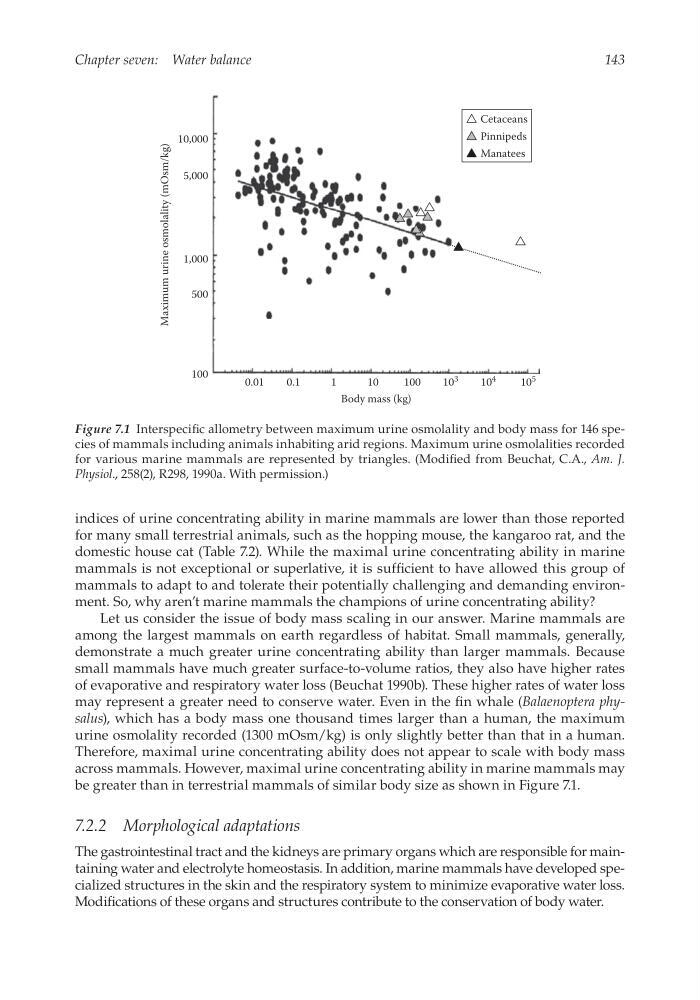
be greater than in terrestrial mammals of similar body size as shown in Figure 7.1.
7.2.2 Morphological adaptations
The gastrointestinal tract and the kidneys are primary organs which are responsible for maintaining water and electrolyte homeostasis. In addition, marine mammals have developed specialized structures in the skin and the respiratory system to minimize evaporative water loss.
Modifications of these organs and structures contribute to the conservation of body water.
100
0.01
0.1
1
1 0
Body mass (kg)
Maximum urine osmolality (mOsm/kg)
10
3
10
4
10
5
100
500
1,000
5,000
10,000
Cetaceans
Pinnipeds
Manatees
Figure 7.1 Interspecific allometry between maximum urine osmolality and body mass for 146 species of mammals including animals inhabiting arid regions. Maximum urine osmolalities recorded
for various marine mammals are represented by triangles. (Modified from Beuchat, C.A., Am. J.
Physiol., 258(2), R298, 1990a. With permission.)
Chapter seven: Water balance
indices of urine concentrating ability in marine mammals are lower than those reported
for many small terrestrial animals, such as the hopping mouse, the kangaroo rat, and the
domestic house cat (Table 7.2). While the maximal urine concentrating ability in marine
mammals is not exceptional or superlative, it is sufficient to have allowed this group of
mammals to adapt to and tolerate their potentially challenging and demanding environment. So, why aren’t marine mammals the champions of urine concentrating ability?
Let us consider the issue of body mass scaling in our answer. Marine mammals are
among the largest mammals on earth regardless of habitat. Small mammals, generally,
demonstrate a much greater urine concentrating ability than larger mammals. Because
small mammals have much greater surface-to-volume ratios, they also have higher rates
of evaporative and respiratory water loss (Beuchat 1990b). These higher rates of water loss
may represent a greater need to conserve water. Even in the fin whale (Balaenoptera physalus), which has a body mass one thousand times larger than a human, the maximum
urine osmolality recorded (1300 mOsm/kg) is only slightly better than that in a human.
Therefore, maximal urine concentrating ability does not appear to scale with body mass
across mammals. However, maximal urine concentrating ability in marine mammals may
be greater than in terrestrial mammals of similar body size as shown in Figure 7.1.
7.2.2 Morphological adaptations
The gastrointestinal tract and the kidneys are primary organs which are responsible for maintaining water and electrolyte homeostasis. In addition, marine mammals have developed specialized structures in the skin and the respiratory system to minimize evaporative water loss.
Modifications of these organs and structures contribute to the conservation of body water.
100
0.01
0.1
1
1 0
Body mass (kg)
Maximum urine osmolality (mOsm/kg)
10
3
10
4
10
5
100
500
1,000
5,000
10,000
Cetaceans
Pinnipeds
Manatees
Figure 7.1 Interspecific allometry between maximum urine osmolality and body mass for 146 species of mammals including animals inhabiting arid regions. Maximum urine osmolalities recorded
for various marine mammals are represented by triangles. (Modified from Beuchat, C.A., Am. J.
Physiol., 258(2), R298, 1990a. With permission.)