

132
Marine Mammal Physiology: Requisites for Ocean Living
components (which appear in animal tissues) have a specific ecological origin that may be
traced through a number of trophic levels (Iverson 1993). Thus, it is possible to consider the pattern of fatty acids in the adipose tissues of marine mammals as a signature that should reflect
an integration of the fatty acid signatures of the major prey items in the diet (Iverson 1993).
6.4.2.3 Molecular analysis of prey
DNA-based techniques allow for the identification of prey species present in samples of
stomach contents, vomit, and feces of predators. DNA metabarcoding has emerged as a
powerful new tool with which to conduct dietary studies using fecal matter as a DNA
mesopelagic fish and squid, and crustaceans, such as euphausiids, which have not
been reported as a prey item for this species. Comparison of isotopic data between
sub-yearlings, and 1-, 2- and 3-year olds indicated that sub-yearlings, limited by their
size, dive capabilities, and prey capture skills to feeding higher in the water column,
fed at a lower trophic level than older seals.
–23.0
–55
–60 Australian-Antarctic
Basin
East Antarctica
Southeast
Indian Ridge
Mid-ocean
ridge
J226
J375
J492 J503
T867
J263
Latitude
140
160
180
Longitude
200
T875
Macquarie Island
Campbell Plateau
–65
7
8
9
10
11
12
(a)
(b)
–22.5
J375
J226
J503
T867
T875
J263
J492
n = 7
n = 7
–22.0
–21.5
δ
13 C (()
δ
15
N (()
–21.0
–20.5
–20.0
ACC to PF-S
PF
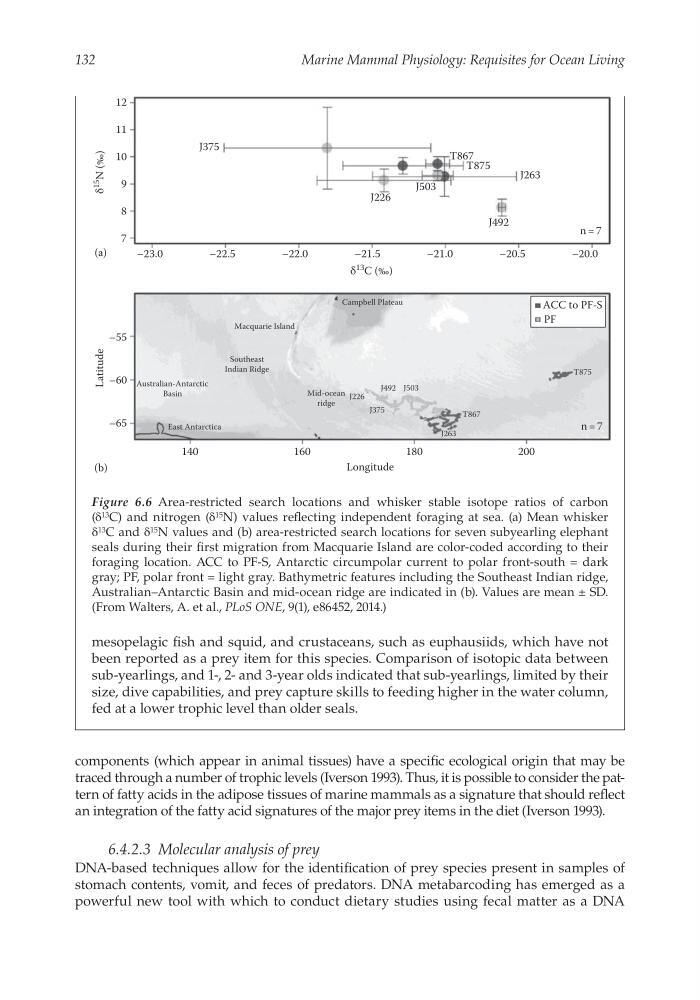
Figure 6.6 Area-restricted search locations and whisker stable isotope ratios of carbon
(δ 13 C) and nitrogen (δ 15 N) values reflecting independent foraging at sea. (a) Mean whisker
δ 13 C and δ 15 N values and (b) area-restricted search locations for seven subyearling elephant
seals during their first migration from Macquarie Island are color-coded according to their
foraging location. ACC to PF-S, Antarctic circumpolar current to polar front-south = dark
gray; PF, polar front = light gray. Bathymetric features including the Southeast Indian ridge,
Australian–Antarctic Basin and mid-ocean ridge are indicated in (b). Values are mean ± SD.
(From Walters, A. et al., PLoS ONE, 9(1), e86452, 2014.)
Marine Mammal Physiology: Requisites for Ocean Living
components (which appear in animal tissues) have a specific ecological origin that may be
traced through a number of trophic levels (Iverson 1993). Thus, it is possible to consider the pattern of fatty acids in the adipose tissues of marine mammals as a signature that should reflect
an integration of the fatty acid signatures of the major prey items in the diet (Iverson 1993).
6.4.2.3 Molecular analysis of prey
DNA-based techniques allow for the identification of prey species present in samples of
stomach contents, vomit, and feces of predators. DNA metabarcoding has emerged as a
powerful new tool with which to conduct dietary studies using fecal matter as a DNA
mesopelagic fish and squid, and crustaceans, such as euphausiids, which have not
been reported as a prey item for this species. Comparison of isotopic data between
sub-yearlings, and 1-, 2- and 3-year olds indicated that sub-yearlings, limited by their
size, dive capabilities, and prey capture skills to feeding higher in the water column,
fed at a lower trophic level than older seals.
–23.0
–55
–60 Australian-Antarctic
Basin
East Antarctica
Southeast
Indian Ridge
Mid-ocean
ridge
J226
J375
J492 J503
T867
J263
Latitude
140
160
180
Longitude
200
T875
Macquarie Island
Campbell Plateau
–65
7
8
9
10
11
12
(a)
(b)
–22.5
J375
J226
J503
T867
T875
J263
J492
n = 7
n = 7
–22.0
–21.5
δ
13 C (()
δ
15
N (()
–21.0
–20.5
–20.0
ACC to PF-S
PF
Figure 6.6 Area-restricted search locations and whisker stable isotope ratios of carbon
(δ 13 C) and nitrogen (δ 15 N) values reflecting independent foraging at sea. (a) Mean whisker
δ 13 C and δ 15 N values and (b) area-restricted search locations for seven subyearling elephant
seals during their first migration from Macquarie Island are color-coded according to their
foraging location. ACC to PF-S, Antarctic circumpolar current to polar front-south = dark
gray; PF, polar front = light gray. Bathymetric features including the Southeast Indian ridge,
Australian–Antarctic Basin and mid-ocean ridge are indicated in (b). Values are mean ± SD.
(From Walters, A. et al., PLoS ONE, 9(1), e86452, 2014.)