

131
Chapter six: Diet and nutrition
BOX 6.1 THE USE OF STABLE ISOTOPES AND TRACKING
INFORMATION TO IDENTIFY BROAD-SCALE FORAGING
HABITAT USE AND DIETARY PREFERENCES
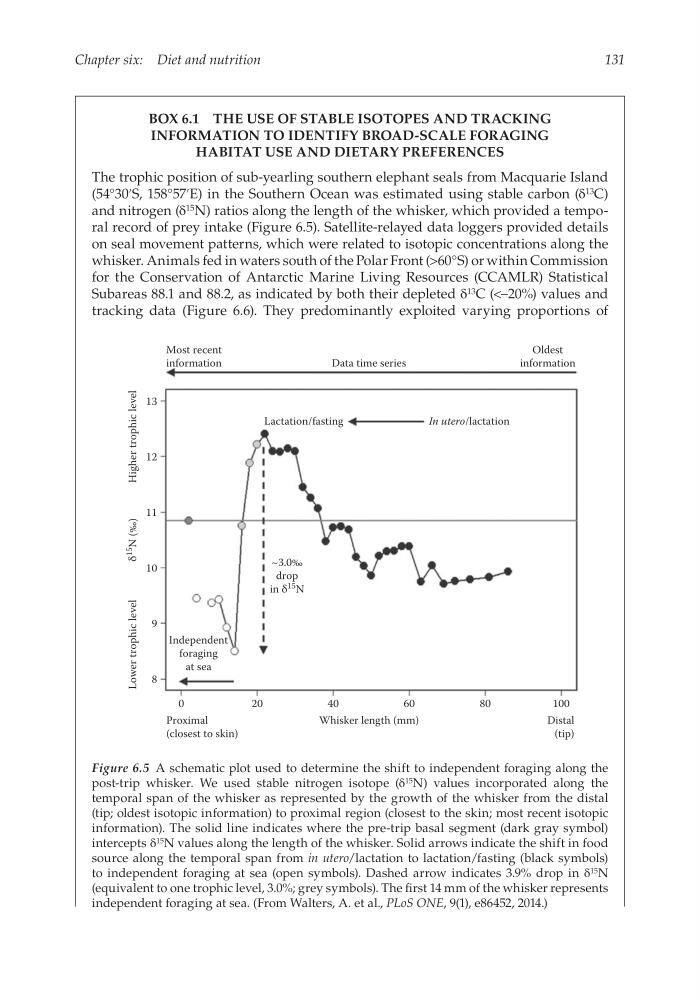
The trophic position of sub-yearling southern elephant seals from Macquarie Island
(54°30′S, 158°57′E) in the Southern Ocean was estimated using stable carbon (δ 13 C)
and nitrogen (δ 15 N) ratios along the length of the whisker, which provided a temporal record of prey intake (Figure 6.5). Satellite-relayed data loggers provided details
on seal movement patterns, which were related to isotopic concentrations along the
whisker. Animals fed in waters south of the Polar Front (>60°S) or within Commission
for the Conservation of Antarctic Marine Living Resources (CCAMLR) Statistical
Subareas 88.1 and 88.2, as indicated by both their depleted δ 13 C (<−20%) values and
tracking data (Figure 6.6). They predominantly exploited varying proportions of
20
Independent
foraging
at sea
~3.00
drop
in δ
15 N
Lactation/fasting
Most recent
information
D ata time series
Oldest
information
In utero/lactation
40
Proximal
(closest to skin)
60
Whisker length (mm)
80
100
Distal
(tip)
0
8
9
Lower trophic level
δ
15
N (()
Higher trophic level
10
11
12
13
Figure 6.5 A schematic plot used to determine the shift to independent foraging along the
post-trip whisker. We used stable nitrogen isotope (δ 15 N) values incorporated along the
temporal span of the whisker as represented by the growth of the whisker from the distal
(tip; oldest isotopic information) to proximal region (closest to the skin; most recent isotopic
information). The solid line indicates where the pre-trip basal segment (dark gray symbol)
intercepts δ 15 N values along the length of the whisker. Solid arrows indicate the shift in food
source along the temporal span from in utero/lactation to lactation/fasting (black symbols)
to independent foraging at sea (open symbols). Dashed arrow indicates 3.9% drop in δ 15 N
(equivalent to one trophic level, 3.0%; grey symbols). The first 14 mm of the whisker represents
independent foraging at sea. (From Walters, A. et al., PLoS ONE, 9(1), e86452, 2014.)
Chapter six: Diet and nutrition
BOX 6.1 THE USE OF STABLE ISOTOPES AND TRACKING
INFORMATION TO IDENTIFY BROAD-SCALE FORAGING
HABITAT USE AND DIETARY PREFERENCES
The trophic position of sub-yearling southern elephant seals from Macquarie Island
(54°30′S, 158°57′E) in the Southern Ocean was estimated using stable carbon (δ 13 C)
and nitrogen (δ 15 N) ratios along the length of the whisker, which provided a temporal record of prey intake (Figure 6.5). Satellite-relayed data loggers provided details
on seal movement patterns, which were related to isotopic concentrations along the
whisker. Animals fed in waters south of the Polar Front (>60°S) or within Commission
for the Conservation of Antarctic Marine Living Resources (CCAMLR) Statistical
Subareas 88.1 and 88.2, as indicated by both their depleted δ 13 C (<−20%) values and
tracking data (Figure 6.6). They predominantly exploited varying proportions of
20
Independent
foraging
at sea
~3.00
drop
in δ
15 N
Lactation/fasting
Most recent
information
D ata time series
Oldest
information
In utero/lactation
40
Proximal
(closest to skin)
60
Whisker length (mm)
80
100
Distal
(tip)
0
8
9
Lower trophic level
δ
15
N (()
Higher trophic level
10
11
12
13
Figure 6.5 A schematic plot used to determine the shift to independent foraging along the
post-trip whisker. We used stable nitrogen isotope (δ 15 N) values incorporated along the
temporal span of the whisker as represented by the growth of the whisker from the distal
(tip; oldest isotopic information) to proximal region (closest to the skin; most recent isotopic
information). The solid line indicates where the pre-trip basal segment (dark gray symbol)
intercepts δ 15 N values along the length of the whisker. Solid arrows indicate the shift in food
source along the temporal span from in utero/lactation to lactation/fasting (black symbols)
to independent foraging at sea (open symbols). Dashed arrow indicates 3.9% drop in δ 15 N
(equivalent to one trophic level, 3.0%; grey symbols). The first 14 mm of the whisker represents
independent foraging at sea. (From Walters, A. et al., PLoS ONE, 9(1), e86452, 2014.)