

123
Chapter six: Diet and nutrition
tropical waters and appear to rely more on fish than other baleen whales. Bryde’s whales
(Balaenoptera brydei and Balaenoptera edeni) eat crustaceans, including krill, in addition to
various fish (mullet and anchovy in the Southern Hemisphere and anchovy in the North
Atlantic). Humpback whales (Megaptera novaeangliae) mainly feed on krill in the Southern
Hemisphere, but mainly schooling fish (anchovies and cod) in the Northern Hemisphere.
Squid are also eaten by humpback whales. The diet of gray whales (Eschrichtius robustus)
consists primarily of benthic gammarid amphipods, although they can forage on a wide
variety of prey, including schooling mysids in some areas. Gray whales have very tough
baleen plates that become worn, particularly on the right side, by rubbing on the seafloor
from which it principally sucks, by a piston action with its tongue, bottom amphipod
crustaceans but also mollusks and bristle worms.
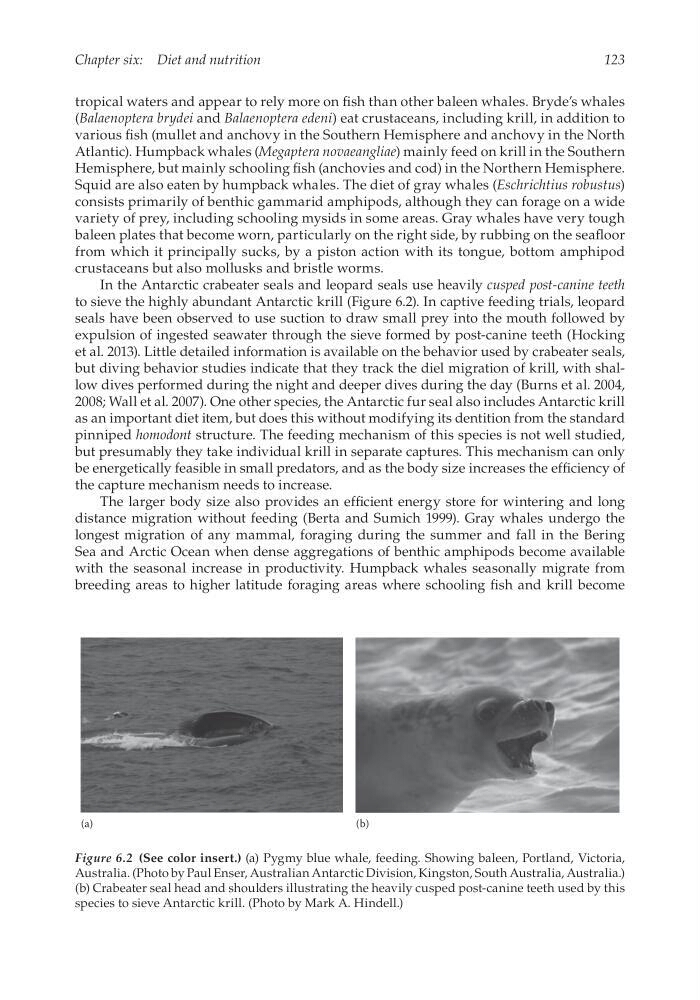
In the Antarctic crabeater seals and leopard seals use heavily cusped post-canine teeth
to sieve the highly abundant Antarctic krill (Figure 6.2). In captive feeding trials, leopard
seals have been observed to use suction to draw small prey into the mouth followed by
expulsion of ingested seawater through the sieve formed by post-canine teeth (Hocking
et al. 2013). Little detailed information is available on the behavior used by crabeater seals,
but diving behavior studies indicate that they track the diel migration of krill, with shallow dives performed during the night and deeper dives during the day (Burns et al. 2004,
2008; Wall et al. 2007). One other species, the Antarctic fur seal also includes Antarctic krill
as an important diet item, but does this without modifying its dentition from the standard
pinniped homodont structure. The feeding mechanism of this species is not well studied,
but presumably they take individual krill in separate captures. This mechanism can only
be energetically feasible in small predators, and as the body size increases the efficiency of
the capture mechanism needs to increase.
The larger body size also provides an efficient energy store for wintering and long
distance migration without feeding (Berta and Sumich 1999). Gray whales undergo the
longest migration of any mammal, foraging during the summer and fall in the Bering
Sea and Arctic Ocean when dense aggregations of benthic amphipods become available
with the seasonal increase in productivity. Humpback whales seasonally migrate from
breeding areas to higher latitude foraging areas where schooling fish and krill become
(a)
(b)
Figure 6.2 (See color insert.) (a) Pygmy blue whale, feeding. Showing baleen, Portland, Victoria,
Australia. (Photo by Paul Enser, Australian Antarctic Division, Kingston, South Australia, Australia.)
(b) Crabeater seal head and shoulders illustrating the heavily cusped post-canine teeth used by this
species to sieve Antarctic krill. (Photo by Mark A. Hindell.)
Chapter six: Diet and nutrition
tropical waters and appear to rely more on fish than other baleen whales. Bryde’s whales
(Balaenoptera brydei and Balaenoptera edeni) eat crustaceans, including krill, in addition to
various fish (mullet and anchovy in the Southern Hemisphere and anchovy in the North
Atlantic). Humpback whales (Megaptera novaeangliae) mainly feed on krill in the Southern
Hemisphere, but mainly schooling fish (anchovies and cod) in the Northern Hemisphere.
Squid are also eaten by humpback whales. The diet of gray whales (Eschrichtius robustus)
consists primarily of benthic gammarid amphipods, although they can forage on a wide
variety of prey, including schooling mysids in some areas. Gray whales have very tough
baleen plates that become worn, particularly on the right side, by rubbing on the seafloor
from which it principally sucks, by a piston action with its tongue, bottom amphipod
crustaceans but also mollusks and bristle worms.
In the Antarctic crabeater seals and leopard seals use heavily cusped post-canine teeth
to sieve the highly abundant Antarctic krill (Figure 6.2). In captive feeding trials, leopard
seals have been observed to use suction to draw small prey into the mouth followed by
expulsion of ingested seawater through the sieve formed by post-canine teeth (Hocking
et al. 2013). Little detailed information is available on the behavior used by crabeater seals,
but diving behavior studies indicate that they track the diel migration of krill, with shallow dives performed during the night and deeper dives during the day (Burns et al. 2004,
2008; Wall et al. 2007). One other species, the Antarctic fur seal also includes Antarctic krill
as an important diet item, but does this without modifying its dentition from the standard
pinniped homodont structure. The feeding mechanism of this species is not well studied,
but presumably they take individual krill in separate captures. This mechanism can only
be energetically feasible in small predators, and as the body size increases the efficiency of
the capture mechanism needs to increase.
The larger body size also provides an efficient energy store for wintering and long
distance migration without feeding (Berta and Sumich 1999). Gray whales undergo the
longest migration of any mammal, foraging during the summer and fall in the Bering
Sea and Arctic Ocean when dense aggregations of benthic amphipods become available
with the seasonal increase in productivity. Humpback whales seasonally migrate from
breeding areas to higher latitude foraging areas where schooling fish and krill become
(a)
(b)
Figure 6.2 (See color insert.) (a) Pygmy blue whale, feeding. Showing baleen, Portland, Victoria,
Australia. (Photo by Paul Enser, Australian Antarctic Division, Kingston, South Australia, Australia.)
(b) Crabeater seal head and shoulders illustrating the heavily cusped post-canine teeth used by this
species to sieve Antarctic krill. (Photo by Mark A. Hindell.)