

122
Marine Mammal Physiology: Requisites for Ocean Living
where foraging takes place to low latitudes where they mate and give birth. However,
data from blue whales (Balaenoptera musculus) in the Pacific indicate that feeding also
takes place at low latitude, upwelling-modified waters, and data from both the Pacific
and the Indian Oceans indicate that some blue whales may remain at low latitudes yearround. Fin (Balaenoptera physalus) and blue whales foraging on krill off the coast of North
America concentrate their foraging efforts on dense aggregations of krill that are deep
(150–300 m) in the water column during the day and may cease feeding when the krill
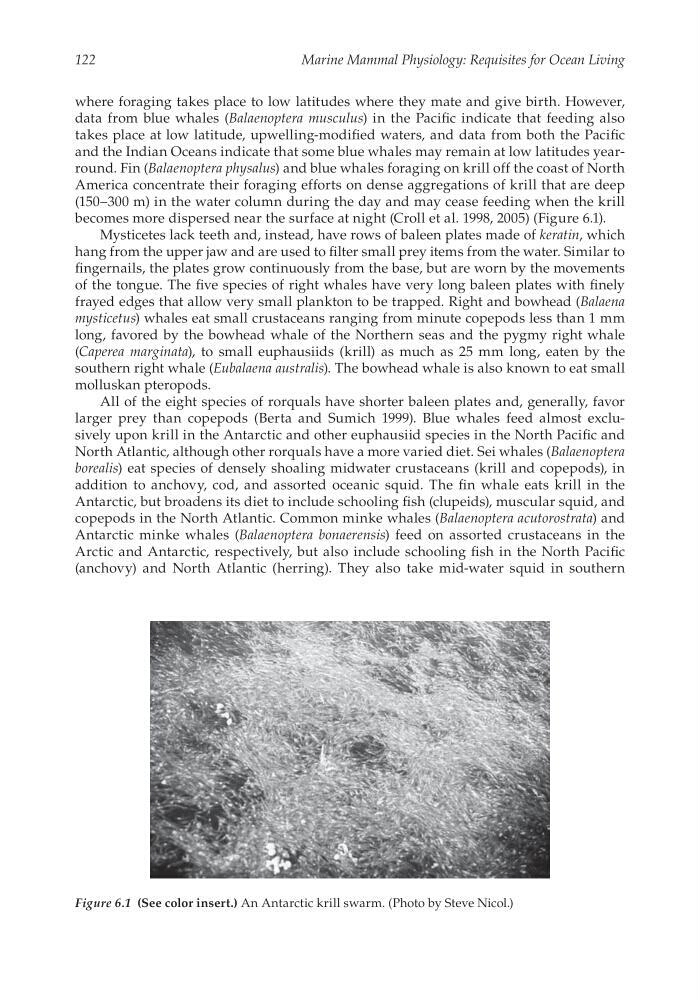
becomes more dispersed near the surface at night (Croll et al. 1998, 2005) (Figure 6.1).
Mysticetes lack teeth and, instead, have rows of baleen plates made of keratin, which
hang from the upper jaw and are used to filter small prey items from the water. Similar to
fingernails, the plates grow continuously from the base, but are worn by the movements
of the tongue. The five species of right whales have very long baleen plates with finely
frayed edges that allow very small plankton to be trapped. Right and bowhead (Balaena
mysticetus) whales eat small crustaceans ranging from minute copepods less than 1 mm
long, favored by the bowhead whale of the Northern seas and the pygmy right whale
(Caperea marginata), to small euphausiids (krill) as much as 25 mm long, eaten by the
southern right whale (Eubalaena australis). The bowhead whale is also known to eat small
molluskan pteropods.
All of the eight species of rorquals have shorter baleen plates and, generally, favor
larger prey than copepods (Berta and Sumich 1999). Blue whales feed almost exclusively upon krill in the Antarctic and other euphausiid species in the North Pacific and
North Atlantic, although other rorquals have a more varied diet. Sei whales (Balaenoptera
borealis) eat species of densely shoaling midwater crustaceans (krill and copepods), in
addition to anchovy, cod, and assorted oceanic squid. The fin whale eats krill in the
Antarctic, but broadens its diet to include schooling fish (clupeids), muscular squid, and
copepods in the North Atlantic. Common minke whales (Balaenoptera acutorostrata) and
Antarctic minke whales (Balaenoptera bonaerensis) feed on assorted crustaceans in the
Arctic and Antarctic, respectively, but also include schooling fish in the North Pacific
(anchovy) and North Atlantic (herring). They also take mid-water squid in southern
Figure 6.1 (See color insert.) An Antarctic krill swarm. (Photo by Steve Nicol.)
Marine Mammal Physiology: Requisites for Ocean Living
where foraging takes place to low latitudes where they mate and give birth. However,
data from blue whales (Balaenoptera musculus) in the Pacific indicate that feeding also
takes place at low latitude, upwelling-modified waters, and data from both the Pacific
and the Indian Oceans indicate that some blue whales may remain at low latitudes yearround. Fin (Balaenoptera physalus) and blue whales foraging on krill off the coast of North
America concentrate their foraging efforts on dense aggregations of krill that are deep
(150–300 m) in the water column during the day and may cease feeding when the krill
becomes more dispersed near the surface at night (Croll et al. 1998, 2005) (Figure 6.1).
Mysticetes lack teeth and, instead, have rows of baleen plates made of keratin, which
hang from the upper jaw and are used to filter small prey items from the water. Similar to
fingernails, the plates grow continuously from the base, but are worn by the movements
of the tongue. The five species of right whales have very long baleen plates with finely
frayed edges that allow very small plankton to be trapped. Right and bowhead (Balaena
mysticetus) whales eat small crustaceans ranging from minute copepods less than 1 mm
long, favored by the bowhead whale of the Northern seas and the pygmy right whale
(Caperea marginata), to small euphausiids (krill) as much as 25 mm long, eaten by the
southern right whale (Eubalaena australis). The bowhead whale is also known to eat small
molluskan pteropods.
All of the eight species of rorquals have shorter baleen plates and, generally, favor
larger prey than copepods (Berta and Sumich 1999). Blue whales feed almost exclusively upon krill in the Antarctic and other euphausiid species in the North Pacific and
North Atlantic, although other rorquals have a more varied diet. Sei whales (Balaenoptera
borealis) eat species of densely shoaling midwater crustaceans (krill and copepods), in
addition to anchovy, cod, and assorted oceanic squid. The fin whale eats krill in the
Antarctic, but broadens its diet to include schooling fish (clupeids), muscular squid, and
copepods in the North Atlantic. Common minke whales (Balaenoptera acutorostrata) and
Antarctic minke whales (Balaenoptera bonaerensis) feed on assorted crustaceans in the
Arctic and Antarctic, respectively, but also include schooling fish in the North Pacific
(anchovy) and North Atlantic (herring). They also take mid-water squid in southern
Figure 6.1 (See color insert.) An Antarctic krill swarm. (Photo by Steve Nicol.)