

76
2. Basic Finite-Difference Methods
,
,
,
, .'
, ,
, \
\
,
.
,
\
,
\
,
, ,
, ,
, ,, ,
\
\
\
\
\
\
\
\
, , , , ,
, ,
,
\
,
, , ,
\
\
\
, , ,
'-'
,
"
--'
/
FIGURE 2.11. Misrepresentation of a 2ßx wave translating to the right as a decaying
standing wave when the wave is sampled at fixed grid points on a numerical mesh. The
grid-point values are indicated by dots at the earlier time and diamonds at the later time.
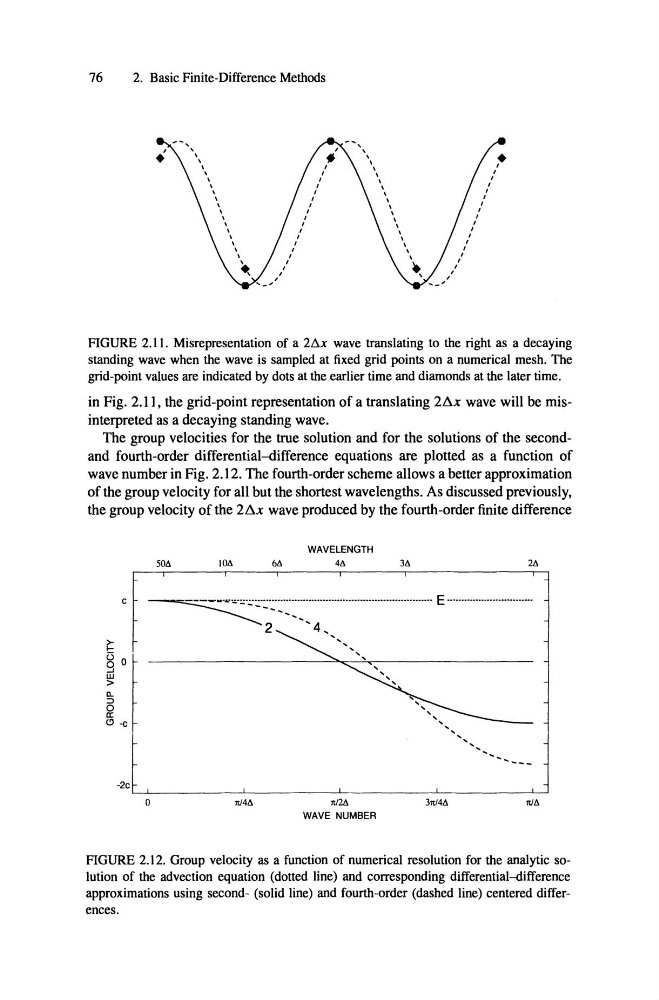
in Fig. 2.11, the grid-point representation of a translating 2ßx wave will be misinterpreted as a deeaying standing wave.
The group veloeities for the true solution and for the solutions of the seeondand fourth-order differential-difference equations are plotted as a function of
wave number in Fig. 2.12. The fourth-order sehe me allows a better approximation
of the group velocity for all but the shortest wavelengths. As discussed previously,
the group velocity of the 2ßx wave produced by the fourth-order finite differenee
4
-=:::::::::::.:"" .::. .::::
---..::::.
.
E
,
g 0
Q.
:;)
o
(!l-e
-c , , ,
, , , ,
FIGURE 2.12. Group velocity as a function of numerical resolution for the analytic solution of the advection equation (dotted line) and corresponding differential-difference
approximations using second- (solid line) and fourth-order (dashed line) centered differences.
2. Basic Finite-Difference Methods
,
,
,
, .'
, ,
, \
\
,
.
,
\
,
\
,
, ,
, ,
, ,, ,
\
\
\
\
\
\
\
\
, , , , ,
, ,
,
\
,
, , ,
\
\
\
, , ,
'-'
,
"
--'
/
FIGURE 2.11. Misrepresentation of a 2ßx wave translating to the right as a decaying
standing wave when the wave is sampled at fixed grid points on a numerical mesh. The
grid-point values are indicated by dots at the earlier time and diamonds at the later time.
in Fig. 2.11, the grid-point representation of a translating 2ßx wave will be misinterpreted as a deeaying standing wave.
The group veloeities for the true solution and for the solutions of the seeondand fourth-order differential-difference equations are plotted as a function of
wave number in Fig. 2.12. The fourth-order sehe me allows a better approximation
of the group velocity for all but the shortest wavelengths. As discussed previously,
the group velocity of the 2ßx wave produced by the fourth-order finite differenee
4
-=:::::::::::.:"" .::. .::::
---..::::.
.
E
,
g 0
Q.
:;)
o
(!l-e
-c , , ,
, , , ,
FIGURE 2.12. Group velocity as a function of numerical resolution for the analytic solution of the advection equation (dotted line) and corresponding differential-difference
approximations using second- (solid line) and fourth-order (dashed line) centered differences.