

74
2. Basic Finite-Difference Methods
retarded. The group veloeity of the 26.x wave is -c; its energy propagates backwards!
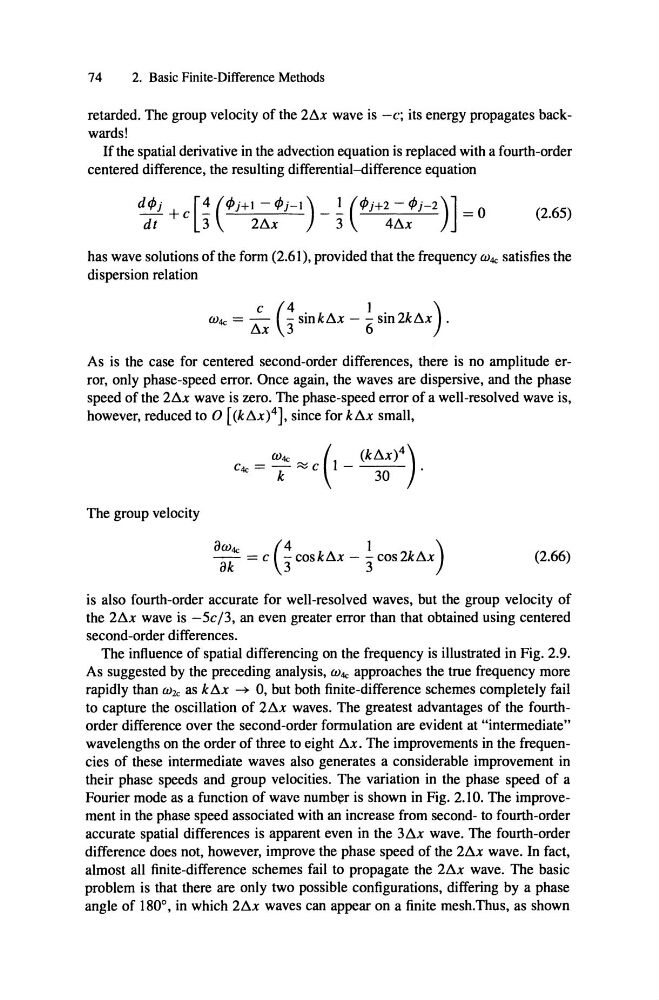
If the spatial derivative in the advection equation is replaced with a fourth -order
centered difference, the resulting differential-difference equation
drp '
_ J +c [4 (rp '+1 -rp' -I)
_ J
J
_ _ 1(rp '+2 -rp' -2)J
J
J
=0
(2.65)
dt
3
26.x
3
46.x
has wave solutions of the form (2.61), provided that the frequency l'.V4c satisfies the
.
dispersion relation
l'.V4c = - c (4 - sink6.x - - I . )
sm2k6.x
6.x 3
6
As is the case for centered second-order differences, there is no amplitude error, only phase-speed error. Once again, the waves are dispersive, and the phase
speed of the 26.x wave is zero. The phase-speed error of a well-resolved wave is,
however, reduced to 0 [(k6.x)4], since for k Sx smalI,
C4c = l'.V4c
c (1 _(k6.X)4) .
k
30
The group veloeity
(2.66)
is also fourth-order accurate for well-resolved waves, but the group veloeity of
the 26.x wave is -5c/3, an even greater error than that obtained using centered
second-order differences .
The influence of spatial differeneing on the frequency is iIIustrated in Fig. 2.9.
As suggested by the preceding analysis, l'.V4c approaches the true frequency more
rapidly than l'.V2c as k Sx
0, but both finite-difference schemes comp1etely fail
to capture the osciIIation of 26.x waves. The greatest advantages of the fourthorder difference over the second-order formulation are evident at "intermediate"
wavelengths on the order of three to eight 6.x . The improvements in the frequeneies of these intermediate waves also generates a considerable improvement in
their phase speeds and group veloeities. The variation in the phase speed of a
Fourier mode as a function of wave number is shown in Fig. 2.10. The improvement in the phase speed assoeiated with an increase from second- to fourth -order
accurate spatial differences is apparent even in the 36.x wave. The fourth-order
difference does not, however, improve the phase speed of the 26.x wave. In fact,
almost all finite-difference schemes fail to propagate the 26.x wave. The basic
problem is that there are only two possible configurations, differing by a phase
angle of 180
0 , in which 26.x waves can appear on a finite mesh.Thus, as shown
2. Basic Finite-Difference Methods
retarded. The group veloeity of the 26.x wave is -c; its energy propagates backwards!
If the spatial derivative in the advection equation is replaced with a fourth -order
centered difference, the resulting differential-difference equation
drp '
_ J +c [4 (rp '+1 -rp' -I)
_ J
J
_ _ 1(rp '+2 -rp' -2)J
J
J
=0
(2.65)
dt
3
26.x
3
46.x
has wave solutions of the form (2.61), provided that the frequency l'.V4c satisfies the
.
dispersion relation
l'.V4c = - c (4 - sink6.x - - I . )
sm2k6.x
6.x 3
6
As is the case for centered second-order differences, there is no amplitude error, only phase-speed error. Once again, the waves are dispersive, and the phase
speed of the 26.x wave is zero. The phase-speed error of a well-resolved wave is,
however, reduced to 0 [(k6.x)4], since for k Sx smalI,
C4c = l'.V4c
c (1 _(k6.X)4) .
k
30
The group veloeity
(2.66)
is also fourth-order accurate for well-resolved waves, but the group veloeity of
the 26.x wave is -5c/3, an even greater error than that obtained using centered
second-order differences .
The influence of spatial differeneing on the frequency is iIIustrated in Fig. 2.9.
As suggested by the preceding analysis, l'.V4c approaches the true frequency more
rapidly than l'.V2c as k Sx
0, but both finite-difference schemes comp1etely fail
to capture the osciIIation of 26.x waves. The greatest advantages of the fourthorder difference over the second-order formulation are evident at "intermediate"
wavelengths on the order of three to eight 6.x . The improvements in the frequeneies of these intermediate waves also generates a considerable improvement in
their phase speeds and group veloeities. The variation in the phase speed of a
Fourier mode as a function of wave number is shown in Fig. 2.10. The improvement in the phase speed assoeiated with an increase from second- to fourth -order
accurate spatial differences is apparent even in the 36.x wave. The fourth-order
difference does not, however, improve the phase speed of the 26.x wave. In fact,
almost all finite-difference schemes fail to propagate the 26.x wave. The basic
problem is that there are only two possible configurations, differing by a phase
angle of 180
0 , in which 26.x waves can appear on a finite mesh.Thus, as shown