

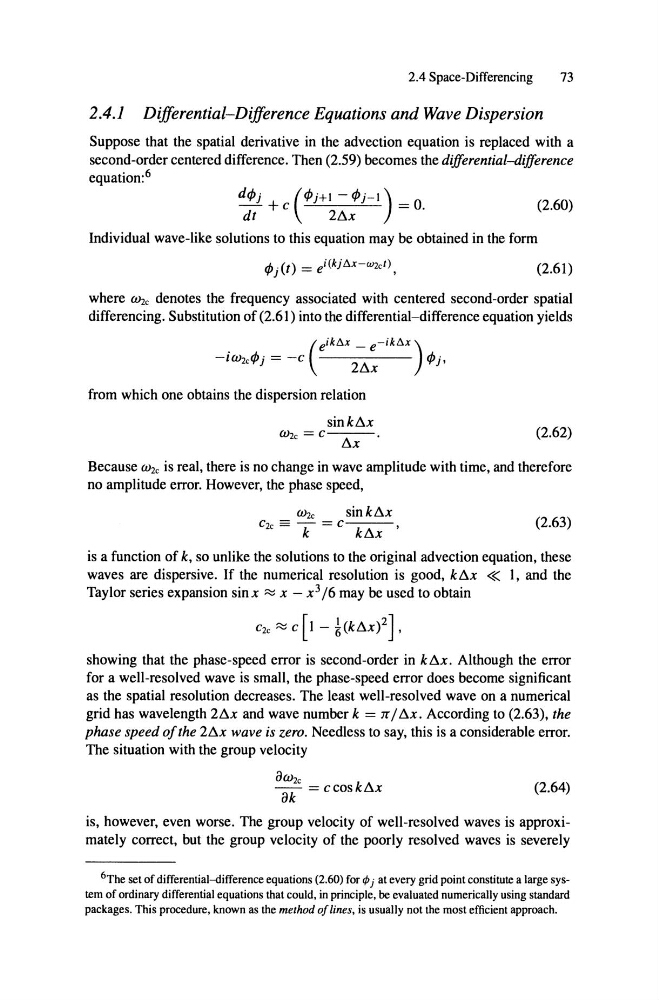
df/J o
_ J +c (f/J O+l-f/J o _l)
J
J
= O.
dt
2t1x
(2.60)
2.4 Space-Differencing
73
2.4.1 Differential-Difference Equations and Wave Dispersion
Suppose that the spatial derivative in the advection equation is replaced with a
second-order centered difference. Then (2.59) becomes the differential-difference
equation.''
Individual wave-like solutions to this equation may be obtained in the form
(2.61)
where W2c denotes the frequency associated with centered second-order spatial
differencing. Substitution of (2.61) into the differential-differencc equation yields
.
-IW2cf/Jj = -c
f/Jj,
(eikl'U _ e-ikI'U)
2t1x
from which one obtains the dispersion relation
sinkt1x
(2.62)
W2c = c t1x
Because W2c is real, there is no change in wave amplitude with time, and therefore
no amplitude error. However, the phase speed,
W2 c
sinkt1x
C2c == - = c
,
(2.63)
k
kt1x
is a function of k, so unlike the solutions to the original advection equation, these
waves are dispersive. If the numerical resolution is good, k t1x « 1, and the
Taylor series expansion sin x
x - x 3/6 may be used to obtain
C2c
C(l -
showing that the phase-speed error is second-order in k Sx, Although the error
for a well-resolved wave is smalI, the phase-speed error does become significant
as the spatial resolution decreases. The least well-resolved wave on a numerical
grid has wavelength 2t1x and wave number k = 7T/ t1x. According to (2.63), the
phase speed ofthe 2t1x wave is zero. Needless to say, this is a considerable error.
The situation with the group velocity
- - = ccoskt1x
ak
(2.64)
is, however, even worse. The group velocity of well-resolved waves is approximately correct, but the group velocity of the poorly resolved waves is severely
6The set of differential-difference equations (2.60) for cf>j at every grid point constitute a large system of ordinary differential equations that could, in principle, be evaluated numerically using standard
packages. This procedure, known as the method 0/lines, is usually not the most efficient approach.
_ J +c (f/J O+l-f/J o _l)
J
J
= O.
dt
2t1x
(2.60)
2.4 Space-Differencing
73
2.4.1 Differential-Difference Equations and Wave Dispersion
Suppose that the spatial derivative in the advection equation is replaced with a
second-order centered difference. Then (2.59) becomes the differential-difference
equation.''
Individual wave-like solutions to this equation may be obtained in the form
(2.61)
where W2c denotes the frequency associated with centered second-order spatial
differencing. Substitution of (2.61) into the differential-differencc equation yields
.
-IW2cf/Jj = -c
f/Jj,
(eikl'U _ e-ikI'U)
2t1x
from which one obtains the dispersion relation
sinkt1x
(2.62)
W2c = c t1x
Because W2c is real, there is no change in wave amplitude with time, and therefore
no amplitude error. However, the phase speed,
W2 c
sinkt1x
C2c == - = c
,
(2.63)
k
kt1x
is a function of k, so unlike the solutions to the original advection equation, these
waves are dispersive. If the numerical resolution is good, k t1x « 1, and the
Taylor series expansion sin x
x - x 3/6 may be used to obtain
C2c
C(l -
showing that the phase-speed error is second-order in k Sx, Although the error
for a well-resolved wave is smalI, the phase-speed error does become significant
as the spatial resolution decreases. The least well-resolved wave on a numerical
grid has wavelength 2t1x and wave number k = 7T/ t1x. According to (2.63), the
phase speed ofthe 2t1x wave is zero. Needless to say, this is a considerable error.
The situation with the group velocity
- - = ccoskt1x
ak
(2.64)
is, however, even worse. The group velocity of well-resolved waves is approximately correct, but the group velocity of the poorly resolved waves is severely
6The set of differential-difference equations (2.60) for cf>j at every grid point constitute a large system of ordinary differential equations that could, in principle, be evaluated numerically using standard
packages. This procedure, known as the method 0/lines, is usually not the most efficient approach.