

2.3 Time-Differencing
71
1.5
-
- - = : : - :
- -
----- -
1.0
lAI
0.5
/4
0.0 '-'-_ _----l._ _----l._ _----l._ _- - '_ _----'' --_
o
0.5
1.0
1.5
K ti.1
2.0
2.5
----'LJ
3.0
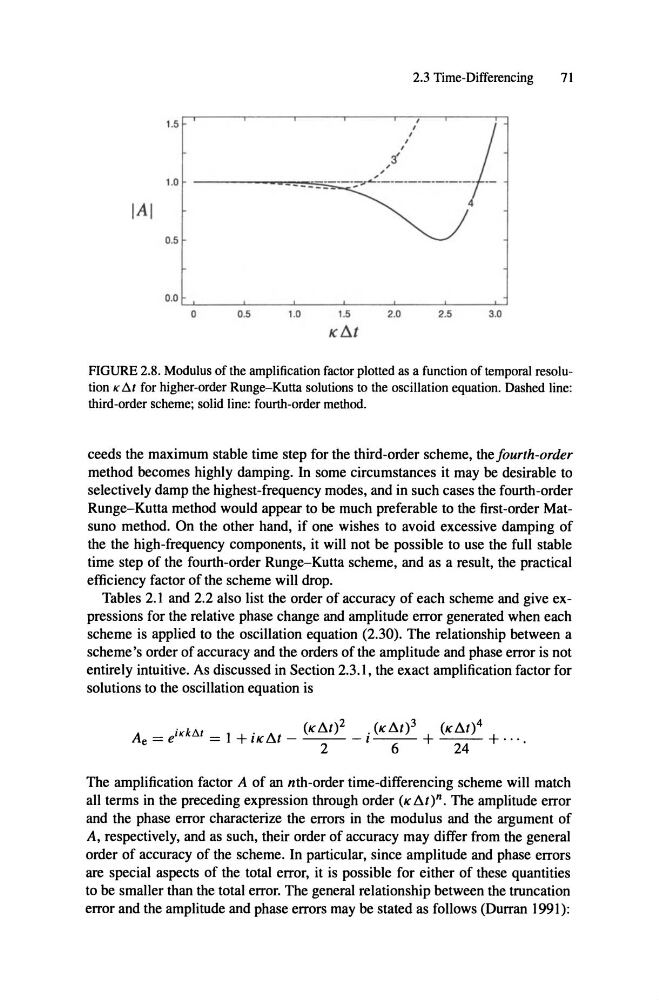
FIGURE 2.8. Modulus of the amplification factor plotted as a function of temporal resolution K 6.1 for higher-order Runge-Kutta solutions to the oscillation equation. Dashed line:
third-order scheme ; solid line: fourth-order method.
ceeds the maximum stable time step for the third-order scheme, the fourth-order
method becomes highly damping. In some circumstances it may be desirable to
selectively damp the highest-frequency modes, and in such cases the fourth-order
Runge-Kutta method would appear to be much preferable to the first-order Matsuno method. On the other hand, if one wishes to avoid excessive damping of
the the high-frequency components, it will not be possible to use the full stable
time step of the fourth-order Runge-Kutta scheme, and as a result, the practical
efficiency factor of the scheme will drop.
Tables 2.1 and 2.2 also list the order of accuracy of each scheme and give expressions for the relative phase change and amplitude error generated when each
scheme is applied to the oscillation equation (2.30). The relationship between a
scheme's order of accuracy and the orders of the amplitude and phase error is not
entirely intuitive. As discussed in Section 2.3.1, the exact amplification factor for
solutions to the oscillation equation is
A = ei Kkß 1 = 1 + iKl:!.t _ (Kl:!.t)2 _ i (Kl:!.t)3 + (Kl:!.t)4 + ....
e
2
6
24
The amplification factor A of an nth-order time-differencing scheme will match
an terms in the preceding expression through order (Kl:!.t)n. The amplitude error
and the phase error characterize the errors in the modulus and the argument of
A, respectively, and as such, their order of accuracy may differ from the general
order of accuracy of the scheme. In particular, since amplitude and phase errors
are special aspects of the total error, it is possible for either of these quantities
to be smalIer than the total error. The general relationship between the truncation
71
1.5
-
- - = : : - :
- -
----- -
1.0
lAI
0.5
/4
0.0 '-'-_ _----l._ _----l._ _----l._ _- - '_ _----'' --_
o
0.5
1.0
1.5
K ti.1
2.0
2.5
----'LJ
3.0
FIGURE 2.8. Modulus of the amplification factor plotted as a function of temporal resolution K 6.1 for higher-order Runge-Kutta solutions to the oscillation equation. Dashed line:
third-order scheme ; solid line: fourth-order method.
ceeds the maximum stable time step for the third-order scheme, the fourth-order
method becomes highly damping. In some circumstances it may be desirable to
selectively damp the highest-frequency modes, and in such cases the fourth-order
Runge-Kutta method would appear to be much preferable to the first-order Matsuno method. On the other hand, if one wishes to avoid excessive damping of
the the high-frequency components, it will not be possible to use the full stable
time step of the fourth-order Runge-Kutta scheme, and as a result, the practical
efficiency factor of the scheme will drop.
Tables 2.1 and 2.2 also list the order of accuracy of each scheme and give expressions for the relative phase change and amplitude error generated when each
scheme is applied to the oscillation equation (2.30). The relationship between a
scheme's order of accuracy and the orders of the amplitude and phase error is not
entirely intuitive. As discussed in Section 2.3.1, the exact amplification factor for
solutions to the oscillation equation is
A = ei Kkß 1 = 1 + iKl:!.t _ (Kl:!.t)2 _ i (Kl:!.t)3 + (Kl:!.t)4 + ....
e
2
6
24
The amplification factor A of an nth-order time-differencing scheme will match
an terms in the preceding expression through order (Kl:!.t)n. The amplitude error
and the phase error characterize the errors in the modulus and the argument of
A, respectively, and as such, their order of accuracy may differ from the general
order of accuracy of the scheme. In particular, since amplitude and phase errors
are special aspects of the total error, it is possible for either of these quantities
to be smalIer than the total error. The general relationship between the truncation