

2.3 Time-Differencing
65
analyze the behavior of the Magazenkov method, it is therefore , best to consider
the averaged effect of a combined leapfrog-Adams-Bashforth cycle.
Thus, for analysis purposes, the scheme will be written as a system of equations
that maps (ifJn-2, ifJn -1) into (ifJn , ifJn+1),
ifJn = ifJn -2 + 2!:1tF(ifJn-I),
ifJn+1 = (ifJ n - 2 + 2!:1tF(ifJn-l»)
(2.56)
+ [3F (ifJ n - 2 + 2!:1tF(ifJn-1») _ F(ifJn-1)] .
(2.57)
When actually implementing the Magazenkov method, however, (2.57) would be
replaced by the equivalent expression (2.46). Application of (2.56) and (2.57) to
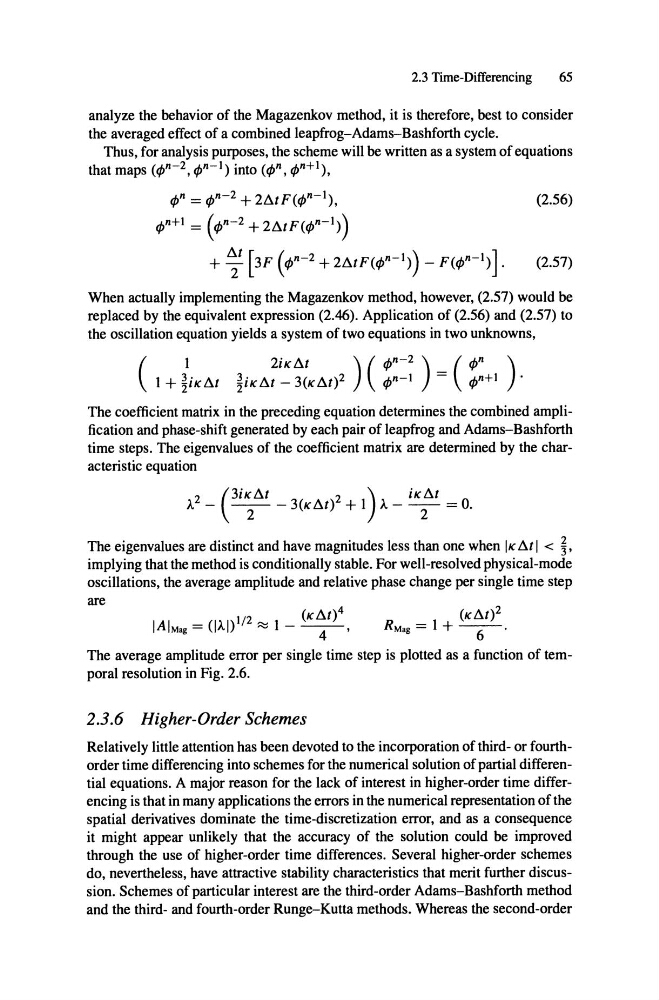
the oscillation equation yields a system of two equations in two unknowns,
( 1+ iiK!:1t
2 -
(3iK!:1t
- 2 - -
)= ( ::+1 ).
-2ix S:
(
2) + I
lAI Ma g = (1}.1)1/2
(K!:1t)4
I - - 4 - '
(K!:1t)2
R Mag = 1 + -
6-,
The coefficient matrix in the preceding equation detennines the combined ampIification and phase-shift generated by each pair of leapfrog and Adams-Bashforth
time steps. The eigenvalues of the coefficient matrix are detennined by the characteristic equation
}.
3(K!:1t)
}. -
= O.
The eigenvalues are distinct and have magnitudes less than one when IK!:1 t 1 < j,
implying that the method is conditionally stable. For well-resolved physical-mode
oscillations, the average amplitude and relative phase change per single time step
are
The average amplitude error per single time step is plotted as a function of temporal resolution in Fig. 2.6.
2.3.6 Higher-Order Schemes
Relatively little attention has been devoted to the incorporation ofthird- or fourth -
order time differencing into schemes for the numerical solution of partial differential equations. A major reason for the lack of interest in higher-order time differencing is that in many applications the errors in the numerical representation of the
spatial derivatives dominate the time-discretization error, and as a consequence
it might appear unlikely that the accuracy of the solution could be improved
through the use of higher-order time differences. Several higher-order schemes
do, nevertheless , have attractive stability characteristics that merit further discussion. Schemes of particular interest are the third-order Adams-Bashforth method
and the third- and fourth-order Runge-Kutta methods. Whereas the second-order
65
analyze the behavior of the Magazenkov method, it is therefore , best to consider
the averaged effect of a combined leapfrog-Adams-Bashforth cycle.
Thus, for analysis purposes, the scheme will be written as a system of equations
that maps (ifJn-2, ifJn -1) into (ifJn , ifJn+1),
ifJn = ifJn -2 + 2!:1tF(ifJn-I),
ifJn+1 = (ifJ n - 2 + 2!:1tF(ifJn-l»)
(2.56)
+ [3F (ifJ n - 2 + 2!:1tF(ifJn-1») _ F(ifJn-1)] .
(2.57)
When actually implementing the Magazenkov method, however, (2.57) would be
replaced by the equivalent expression (2.46). Application of (2.56) and (2.57) to
the oscillation equation yields a system of two equations in two unknowns,
( 1+ iiK!:1t
2 -
(3iK!:1t
- 2 - -
)= ( ::+1 ).
-2ix S:
(
2) + I
lAI Ma g = (1}.1)1/2
(K!:1t)4
I - - 4 - '
(K!:1t)2
R Mag = 1 + -
6-,
The coefficient matrix in the preceding equation detennines the combined ampIification and phase-shift generated by each pair of leapfrog and Adams-Bashforth
time steps. The eigenvalues of the coefficient matrix are detennined by the characteristic equation
}.
3(K!:1t)
}. -
= O.
The eigenvalues are distinct and have magnitudes less than one when IK!:1 t 1 < j,
implying that the method is conditionally stable. For well-resolved physical-mode
oscillations, the average amplitude and relative phase change per single time step
are
The average amplitude error per single time step is plotted as a function of temporal resolution in Fig. 2.6.
2.3.6 Higher-Order Schemes
Relatively little attention has been devoted to the incorporation ofthird- or fourth -
order time differencing into schemes for the numerical solution of partial differential equations. A major reason for the lack of interest in higher-order time differencing is that in many applications the errors in the numerical representation of the
spatial derivatives dominate the time-discretization error, and as a consequence
it might appear unlikely that the accuracy of the solution could be improved
through the use of higher-order time differences. Several higher-order schemes
do, nevertheless , have attractive stability characteristics that merit further discussion. Schemes of particular interest are the third-order Adams-Bashforth method
and the third- and fourth-order Runge-Kutta methods. Whereas the second-order