

56
2. Basic Finite-Difference Methods
1.5
1.0
4 . . . . .
0.5
1.0
u/ / ' / '
- . FB _ _
R-·
-------=::::------------------1----_
=----- -
-E - - - - -
R
o
0.5
K 1:11
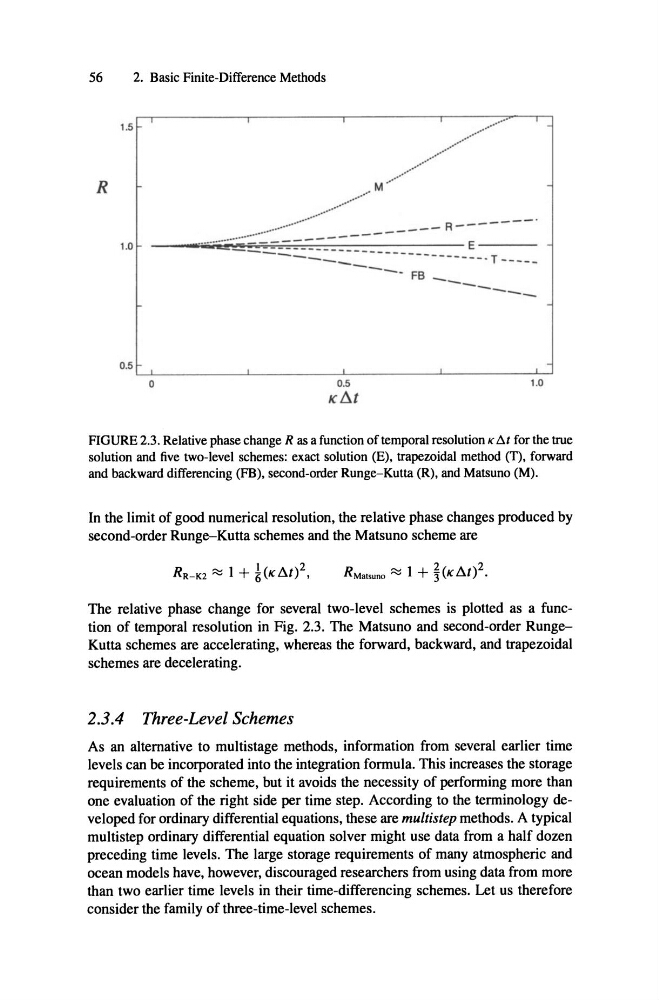
FIGURE2.3. Relative phasechangeRas a function oftemporal resolution K!::>t for the true
solution and live two-level schemes: exact solution (E), trapezoidal method (T), forward
and backward differencing (PB), second-order Runge-Kutta (R), and Matsuno (M).
In the limit of good numerical resolution, the relative phase changes produced by
second-order Runge-Kutta schemes and the Matsuno scheme are
The relative phase change for several two-Ievel schemes is plotted as a function of temporal resolution in Fig. 2.3. The Matsuno and second -order RungeKutta schemes are accelerating, whereas the forward, backward, and trapezoidal
schemes are decelerating.
2.3.4 Three-Level Schemes
As an alternative to multistage methods, information from several earlier time
levels can be incorporated into the integration formula. This increases the storage
requirements of the scheme, but it avoids the necessity of performing more than
one evaluation of the right side per time step. According to the terminology developed for ordinary differential equations, these are multistep methods. A typical
multistep ordinary differential equation solver might use data from a half dozen
preceding time levels. The large storage requirements of many atmospheric and
ocean models have, however, discouraged researchers from using data from more
than two earlier time levels in their time-differencing schemes. Let us therefore
consider the family of three -time -level schemes.
2. Basic Finite-Difference Methods
1.5
1.0
4 . . . . .
0.5
1.0
u/ / ' / '
- . FB _ _
R-·
-------=::::------------------1----_
=----- -
-E - - - - -
R
o
0.5
K 1:11
FIGURE2.3. Relative phasechangeRas a function oftemporal resolution K!::>t for the true
solution and live two-level schemes: exact solution (E), trapezoidal method (T), forward
and backward differencing (PB), second-order Runge-Kutta (R), and Matsuno (M).
In the limit of good numerical resolution, the relative phase changes produced by
second-order Runge-Kutta schemes and the Matsuno scheme are
The relative phase change for several two-Ievel schemes is plotted as a function of temporal resolution in Fig. 2.3. The Matsuno and second -order RungeKutta schemes are accelerating, whereas the forward, backward, and trapezoidal
schemes are decelerating.
2.3.4 Three-Level Schemes
As an alternative to multistage methods, information from several earlier time
levels can be incorporated into the integration formula. This increases the storage
requirements of the scheme, but it avoids the necessity of performing more than
one evaluation of the right side per time step. According to the terminology developed for ordinary differential equations, these are multistep methods. A typical
multistep ordinary differential equation solver might use data from a half dozen
preceding time levels. The large storage requirements of many atmospheric and
ocean models have, however, discouraged researchers from using data from more
than two earlier time levels in their time-differencing schemes. Let us therefore
consider the family of three -time -level schemes.