

2.3 Time-Differencing
55
lAI
2.0
1.5
1.0
0.0
o
.>:. . . . .
.. ...
. :.. :.-M-,-,-'-'-'
,
ET - -
»>: F"'_ - - - R .- .... ;.:7
_
.
....z==--__ --------------- -;.:..::.,:.
-- _-- . B -------- ---- -- -0.5
0.5
K!::J.t
1.0
1.5
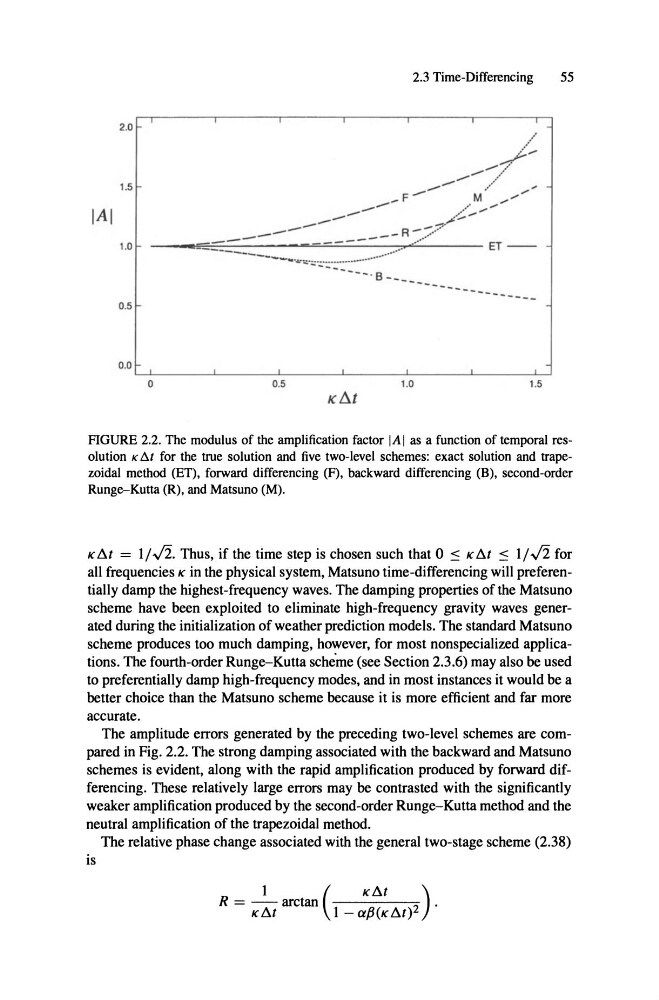
FIGURE 2.2. The modulus of the amplification factor lAI as a function of temporal resolution K tlt for the true solution and five two-level schemes: exact solution and trapezoidal method (ET), forward differencing (F), backward differencing (8), second-order
Runge-Kutta (R), and Matsuno (M).
Kl:i.t = 1/,J2. Thus, if the time step is chosen such that 0 SK/),.I S 1/,J2 for
all frequencies K in the physical system, Matsuno time-differencing will preferentially damp the highest-frequency waves. The damping properties of the Matsuno
scheme have been exploited to eliminate high -frequency gravity waves generated during the initialization of weather prediction models. The standard Matsuno
scheme produces too much damping, however, for most nonspecialized applications. The fourth-order Runge-Kutta scheme (see Section 2.3.6) mayaiso be used
to preferentially damp high-frequency modes, and in most instances it would be a
better choice than the Matsuno scheme because it is more efficient and far more
accurate.
The amplitude errors generated by the preceding two-level schemes are compared in Fig. 2.2. The strong damping associated with the backward and Matsuno
schemes is evident, along with the rapid amplification produced by forward differencing. These relatively large errors may be contrasted with the significantly
weaker amplification produced by the second-order Runge-Kutta method and the
neutral amplification of the trapezoidal method.
The relative phase change associated with the general two-stage scheme (2.38)
is
R = - - arctan
1
(KM) .
Kl:i.t
1 - aß(K /),.t)2
55
lAI
2.0
1.5
1.0
0.0
o
.>:. . . . .
.. ...
. :.. :.-M-,-,-'-'-'
,
ET - -
»>: F"'_ - - - R .- .... ;.:7
_
.
....z==--__ --------------- -;.:..::.,:.
-- _-- . B -------- ---- -- -0.5
0.5
K!::J.t
1.0
1.5
FIGURE 2.2. The modulus of the amplification factor lAI as a function of temporal resolution K tlt for the true solution and five two-level schemes: exact solution and trapezoidal method (ET), forward differencing (F), backward differencing (8), second-order
Runge-Kutta (R), and Matsuno (M).
Kl:i.t = 1/,J2. Thus, if the time step is chosen such that 0 SK/),.I S 1/,J2 for
all frequencies K in the physical system, Matsuno time-differencing will preferentially damp the highest-frequency waves. The damping properties of the Matsuno
scheme have been exploited to eliminate high -frequency gravity waves generated during the initialization of weather prediction models. The standard Matsuno
scheme produces too much damping, however, for most nonspecialized applications. The fourth-order Runge-Kutta scheme (see Section 2.3.6) mayaiso be used
to preferentially damp high-frequency modes, and in most instances it would be a
better choice than the Matsuno scheme because it is more efficient and far more
accurate.
The amplitude errors generated by the preceding two-level schemes are compared in Fig. 2.2. The strong damping associated with the backward and Matsuno
schemes is evident, along with the rapid amplification produced by forward differencing. These relatively large errors may be contrasted with the significantly
weaker amplification produced by the second-order Runge-Kutta method and the
neutral amplification of the trapezoidal method.
The relative phase change associated with the general two-stage scheme (2.38)
is
R = - - arctan
1
(KM) .
Kl:i.t
1 - aß(K /),.t)2