

2.3 Time-Differencing
53
As with forward differencing and backward differencing, the trapezoidal scheme
retards the phase change of well-resolved oscillations. However, the deceleration
is only i as great as that produced by the other schemes.
Although the trapezoidal scheme is accurate and unconditionally stable, it suffers from one serious disadvantage: It requires the evaluation of F(lj)n+l) during
the computation of lj)n+ I . A scheme such as the trapezoidal method, in which the
calculation of lj)n+1 depends on F(lj)n+I), is known as an implicit method. Ifthe
calculation of lj)n+1 does not depend on F(lj)n+I), the scheme is explicit. In the
case of the oscillation equation, implicitness is a trivial complication. However,
if F is a nonlinear function, any implicit finite-difference scheme will convert the
differential equation into a nonlinear algebraic equation for lj)n+ I. In the general
case, the solution to this nonlinear equation must be obtained by some iterative
technique. Thus, implicit finite-difference schemes generally require much more
computation per individual time step than do similar explicit methods. Some of
that extra computation may be offset if the implicit method is unconditionally stable, in which case the step size is determined solely by accuracy considerations,
and the implicit time step can sometimes be much larger than the maximum stable
time step of comparable explicit schemes .
2.3.3 Multistage Methods
All stable schemes of the form (2.33) have the disadvantage that they are implicit.
Moreover, alI except the trapezoidal scheme are only of first order. Is there a stable, accurate scheme that is not implicit? One may attempt to construct such a
scheme by evaluating the function F in (2.32) at additional points in the interval (n1).t, (n + 1)1).t) and using this extra information to improve the accuracy
of the calculation. These schemes are often referred to as multistage methods ,
because each integration step may require the estimation of 1{f at several intermediate times, or "stages,' before a final approximation to 1{f«n + I)M) is obtained.
Each stage involves an additional evaluation of F, the right side of the differen -
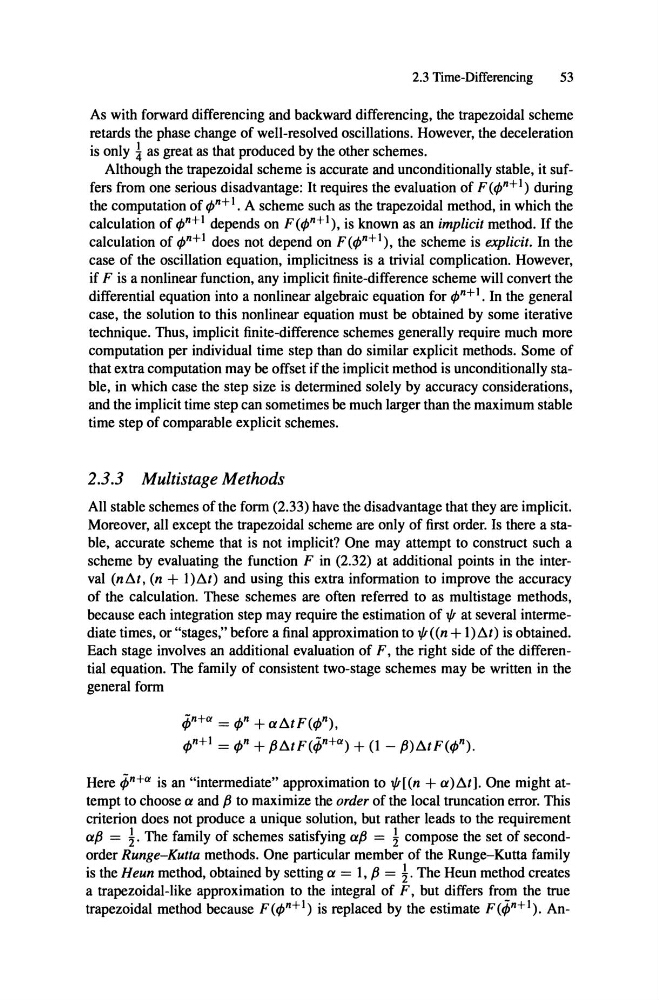
tial equation. The family of consistent two-stage schemes may be written in the
general form
iP n+a = lj)n + (1).tF(lj)n) ,
lj)n+1 = lj)n + ß1).tF(iP n+a ) + (1 - ß)1).tF(lj)n).
Here iP n + a is an "intermediate" approximation to 1{f[(n + a)M]. One might attempt to choose a and ß to maximize the order of the local truncation error. This
criterion does not produce a unique solution, but rather leads to the requirement
aß =
The family of schemes satisfying aß = compose the set of secondorder Runge-Kutta methods. One particular member of the Runge-Kutta family
is the Heun method, obtained by setting a = I, ß = The Heun method creates
a trapezoidal-like approximation to the integral of F, but differs from the true
trapezoidal method because F(lj)n+l) is replaced by the estimate F(iP n+I) . An-
53
As with forward differencing and backward differencing, the trapezoidal scheme
retards the phase change of well-resolved oscillations. However, the deceleration
is only i as great as that produced by the other schemes.
Although the trapezoidal scheme is accurate and unconditionally stable, it suffers from one serious disadvantage: It requires the evaluation of F(lj)n+l) during
the computation of lj)n+ I . A scheme such as the trapezoidal method, in which the
calculation of lj)n+1 depends on F(lj)n+I), is known as an implicit method. Ifthe
calculation of lj)n+1 does not depend on F(lj)n+I), the scheme is explicit. In the
case of the oscillation equation, implicitness is a trivial complication. However,
if F is a nonlinear function, any implicit finite-difference scheme will convert the
differential equation into a nonlinear algebraic equation for lj)n+ I. In the general
case, the solution to this nonlinear equation must be obtained by some iterative
technique. Thus, implicit finite-difference schemes generally require much more
computation per individual time step than do similar explicit methods. Some of
that extra computation may be offset if the implicit method is unconditionally stable, in which case the step size is determined solely by accuracy considerations,
and the implicit time step can sometimes be much larger than the maximum stable
time step of comparable explicit schemes .
2.3.3 Multistage Methods
All stable schemes of the form (2.33) have the disadvantage that they are implicit.
Moreover, alI except the trapezoidal scheme are only of first order. Is there a stable, accurate scheme that is not implicit? One may attempt to construct such a
scheme by evaluating the function F in (2.32) at additional points in the interval (n1).t, (n + 1)1).t) and using this extra information to improve the accuracy
of the calculation. These schemes are often referred to as multistage methods ,
because each integration step may require the estimation of 1{f at several intermediate times, or "stages,' before a final approximation to 1{f«n + I)M) is obtained.
Each stage involves an additional evaluation of F, the right side of the differen -
tial equation. The family of consistent two-stage schemes may be written in the
general form
iP n+a = lj)n + (1).tF(lj)n) ,
lj)n+1 = lj)n + ß1).tF(iP n+a ) + (1 - ß)1).tF(lj)n).
Here iP n + a is an "intermediate" approximation to 1{f[(n + a)M]. One might attempt to choose a and ß to maximize the order of the local truncation error. This
criterion does not produce a unique solution, but rather leads to the requirement
aß =
The family of schemes satisfying aß = compose the set of secondorder Runge-Kutta methods. One particular member of the Runge-Kutta family
is the Heun method, obtained by setting a = I, ß = The Heun method creates
a trapezoidal-like approximation to the integral of F, but differs from the true
trapezoidal method because F(lj)n+l) is replaced by the estimate F(iP n+I) . An-