

52
2. Basic Finite-DifferenceMethods
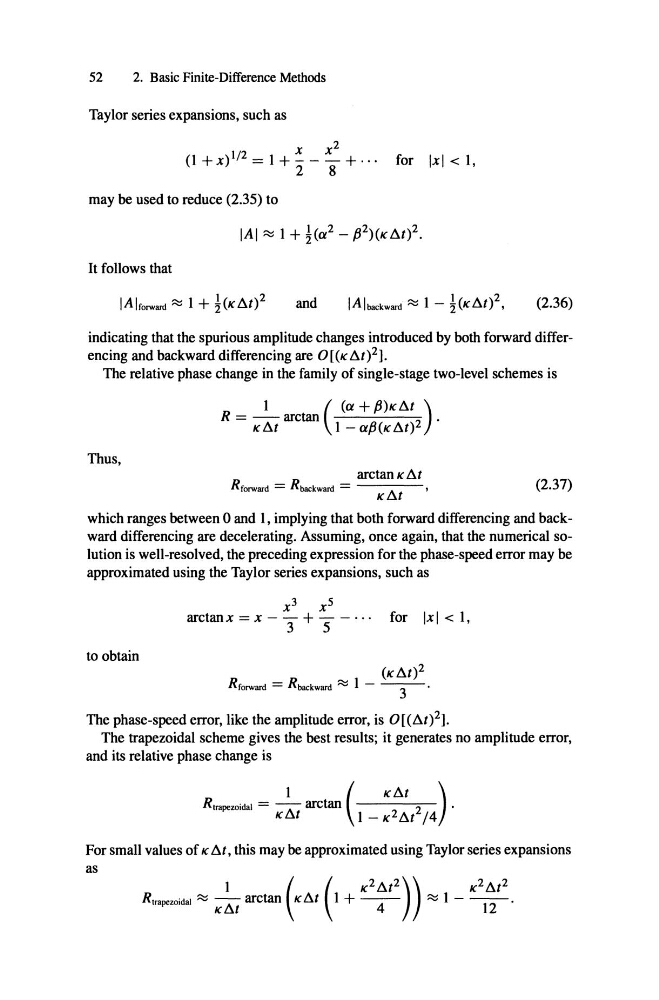
Taylor series expansions, such as
(l + x)I/2 = 1 + - x g
may be used to reduce (2.35) to
2 + ... for [x] « I,
It follows that
and
(2.36)
indicating that the spurious amplitude changes introduced by both forward differencing and backward differencing are O[(K
The relative phase change in the family of single-stage two-level schemes is
R = - - arctan
1
( (a + ß)K ) .
Thus,
arctan z Ar
R forward = Rba
which ranges between 0 and 1, implying that both forward differencing and backward differencing are decelerating. Assuming, once again, that the numerical so -
lution is well-resolved, the preceding expression for the phase-speed error may be
approximated using the Taylor series expansions, such as
x 3 x 5
arctanx = x - - + - -. ..
3
5
for [x] « 1,
to obtain
Rforward = Rbackward
(K
1 - --3-'
The phase-speed error, like the amplitude error, is
The trapezoidal scheme gives the best results; it generates no amplitude error,
and its relative phase change is
Rtrapezoidal = - - arctan
1
1 -
2 '
/4
For small values of K Sr, this may be approximated using Taylor series expansions
as
R trapezoidal
- - arctan
1
( (
K
1 + - -
4
1 - - - .
12
2. Basic Finite-DifferenceMethods
Taylor series expansions, such as
(l + x)I/2 = 1 + - x g
may be used to reduce (2.35) to
2 + ... for [x] « I,
It follows that
and
(2.36)
indicating that the spurious amplitude changes introduced by both forward differencing and backward differencing are O[(K
The relative phase change in the family of single-stage two-level schemes is
R = - - arctan
1
( (a + ß)K ) .
Thus,
arctan z Ar
R forward = Rba
which ranges between 0 and 1, implying that both forward differencing and backward differencing are decelerating. Assuming, once again, that the numerical so -
lution is well-resolved, the preceding expression for the phase-speed error may be
approximated using the Taylor series expansions, such as
x 3 x 5
arctanx = x - - + - -. ..
3
5
for [x] « 1,
to obtain
Rforward = Rbackward
(K
1 - --3-'
The phase-speed error, like the amplitude error, is
The trapezoidal scheme gives the best results; it generates no amplitude error,
and its relative phase change is
Rtrapezoidal = - - arctan
1
1 -
2 '
/4
For small values of K Sr, this may be approximated using Taylor series expansions
as
R trapezoidal
- - arctan
1
( (
K
1 + - -
4
1 - - - .
12