

Problems
437
Once exact or approximate boundary conditions have been formulated for the
continuous problem, they must be approximated for use in the numerical integration. Extra boundary conditions beyond those required to yield a well-posed problem mayaiso be needed to evaluate finite differences near the boundary. Although
these numerical boundary conditions can have a significant impact on the stability and accuracy of the solution, it can be easier to reduce these finite-differencing
errors than the errors that originate from inadequate approximations to the correct
open boundary condition.
Problems
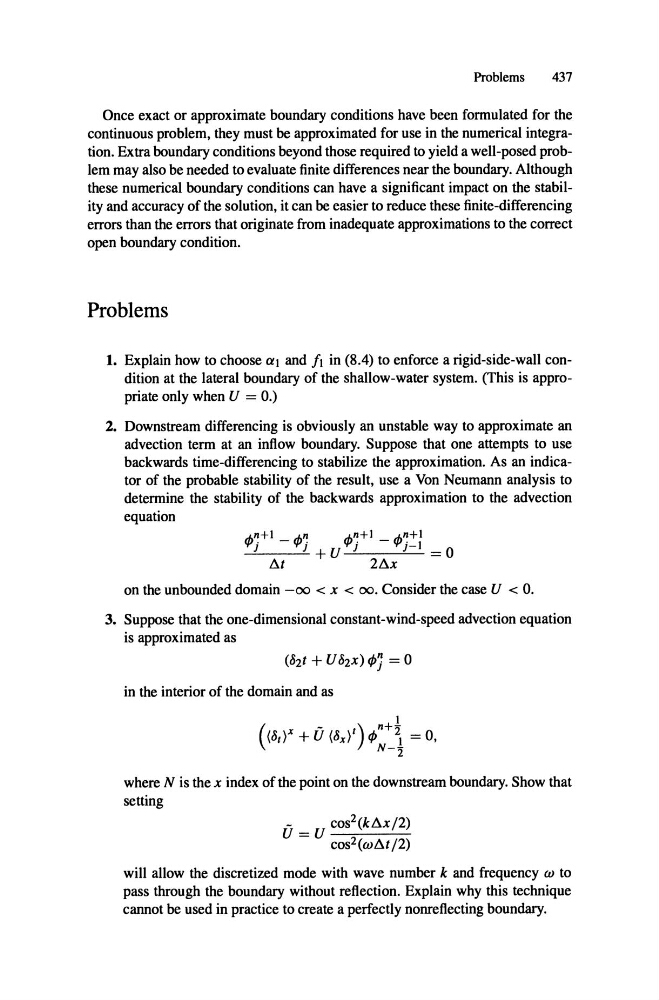
1. Explain how to choose al and I1 in (8.4) to enforce a rigid-side-wall condition at the lateral boundary of the shallow-water system. (This is appropriate only when U = 0.)
2. Downstream differencing is obviously an unstable way to approximate an
advection term at an inflow boundary. Suppose that one attempts to use
backwards time-differencing to stabilize the approximation . As an indicator of the probable stability of the result, use a Von Neumann analysis to
determine the stability of the backwards approximation to the advection
equation
,p".+1 -,pT!
)
,pT!+ I - ,p".+1
) + U )
= 0
) -1
!:lt
2!:lx
on the unbounded domain -00 < x < 00. Consider the case U < O.
3. Suppose that the one-dimensional constant-wind-speed advection equation
is approximated as
in the interior of the domain and as
where N is the x index of the point on the downstream boundary. Show that
setting
will allow the discretized mode with wave number k and frequency w to
pass through the boundary without reflection . Explain why this technique
cannot be used in practice to create a perfectly nonreflecting boundary.
437
Once exact or approximate boundary conditions have been formulated for the
continuous problem, they must be approximated for use in the numerical integration. Extra boundary conditions beyond those required to yield a well-posed problem mayaiso be needed to evaluate finite differences near the boundary. Although
these numerical boundary conditions can have a significant impact on the stability and accuracy of the solution, it can be easier to reduce these finite-differencing
errors than the errors that originate from inadequate approximations to the correct
open boundary condition.
Problems
1. Explain how to choose al and I1 in (8.4) to enforce a rigid-side-wall condition at the lateral boundary of the shallow-water system. (This is appropriate only when U = 0.)
2. Downstream differencing is obviously an unstable way to approximate an
advection term at an inflow boundary. Suppose that one attempts to use
backwards time-differencing to stabilize the approximation . As an indicator of the probable stability of the result, use a Von Neumann analysis to
determine the stability of the backwards approximation to the advection
equation
,p".+1 -,pT!
)
,pT!+ I - ,p".+1
) + U )
= 0
) -1
!:lt
2!:lx
on the unbounded domain -00 < x < 00. Consider the case U < O.
3. Suppose that the one-dimensional constant-wind-speed advection equation
is approximated as
in the interior of the domain and as
where N is the x index of the point on the downstream boundary. Show that
setting
will allow the discretized mode with wave number k and frequency w to
pass through the boundary without reflection . Explain why this technique
cannot be used in practice to create a perfectly nonreflecting boundary.