

436
8. Nonreflecting Boundary Conditions
8.5 Summary
When simulating the evolution of localized disturbances within a large body of
fluid, it is often necessary to limit the computational domain to an arbitrary subset
of the total fluid. The conditions that are imposed at artificial boundaries within
the fluid are often only approximate descriptions of the true physieal behavior of
the system and can be a significant source of error. Unless special information
is available describing the solution outside the limited domain , the only practieal
boundary condition that can be specified is one that attempts to radiate disturbances through the boundary without spurious reflection . Nevertheless, the radiation condition is not always the correct physieal boundary condition , because nonlinear interactions among the waves that have passed through an artificial boundary can generate a new wave that propagates backwards and should reenter the
domain .
Even when the radiation boundary condition correctly describes the physieal
processes occurring at an open boundary, it is frequently impossible to exactly
express that boundary condition in a useful mathematieal form. In many practieal
problems, the radiation boundary condition can be expressed only in a form that
involves the frequencies and wave numbers of the incident disturbance, or equivalently, temporal and spatial integrals of the solution along the boundary. Such
boundary conditions are nonlocal because the condition that must be imposed on
the fields at a point (xo. to) cannot be exactly evaluated from the data available in
a limited neighborhood of (xo,to). Boundary conditions that are nonlocal in time
are partieularly unsuitable because only data from a few time levels are routinely
stored during the numerical solution of time-dependent problems.
Exact local radiation boundary conditions can be obtained for some one-dimensional problems, such as the linearized one-dimensional shallow-water system . In
more complicated situations, approximate radiation boundary conditions can be
obtained using approximate one-way wave equations. Exact radiation boundary
conditions that are local in time but nonlocal in space are also available for a limited class of multidimensional problems. Examples include the upper boundary
condition for the linearized hydrostatie waves discussed in connection with (8.55)
and (8.59), and the radiation condition proposed by Grote and Keller (1996) for
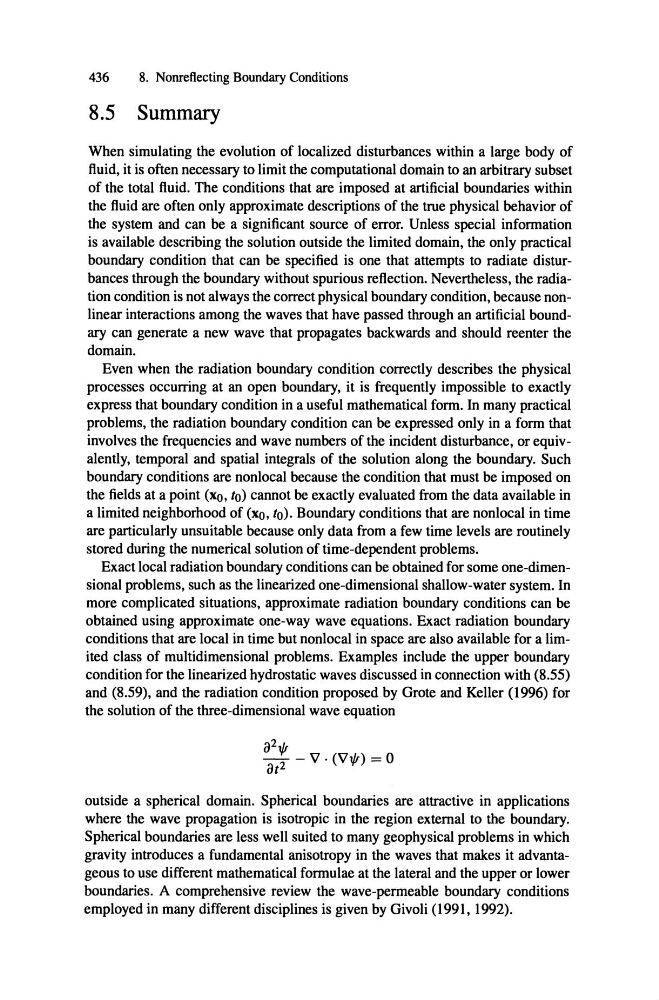
the solution of the three-dimensional wave equation
outside a spherieal domain . Spherical boundaries are attractive in applications
where the wave propagation is isotropie in the region extemal to the boundary.
Spherical boundaries are less weIl suited to many geophysical problems in whieh
gravity introduces a fundamental anisotropy in the waves that makes it advantageous to use different mathematieal formulae at the lateral and the upper or lower
boundaries. A comprehensive review the wave-permeable boundary conditions
employed in many different disciplines is given by Givoli (1991, 1992).
8. Nonreflecting Boundary Conditions
8.5 Summary
When simulating the evolution of localized disturbances within a large body of
fluid, it is often necessary to limit the computational domain to an arbitrary subset
of the total fluid. The conditions that are imposed at artificial boundaries within
the fluid are often only approximate descriptions of the true physieal behavior of
the system and can be a significant source of error. Unless special information
is available describing the solution outside the limited domain , the only practieal
boundary condition that can be specified is one that attempts to radiate disturbances through the boundary without spurious reflection . Nevertheless, the radiation condition is not always the correct physieal boundary condition , because nonlinear interactions among the waves that have passed through an artificial boundary can generate a new wave that propagates backwards and should reenter the
domain .
Even when the radiation boundary condition correctly describes the physieal
processes occurring at an open boundary, it is frequently impossible to exactly
express that boundary condition in a useful mathematieal form. In many practieal
problems, the radiation boundary condition can be expressed only in a form that
involves the frequencies and wave numbers of the incident disturbance, or equivalently, temporal and spatial integrals of the solution along the boundary. Such
boundary conditions are nonlocal because the condition that must be imposed on
the fields at a point (xo. to) cannot be exactly evaluated from the data available in
a limited neighborhood of (xo,to). Boundary conditions that are nonlocal in time
are partieularly unsuitable because only data from a few time levels are routinely
stored during the numerical solution of time-dependent problems.
Exact local radiation boundary conditions can be obtained for some one-dimensional problems, such as the linearized one-dimensional shallow-water system . In
more complicated situations, approximate radiation boundary conditions can be
obtained using approximate one-way wave equations. Exact radiation boundary
conditions that are local in time but nonlocal in space are also available for a limited class of multidimensional problems. Examples include the upper boundary
condition for the linearized hydrostatie waves discussed in connection with (8.55)
and (8.59), and the radiation condition proposed by Grote and Keller (1996) for
the solution of the three-dimensional wave equation
outside a spherieal domain . Spherical boundaries are attractive in applications
where the wave propagation is isotropie in the region extemal to the boundary.
Spherical boundaries are less weIl suited to many geophysical problems in whieh
gravity introduces a fundamental anisotropy in the waves that makes it advantageous to use different mathematieal formulae at the lateral and the upper or lower
boundaries. A comprehensive review the wave-permeable boundary conditions
employed in many different disciplines is given by Givoli (1991, 1992).