

8.4 Wave-Absorbing Layers
433
cous damping (v > 0, R = 0) because the erroneous backward reflection induced
by the Rayleigh damping is less scale dependent than that generated by viscous
damping. Israeli and Orszag also suggested that superior results could be obtained
by using a wave-absorbing layer in combination with a one-way wave equation
at the actual boundary. When using both techniques in combination, the one-way
wave equation must be modified to account for the dissipation near the boundary.
For example, an approximate one-way wave equation for the right-moving wave
supported by (8.65) and (8.66) with v = 0 and R constant is
au au
-+c-=--u.
R
(8.67)
at ax
2
The problem considered by Israeli and Orszag is somewhat special in that it can
be numerically integrated without specifying any boundary conditions for 11. If a
mean current were present, so that the unapproximated linear system is described
by (8.2), then numerical boundary conditions would also be required for 11 in order
to evaluate U a11/ ax. The specification of 11 at the boundary where the mean wind
is directed inward, together with specification of u at each boundary, will lead
to an overdetermined problem. Nevertheless, Davies (1976 , 1983) has suggested
that wave-absorbing layers can have considerable practical utility even when they
require overspecification of the boundary conditions.
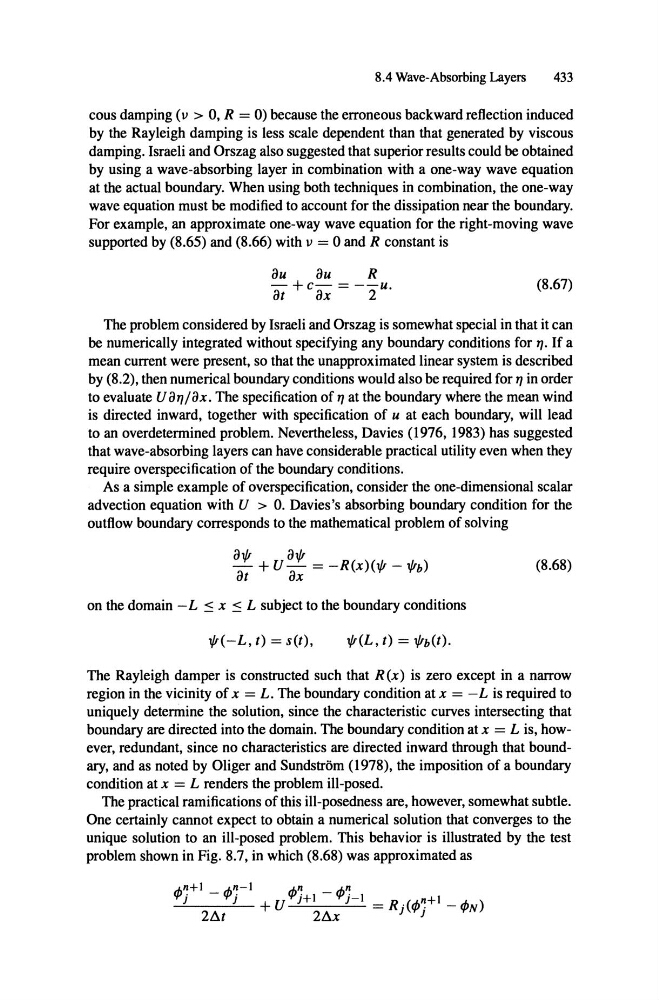
As a simple example of overspecification, consider the one-dimensional scalar
advection equation with U > O. Davies's absorbing boundary condition for the
outflow boundary corresponds to the mathematical problem of solving
-
ay,
aY,
+ U - = - R (x ) (y, -Y,b)
at
ax
(8.68)
on the domain - L :s x :s L subject to the boundary conditions
y,(-L, t) = s(t) ,
The Rayleigh damper is constructed such that R (x) is zero except in a narrow
region in the vicinity of x = L. The boundary condition at x = -L is required to
uniquely determine the solution, since the characteristic curves intersecting that
boundary are directed into the domain . The boundary condition at x = L is, however, redundant, since no characteristics are directed inward through that boundary, and as noted by Oliger and Sundström (1978), the imposition of a boundary
condition at x = L renders the problem ill-posed.
The practical ramifications ofthis ill-posedness are, however, somewhat subtle.
One certainly cannot expect to obtain a numerical solution that converges to the
unique solution to an ill-posed problem . This behavior is illustrated by the test
problem shown in Fig. 8.7, in which (8.68) was approximated as
433
cous damping (v > 0, R = 0) because the erroneous backward reflection induced
by the Rayleigh damping is less scale dependent than that generated by viscous
damping. Israeli and Orszag also suggested that superior results could be obtained
by using a wave-absorbing layer in combination with a one-way wave equation
at the actual boundary. When using both techniques in combination, the one-way
wave equation must be modified to account for the dissipation near the boundary.
For example, an approximate one-way wave equation for the right-moving wave
supported by (8.65) and (8.66) with v = 0 and R constant is
au au
-+c-=--u.
R
(8.67)
at ax
2
The problem considered by Israeli and Orszag is somewhat special in that it can
be numerically integrated without specifying any boundary conditions for 11. If a
mean current were present, so that the unapproximated linear system is described
by (8.2), then numerical boundary conditions would also be required for 11 in order
to evaluate U a11/ ax. The specification of 11 at the boundary where the mean wind
is directed inward, together with specification of u at each boundary, will lead
to an overdetermined problem. Nevertheless, Davies (1976 , 1983) has suggested
that wave-absorbing layers can have considerable practical utility even when they
require overspecification of the boundary conditions.
As a simple example of overspecification, consider the one-dimensional scalar
advection equation with U > O. Davies's absorbing boundary condition for the
outflow boundary corresponds to the mathematical problem of solving
-
ay,
aY,
+ U - = - R (x ) (y, -Y,b)
at
ax
(8.68)
on the domain - L :s x :s L subject to the boundary conditions
y,(-L, t) = s(t) ,
The Rayleigh damper is constructed such that R (x) is zero except in a narrow
region in the vicinity of x = L. The boundary condition at x = -L is required to
uniquely determine the solution, since the characteristic curves intersecting that
boundary are directed into the domain . The boundary condition at x = L is, however, redundant, since no characteristics are directed inward through that boundary, and as noted by Oliger and Sundström (1978), the imposition of a boundary
condition at x = L renders the problem ill-posed.
The practical ramifications ofthis ill-posedness are, however, somewhat subtle.
One certainly cannot expect to obtain a numerical solution that converges to the
unique solution to an ill-posed problem . This behavior is illustrated by the test
problem shown in Fig. 8.7, in which (8.68) was approximated as