

432
8. Nonreflecting Boundary Conditions
sorbing layer is largely determined by the vertical profile of the artificial viscosity
a(z) and the total absorbing-Iayer depth D. The total viscosity in the absorbing
layer must be sufficient to dissipate a wave before it has time to propagate upward
through the absorbing layer, reflect off the rigid upper boundary, and travel back
down through the depth of the layer. It might, therefore, appear advantageous
simply to set a to the maximum value permitted by the stability constraints of
the finite-difference scheme. Reflections will also occur, however, when a wave
encounters a rapid change in the propagation characteristics of its medium, and
as a consequence, reflection will be produced if the artificial viscosity increases
too rapidly with height. The only way to make the total damping within the wave
absorber large while keeping the gradient of a(z) small is to use a relatively thick
wave-absorbing layer.
The reflectivity of a wave-absorbing layer also depends on the characteristics of
the incident wave. Klemp and Lilly (1978) examined the reflections produced by
a wave-absorbing layer at the upper boundary in a problem where hydrostatic vertically propagating gravity waves were generated by continuously stratified flow
over topography. They found that although a very thin absorbing layer could be
tuned to efficiently remove a single horizontal wave number, considerably deeper
layers were required to uniformly minimize the reflection over a broad range of
wave numbers. In order to ensure that the absorbing layer was sufficiently deep,
and to guarantee that the numerical solution was adequately resolved within the
wave-absorbing layer, Klemp and Lilly devoted the entire upper half of their computational domain to the absorber. The efficiency of their numerical model could
have been increased by a factor of two if the wave-absorbing layer had been replaced with the radiation upper boundary condition described in the preceding
section.
The finding that effective wave-absorbing layers must often be rather thick is
also supported by Israeli and Orszag (1981), who examined both viscous and
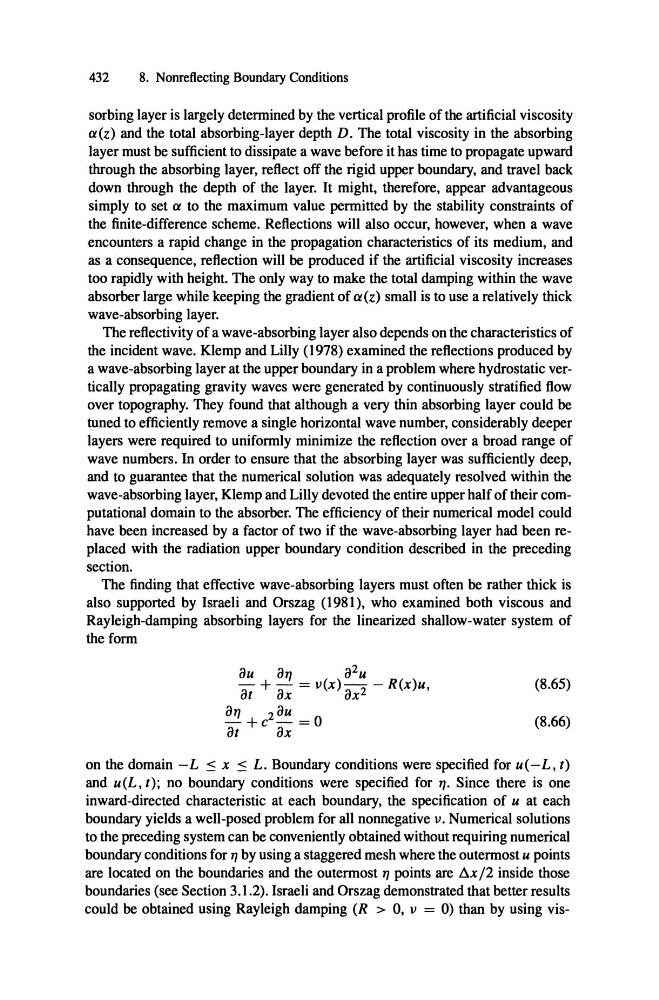
Rayleigh-damping absorbing layers for the linearized shallow-water system of
the form
(8.65)
(8.66)
ou
-
011
+ -
02u
ot ox
= v(x)- -
ox 2 R(x)u,
011 + c2ou = 0
ot
ox
on the domain -L :5 x :5 L. Boundary conditions were specified for u(-L, t)
and u(L, t); no boundary conditions were specified for 11. Since there is one
inward-directed characteristic at each boundary, the specification of u at each
boundary yields a well-posed problem for all nonnegative v. Numerical solutions
to the preceding system can be conveniently obtained without requiring numerical
boundary conditions for 11 by using a staggered mesh where the outermost u points
are located on the boundaries and the outermost 11 points are 6.x /2 inside those
boundaries (see Section 3.1.2) . Israeli and Orszag demonstrated that better results
could be obtained using Rayleigh damping (R > 0, v = 0) than by using vis-
8. Nonreflecting Boundary Conditions
sorbing layer is largely determined by the vertical profile of the artificial viscosity
a(z) and the total absorbing-Iayer depth D. The total viscosity in the absorbing
layer must be sufficient to dissipate a wave before it has time to propagate upward
through the absorbing layer, reflect off the rigid upper boundary, and travel back
down through the depth of the layer. It might, therefore, appear advantageous
simply to set a to the maximum value permitted by the stability constraints of
the finite-difference scheme. Reflections will also occur, however, when a wave
encounters a rapid change in the propagation characteristics of its medium, and
as a consequence, reflection will be produced if the artificial viscosity increases
too rapidly with height. The only way to make the total damping within the wave
absorber large while keeping the gradient of a(z) small is to use a relatively thick
wave-absorbing layer.
The reflectivity of a wave-absorbing layer also depends on the characteristics of
the incident wave. Klemp and Lilly (1978) examined the reflections produced by
a wave-absorbing layer at the upper boundary in a problem where hydrostatic vertically propagating gravity waves were generated by continuously stratified flow
over topography. They found that although a very thin absorbing layer could be
tuned to efficiently remove a single horizontal wave number, considerably deeper
layers were required to uniformly minimize the reflection over a broad range of
wave numbers. In order to ensure that the absorbing layer was sufficiently deep,
and to guarantee that the numerical solution was adequately resolved within the
wave-absorbing layer, Klemp and Lilly devoted the entire upper half of their computational domain to the absorber. The efficiency of their numerical model could
have been increased by a factor of two if the wave-absorbing layer had been replaced with the radiation upper boundary condition described in the preceding
section.
The finding that effective wave-absorbing layers must often be rather thick is
also supported by Israeli and Orszag (1981), who examined both viscous and
Rayleigh-damping absorbing layers for the linearized shallow-water system of
the form
(8.65)
(8.66)
ou
-
011
+ -
02u
ot ox
= v(x)- -
ox 2 R(x)u,
011 + c2ou = 0
ot
ox
on the domain -L :5 x :5 L. Boundary conditions were specified for u(-L, t)
and u(L, t); no boundary conditions were specified for 11. Since there is one
inward-directed characteristic at each boundary, the specification of u at each
boundary yields a well-posed problem for all nonnegative v. Numerical solutions
to the preceding system can be conveniently obtained without requiring numerical
boundary conditions for 11 by using a staggered mesh where the outermost u points
are located on the boundaries and the outermost 11 points are 6.x /2 inside those
boundaries (see Section 3.1.2) . Israeli and Orszag demonstrated that better results
could be obtained using Rayleigh damping (R > 0, v = 0) than by using vis-