

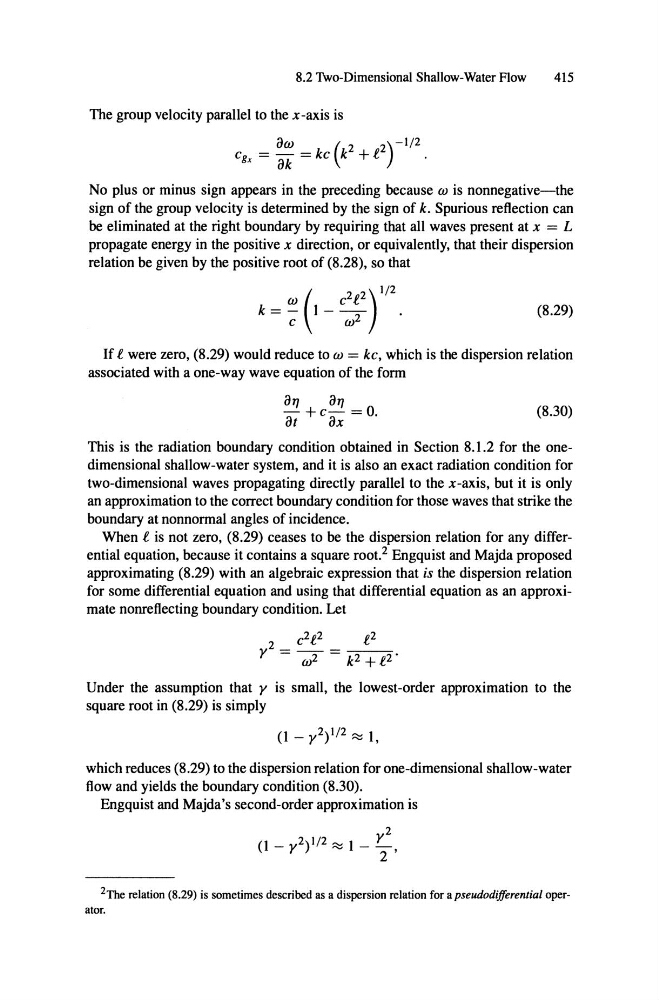
415
8.2 Two-Dimensional ShaIlow-Water Flow
The group velocity parallel to the x-axis is
Cgx =
Bca
ak = kc
(2
k + l
2)-1/2 .
No plus or minus sign appears in the preceding because w is nonnegative-the
sign of the group velocity is determined by the sign of k. Spurious reflection can
be eliminated at the right boundary by requiring that all waves present at x = L
propagate energy in the positive x direction, or equivalently, that their dispersion
relation be given by the positive root of (8.28), so that
w
k=c (
cl 2 2)1/2
1 - -
w 2
(8.29)
If l were zero, (8.29) would reduce to co = kc, which is the dispersion relation
associated with a one-way wave equation of the form
OTJ
aTJ
-+c- =0.
at ax
(8.30)
This is the radiation boundary condition obtained in Section 8.1.2 for the onedimensional shallow-water system, and it is also an exact radiation condition for
two-dimensional waves propagating directly parallel to the x-axis, but it is only
an approximation to the correct boundary condition for those waves that strike the
boundary at nonnormal angles of incidence.
When l is not zero, (8.29) ceases to be the dispersion relation for any differential equation, because it contains a square root .? Engquist and Majda proposed
approximating (8.29) with an algebraic expression that is the dispersion relation
for some differential equation and using that differential equation as an approximate nonreflecting boundary condition. Let
2 _ c
2 1
2 _ _ l_2_
y - w2 - k2 + 12 .
Under the assumption that y is smalI , the lowest-ordcr approximation to the
square root in (8.29) is simply
which reduces (8.29) to the dispersion relation for one-dimensional shallow-water
flow and yields the boundary condition (8.30).
Engquist and Majda's second-order approximation is
2
(l - y2)1 /2
1 -
,
2The relation (8.29) is sometimes described as a dispersion relation for a pseudodifferential operator.
8.2 Two-Dimensional ShaIlow-Water Flow
The group velocity parallel to the x-axis is
Cgx =
Bca
ak = kc
(2
k + l
2)-1/2 .
No plus or minus sign appears in the preceding because w is nonnegative-the
sign of the group velocity is determined by the sign of k. Spurious reflection can
be eliminated at the right boundary by requiring that all waves present at x = L
propagate energy in the positive x direction, or equivalently, that their dispersion
relation be given by the positive root of (8.28), so that
w
k=c (
cl 2 2)1/2
1 - -
w 2
(8.29)
If l were zero, (8.29) would reduce to co = kc, which is the dispersion relation
associated with a one-way wave equation of the form
OTJ
aTJ
-+c- =0.
at ax
(8.30)
This is the radiation boundary condition obtained in Section 8.1.2 for the onedimensional shallow-water system, and it is also an exact radiation condition for
two-dimensional waves propagating directly parallel to the x-axis, but it is only
an approximation to the correct boundary condition for those waves that strike the
boundary at nonnormal angles of incidence.
When l is not zero, (8.29) ceases to be the dispersion relation for any differential equation, because it contains a square root .? Engquist and Majda proposed
approximating (8.29) with an algebraic expression that is the dispersion relation
for some differential equation and using that differential equation as an approximate nonreflecting boundary condition. Let
2 _ c
2 1
2 _ _ l_2_
y - w2 - k2 + 12 .
Under the assumption that y is smalI , the lowest-ordcr approximation to the
square root in (8.29) is simply
which reduces (8.29) to the dispersion relation for one-dimensional shallow-water
flow and yields the boundary condition (8.30).
Engquist and Majda's second-order approximation is
2
(l - y2)1 /2
1 -
,
2The relation (8.29) is sometimes described as a dispersion relation for a pseudodifferential operator.