

8.1 One-Dimensional Flow
399
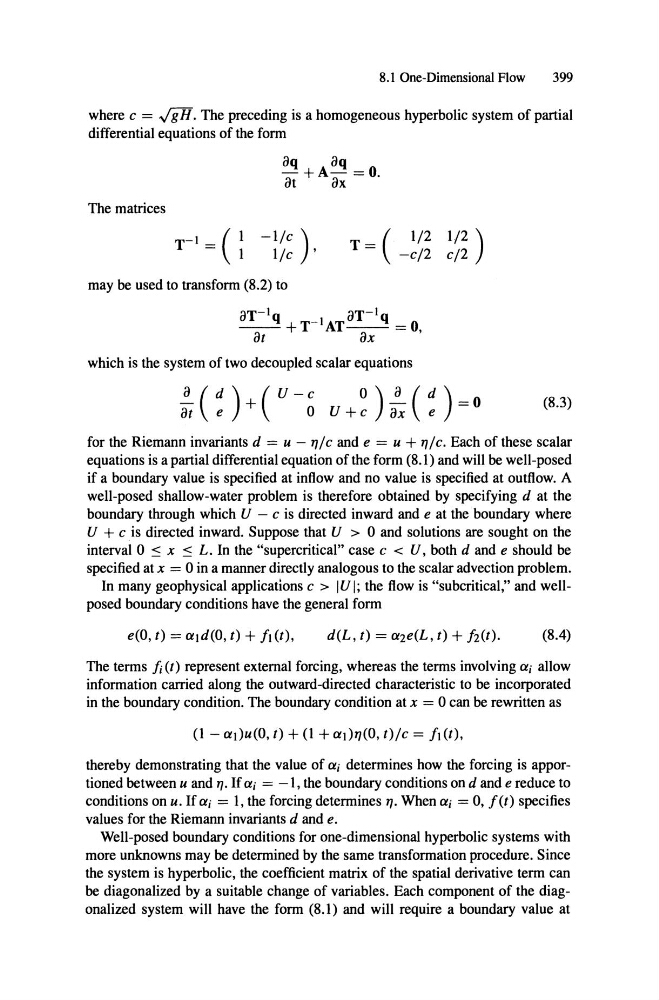
where e = JgH. The preeeding is a homogeneous hyperbolie system of partial
differential equations of the form
aq
aq
- + A - =0.
at
ax
The matriees
T- 1 _
-
1
1
(
-I/e)
l/e '
-e/2 e/2
T=(
1/2 1/2)
may be used to transform (8.2) to
aT-1q +T-IATaT-lq =0,
at
ax
which is the system of two decoupled sealar equations
at e
0 V + e ax e -
(8.3)
for the Riemann invariants d = u - TI/e and e = u + TI/e. Each of these scalar
equations is a partial differential equation ofthe form (8.1) and will be well-posed
if a boundary value is specified at inflow and no value is specified at outflow. A
well-posed shallow -water problem is therefore obtained by specifying d at the
boundary through whieh V - e is directed inward and e at the boundary where
V + e is directed inward. Suppose that V > 0 and solutions are sought on the
interval 0
x
L. In the "supercritical" case e < V , both d and e should be
specified at x = 0 in a manner directly analogous to the scalar adveetion problem.
In many geophysical applications e > lVI; the flow is "subcritical," and wellposed boundary eonditions have the general form
e(O, I) = Clld(O, t) + JI (I),
d(L, t) = Cl2e(L, t) + 12(1).
(8.4)
The terms fi (I) represent extemal forcing , whereas the terms involving a; allow
information carried along the outward-directed charaeteristic to be ineorporated
in the boundary condition. The boundary eondition at x = 0 can be rewritten as
(l - ClI)U(O, t) + (1 + ClI)TI(O, n/e = JI (1),
thereby demonstrating that the value of a, determines how the forcing is apportioned between U and 1J. If Clj = -1, the boundary conditions on d and e reduce to
conditions on u , If a; = 1, the forcing determines 1J. When a, = 0, J(I) specifies
values for the Riemann invariants d and e.
Well-posed boundary conditions for one-dimensional hyperbolic systems with
more unknowns may be determined by the same transformation procedure. Since
the system is hyperbolic, the coefficient matrix of the spatial derivative term can
be diagonalized by a suitable change of variables. Each component of the diagonalized system will have the form (8.1) and will require a boundary value at
399
where e = JgH. The preeeding is a homogeneous hyperbolie system of partial
differential equations of the form
aq
aq
- + A - =0.
at
ax
The matriees
T- 1 _
-
1
1
(
-I/e)
l/e '
-e/2 e/2
T=(
1/2 1/2)
may be used to transform (8.2) to
aT-1q +T-IATaT-lq =0,
at
ax
which is the system of two decoupled sealar equations
at e
0 V + e ax e -
(8.3)
for the Riemann invariants d = u - TI/e and e = u + TI/e. Each of these scalar
equations is a partial differential equation ofthe form (8.1) and will be well-posed
if a boundary value is specified at inflow and no value is specified at outflow. A
well-posed shallow -water problem is therefore obtained by specifying d at the
boundary through whieh V - e is directed inward and e at the boundary where
V + e is directed inward. Suppose that V > 0 and solutions are sought on the
interval 0
x
L. In the "supercritical" case e < V , both d and e should be
specified at x = 0 in a manner directly analogous to the scalar adveetion problem.
In many geophysical applications e > lVI; the flow is "subcritical," and wellposed boundary eonditions have the general form
e(O, I) = Clld(O, t) + JI (I),
d(L, t) = Cl2e(L, t) + 12(1).
(8.4)
The terms fi (I) represent extemal forcing , whereas the terms involving a; allow
information carried along the outward-directed charaeteristic to be ineorporated
in the boundary condition. The boundary eondition at x = 0 can be rewritten as
(l - ClI)U(O, t) + (1 + ClI)TI(O, n/e = JI (1),
thereby demonstrating that the value of a, determines how the forcing is apportioned between U and 1J. If Clj = -1, the boundary conditions on d and e reduce to
conditions on u , If a; = 1, the forcing determines 1J. When a, = 0, J(I) specifies
values for the Riemann invariants d and e.
Well-posed boundary conditions for one-dimensional hyperbolic systems with
more unknowns may be determined by the same transformation procedure. Since
the system is hyperbolic, the coefficient matrix of the spatial derivative term can
be diagonalized by a suitable change of variables. Each component of the diagonalized system will have the form (8.1) and will require a boundary value at