

398
8. Nonreflecting Boundary Conditions
o
o
x
L
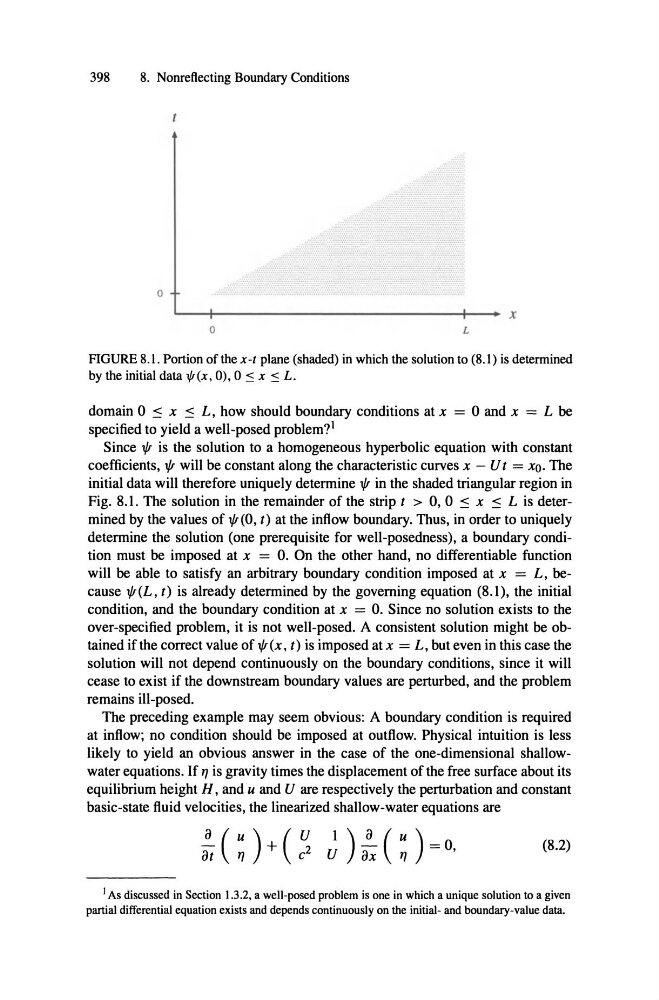
FIGURE8.1. Portionof the x-t plane (shaded) in which the solutionto (8.1) is detennined
by the initial data 1fJ(x, 0), 0 :s x :s L.
domain 0 :5 x :5 L, how should boundary conditions at x = 0 and x = L be
specified to yield a well -posed problernr!
Since 1/r is the solution to a homogeneous hyperbolic equation with constant
coefficients, 1/r will be constant along the characteristic curves x - U t = xo. The
initial data will therefore uniquely determine 1/r in the shaded triangular region in
Fig . 8.1. The solution in the remainder of the strip t > 0, 0 :5 x :5 L is determined by the values of 1/r(0, t) at the inflow boundary. Thus, in order to uniquely
determine the solution (one prerequisite for well-posedness), a boundary condition must be imposed at x = o. On the other hand, no differentiable function
will be able to satisfy an arbitrary boundary condition imposed at x = L, because 1/r(L, r) is already determined by the goveming equation (8.1), the initial
condition, and the boundary condition at x = o. Since no solution exists to the
over-specified problem, it is not well-posed, A consistent solution might be obtained ifthe correct value of 1/r(x, t) is imposed at x = L, but even in this case the
solution will not depend continuously on the boundary conditions, since it will
cease to exist if the downstream boundary values are perturbed, and the problem
remains ill-posed.
The preceding example may seem obvious: A boundary condition is required
at inflow; no condition should be imposed at outflow. Physical intuition is less
likely to yield an obvious answer in the case of the one-dimensional shallowwater equations. If TI is gravity times the displacement of the free surface about its
equilibrium height H, and u and U are respectively the perturbation and constant
basic-state fluid velocities, the linearized shallow-water equations are
l)!-(U)_o
(8.2)
lAs discussed in Section 1.3.2, a well-posed problem is one in which a unique solution to a given
partial differential equation exists and depends continuously on the initial- and boundary-value data.
öt
TI
c 2 U
öx
TI
- ,
8. Nonreflecting Boundary Conditions
o
o
x
L
FIGURE8.1. Portionof the x-t plane (shaded) in which the solutionto (8.1) is detennined
by the initial data 1fJ(x, 0), 0 :s x :s L.
domain 0 :5 x :5 L, how should boundary conditions at x = 0 and x = L be
specified to yield a well -posed problernr!
Since 1/r is the solution to a homogeneous hyperbolic equation with constant
coefficients, 1/r will be constant along the characteristic curves x - U t = xo. The
initial data will therefore uniquely determine 1/r in the shaded triangular region in
Fig . 8.1. The solution in the remainder of the strip t > 0, 0 :5 x :5 L is determined by the values of 1/r(0, t) at the inflow boundary. Thus, in order to uniquely
determine the solution (one prerequisite for well-posedness), a boundary condition must be imposed at x = o. On the other hand, no differentiable function
will be able to satisfy an arbitrary boundary condition imposed at x = L, because 1/r(L, r) is already determined by the goveming equation (8.1), the initial
condition, and the boundary condition at x = o. Since no solution exists to the
over-specified problem, it is not well-posed, A consistent solution might be obtained ifthe correct value of 1/r(x, t) is imposed at x = L, but even in this case the
solution will not depend continuously on the boundary conditions, since it will
cease to exist if the downstream boundary values are perturbed, and the problem
remains ill-posed.
The preceding example may seem obvious: A boundary condition is required
at inflow; no condition should be imposed at outflow. Physical intuition is less
likely to yield an obvious answer in the case of the one-dimensional shallowwater equations. If TI is gravity times the displacement of the free surface about its
equilibrium height H, and u and U are respectively the perturbation and constant
basic-state fluid velocities, the linearized shallow-water equations are
l)!-(U)_o
(8.2)
lAs discussed in Section 1.3.2, a well-posed problem is one in which a unique solution to a given
partial differential equation exists and depends continuously on the initial- and boundary-value data.
öt
TI
c 2 U
öx
TI
- ,