

where
1.2 Wave Equations in Geophysical Fluid Dynamies
25
where the hydrostatically balanced components of the Exner function pressure
and the potential temperature have been removed using (1.58) . The anelastic system can be derived from the pseudo-incompressible system by choosing a horizontally uniform hydrostatically balanced reference state, approximating the total
press ure gradient as cii\1rr', and neglecting d7f/dz in both (1.54) and the momentum equations. The same approximation can be obtained by a rigorous, if
somewhat delicate, scaling argument (Lipps 1990). The anelastic system consisting of equations (1.33), (1.52), and (1.64) provides a good approximation to the
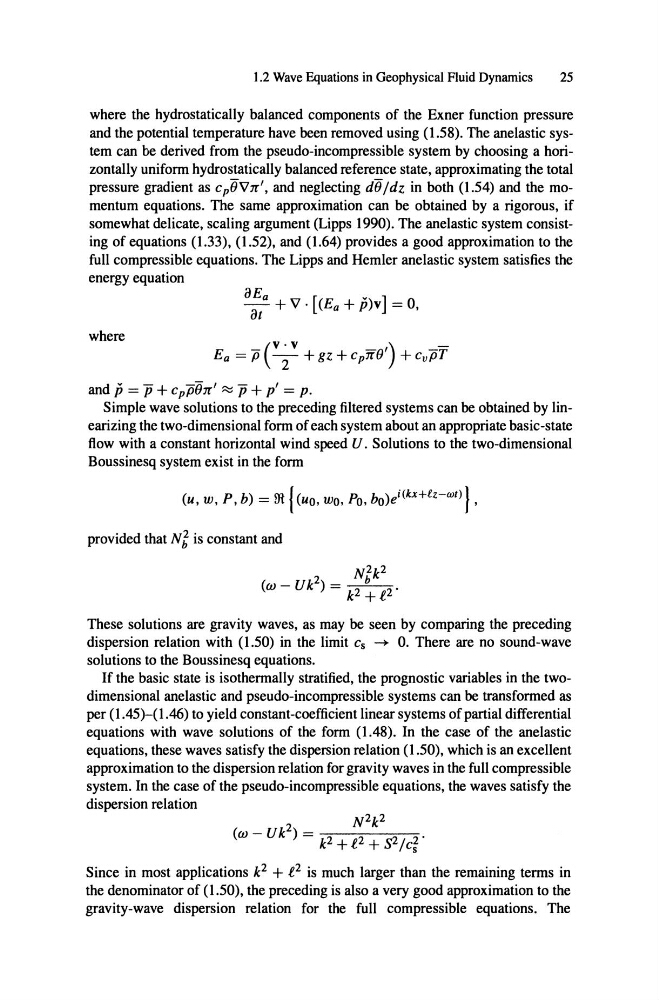
full compressible equations. The Lipps and Hemler anelastic system satisfies the
energy equation
-+\1 . (Ea+p)v V]
es,
[
=0,
at
Ea = P 2
V , v
(
+ gz + cp1f() ' ) -
+ cvpT
and p = p + cppOrr' :::::: p + p' = p.
Simple wave solutions to the preceding filtered systems can be obtained by linearizing the two-dimensional form of each system about an appropriate basic-state
flow with a constant horizontal wind speed U . Solutions to the two-dimensional
Boussinesq system exist in the form
(u, w, P , b) = m
in {( Uo, WO , p, 0, b) o e ,
i (kXH z- wt ) }
provided that N; is constant and
These solutions are gravity waves, as may be seen by comparing the preceding
dispersion relation with (1.50) in the limit C s
solutions to the Boussinesq equations.
O. There are no sound-wave
If the basic state is isothermally stratified, the prognostic variables in the twodimensional anelastic and pseudo-incompressible systems can be transformed as
per (1.45)-( 1.46) to yield constant-coefficient linear systems of partial differential
equations with wave solutions of the form (1.48). In the case of the anelastic
equations, these waves satisfy the dispersion relation (1.50), which is an excellent
approximation to the dispersion relation for gravity waves in the full compressible
system. In the case of the pseudo-incompressible equations, the waves satisfy the
dispersion relation
N
2k2
2
) = k2 +.e2 + Sl/cf
(w - Uk
Since in most applications k 2 + .e 2 is much larger than the remaining terms in
the denominator of (1.50), the preceding is also a very good approximation to the
gravity-wave dispersion relation for the full compressible equations. The
1.2 Wave Equations in Geophysical Fluid Dynamies
25
where the hydrostatically balanced components of the Exner function pressure
and the potential temperature have been removed using (1.58) . The anelastic system can be derived from the pseudo-incompressible system by choosing a horizontally uniform hydrostatically balanced reference state, approximating the total
press ure gradient as cii\1rr', and neglecting d7f/dz in both (1.54) and the momentum equations. The same approximation can be obtained by a rigorous, if
somewhat delicate, scaling argument (Lipps 1990). The anelastic system consisting of equations (1.33), (1.52), and (1.64) provides a good approximation to the
full compressible equations. The Lipps and Hemler anelastic system satisfies the
energy equation
-+\1 . (Ea+p)v V]
es,
[
=0,
at
Ea = P 2
V , v
(
+ gz + cp1f() ' ) -
+ cvpT
and p = p + cppOrr' :::::: p + p' = p.
Simple wave solutions to the preceding filtered systems can be obtained by linearizing the two-dimensional form of each system about an appropriate basic-state
flow with a constant horizontal wind speed U . Solutions to the two-dimensional
Boussinesq system exist in the form
(u, w, P , b) = m
in {( Uo, WO , p, 0, b) o e ,
i (kXH z- wt ) }
provided that N; is constant and
These solutions are gravity waves, as may be seen by comparing the preceding
dispersion relation with (1.50) in the limit C s
solutions to the Boussinesq equations.
O. There are no sound-wave
If the basic state is isothermally stratified, the prognostic variables in the twodimensional anelastic and pseudo-incompressible systems can be transformed as
per (1.45)-( 1.46) to yield constant-coefficient linear systems of partial differential
equations with wave solutions of the form (1.48). In the case of the anelastic
equations, these waves satisfy the dispersion relation (1.50), which is an excellent
approximation to the dispersion relation for gravity waves in the full compressible
system. In the case of the pseudo-incompressible equations, the waves satisfy the
dispersion relation
N
2k2
2
) = k2 +.e2 + Sl/cf
(w - Uk
Since in most applications k 2 + .e 2 is much larger than the remaining terms in
the denominator of (1.50), the preceding is also a very good approximation to the
gravity-wave dispersion relation for the full compressible equations. The