

24
l. Introduction
where the perturbation density continues to be defined as p - p(z) (rather than
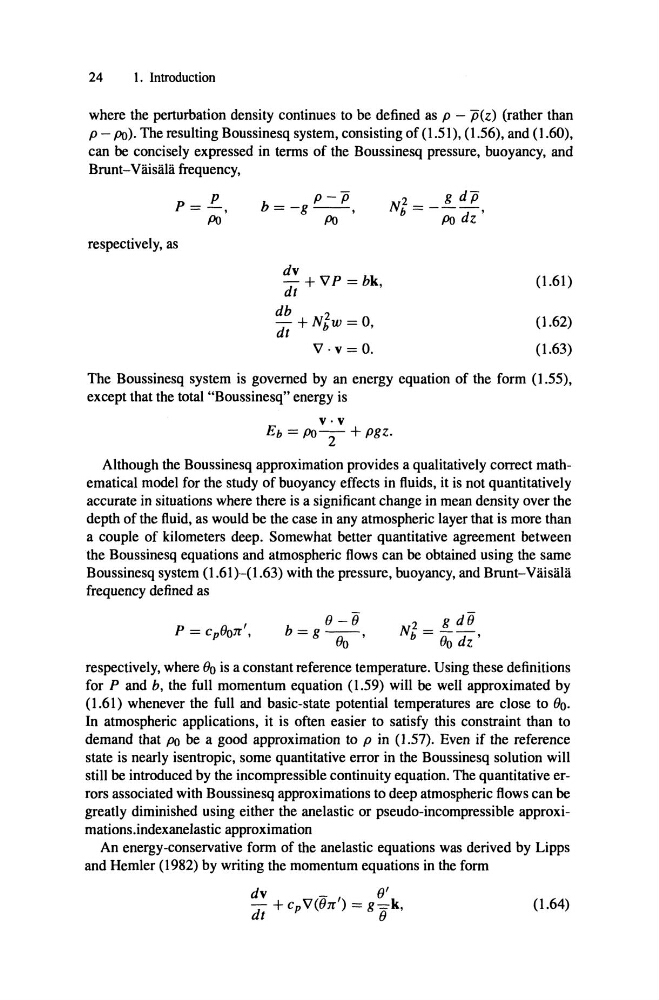
p - Po). The resulting Boussinesq system, consisting of (1.51), (1.56), and (1.60),
can be concisely expressed in terms of the Boussinesq pressure, buoyancy, and
Brunt-Väisälä frequency,
p
P=-,
Po
respectively, as
p-p
b=-g--,
Po
2
g dp
Nb = - - - ,
dv
-+VP =bk,
dt
db
2
dt +Nbw=O,
V ·v=O.
(1.61 )
(1.62)
(1.63)
The Boussinesq system is govemed by an energy equation of the form (1.55) ,
except that the total "Boussinesq" energy is
v ·v
Eb = PoT + pg«.
Although the Boussinesq approximation provides a qualitatively correct mathematical model for the study of buoyancy effects in fluids, it is not quantitatively
accurate in situations where there is a significant change in mean density over the
depth of the fluid, as would be the case in any atmospheric layer that is more than
a couple of kilometers deep . Somewhat better quantitative agreement between
the Boussinesq equations and atmospheric flows can be obtained using the same
Boussinesq system (1.61)-(1.63) with the pressure, buoyancy, and Brunt-Väisälä
frequency defined as
P = cpOon' ,
O-B
b=g--,
00
2
g dB
Nb = - - ,
00 dz
respectively, where 00 is a constant reference temperature. Using these definitions
for P and b, the full momentum equation (1.59) will be weIl approximated by
(1.61) whenever the full and basic -state potential temperatures are elose to 00.
In atmospheric applications, it is often easier to satisfy this constraint than to
demand that Po be a good approximation to p in (1.57). Even if the reference
state is nearly isentropic, some quantitative error in the Boussinesq solution will
still be introduced by the incompressible continuity equation. The quantitative errors associated with Boussinesq approximations to deep atmospheric flows can be
greatly diminished using either the anelastic or pseudo-incompressible approximations.indexanelastic approximation
An energy-conservative form of the anelastic equations was derived by Lipps
and Hemler (1982) by writing the momentum equations in the form
dv
- ,
0'
-d + -»V(On ) = g=k,
t
e
(1.64)
l. Introduction
where the perturbation density continues to be defined as p - p(z) (rather than
p - Po). The resulting Boussinesq system, consisting of (1.51), (1.56), and (1.60),
can be concisely expressed in terms of the Boussinesq pressure, buoyancy, and
Brunt-Väisälä frequency,
p
P=-,
Po
respectively, as
p-p
b=-g--,
Po
2
g dp
Nb = - - - ,
dv
-+VP =bk,
dt
db
2
dt +Nbw=O,
V ·v=O.
(1.61 )
(1.62)
(1.63)
The Boussinesq system is govemed by an energy equation of the form (1.55) ,
except that the total "Boussinesq" energy is
v ·v
Eb = PoT + pg«.
Although the Boussinesq approximation provides a qualitatively correct mathematical model for the study of buoyancy effects in fluids, it is not quantitatively
accurate in situations where there is a significant change in mean density over the
depth of the fluid, as would be the case in any atmospheric layer that is more than
a couple of kilometers deep . Somewhat better quantitative agreement between
the Boussinesq equations and atmospheric flows can be obtained using the same
Boussinesq system (1.61)-(1.63) with the pressure, buoyancy, and Brunt-Väisälä
frequency defined as
P = cpOon' ,
O-B
b=g--,
00
2
g dB
Nb = - - ,
00 dz
respectively, where 00 is a constant reference temperature. Using these definitions
for P and b, the full momentum equation (1.59) will be weIl approximated by
(1.61) whenever the full and basic -state potential temperatures are elose to 00.
In atmospheric applications, it is often easier to satisfy this constraint than to
demand that Po be a good approximation to p in (1.57). Even if the reference
state is nearly isentropic, some quantitative error in the Boussinesq solution will
still be introduced by the incompressible continuity equation. The quantitative errors associated with Boussinesq approximations to deep atmospheric flows can be
greatly diminished using either the anelastic or pseudo-incompressible approximations.indexanelastic approximation
An energy-conservative form of the anelastic equations was derived by Lipps
and Hemler (1982) by writing the momentum equations in the form
dv
- ,
0'
-d + -»V(On ) = g=k,
t
e
(1.64)