

362
7. PhysicallyInsignificant Fast Waves
using forward-backward differencing, in which case the stability criterion for the
small time step would include an additional term proportional to c.L Ilr , where
L is the maximum resolvable vertical wave number. It may be appropriate to use
fotward-backward differencing instead of the trapezoidal scheme in applications
with identical vertical and horizontal grid spacing, but if the vertical resolution is
much finer than the horizontal resolution, the additional stability constraint imposed by vertical sound-wave propagation will reduce efficiency by requiring an
excessive number of small time steps.
The performance of the preceding scheme is evaluated in a problem involving
flow past a compact gravity-wave generator. The wave generator is modeled by
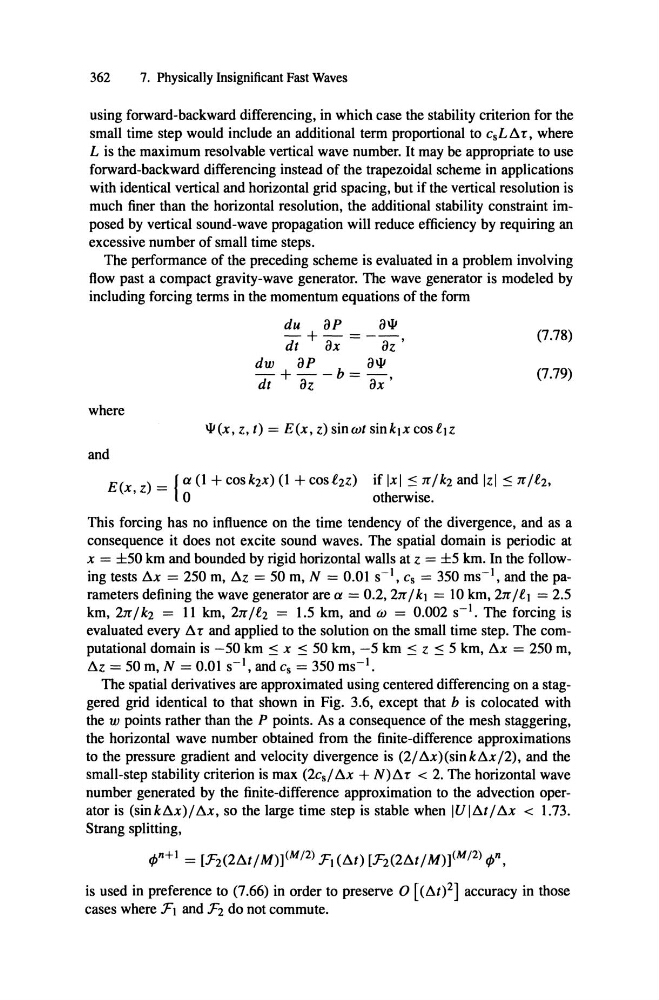
including forcing terms in the momentum equations of the form
du
OP
0\11
- + - = - - ,
dw
dt
OP
ox
oz
0\11
- + - - b = - ,
dt
oz
ox
\I1(x,z,t) = E(x,z)sinwtsinklxcosllz
where
(7.78)
(7.79)
and
E(x, z) = {fX
O
Cl + cos k2 X ) Cl + COSl2Z) if [x] s n / k2 and lzl s rr/h
otherwise.
This forcing has no influence on the time tendency of the divergence, and as a
consequence it does not excite sound waves. The spatial domain is periodic at
x = ±50 km and bounded by rigid horizontal walls at z = ±5 km. In the following tests Ilx = 250 m, Ilz = 50 m, N = 0.01 s", Cs = 350 ms " , and the parameters defining the wave generator are a = 0.2, 2rr/ kl = 10 km, 2rr/ II = 2.5
km,2rr/k2 = II km,2rr/l2 = 1.5 km, and Cl) = 0.002 s", The forcing is
evaluated every Ilr and applied to the solution on the small time step. The computational domain is -50 km :s x :s 50 km, -5 km :s z :s 5 km, Ilx = 250 m,
Ilz = 50 m, N = 0.01 s-I, and es = 350 ms-I .
The spatial derivatives are approximated using centered differencing on a staggered grid identical to that shown in Fig. 3.6, except that b is colocated with
the w points rather than the P points . As a consequence of the mesh staggering,
the horizontal wave number obtained from the finite-difference approximations
to the pressure gradient and velocity divergence is (2/llx)(sinkllx/2), and the
small-step stability criterion is max (2c s / Ilx + N)1l r < 2. The horizontal wave
number generated by the finite-difference approximation to the advection operator is (sinkllx)/Ilx, so the large time step is stable when IUlllt/llx < 1.73.
Strang splitting,
rP
n
+ 1 = [F2(2Ilt/ M)](M/2) FI (Ilt) [F2(2Ilt/ M)](M/2) rP n ,
is used in preference to (7.66) in order to preserve 0 [(!lt)2] accuracy in those
cases where FI and F2 do not commute.
7. PhysicallyInsignificant Fast Waves
using forward-backward differencing, in which case the stability criterion for the
small time step would include an additional term proportional to c.L Ilr , where
L is the maximum resolvable vertical wave number. It may be appropriate to use
fotward-backward differencing instead of the trapezoidal scheme in applications
with identical vertical and horizontal grid spacing, but if the vertical resolution is
much finer than the horizontal resolution, the additional stability constraint imposed by vertical sound-wave propagation will reduce efficiency by requiring an
excessive number of small time steps.
The performance of the preceding scheme is evaluated in a problem involving
flow past a compact gravity-wave generator. The wave generator is modeled by
including forcing terms in the momentum equations of the form
du
OP
0\11
- + - = - - ,
dw
dt
OP
ox
oz
0\11
- + - - b = - ,
dt
oz
ox
\I1(x,z,t) = E(x,z)sinwtsinklxcosllz
where
(7.78)
(7.79)
and
E(x, z) = {fX
O
Cl + cos k2 X ) Cl + COSl2Z) if [x] s n / k2 and lzl s rr/h
otherwise.
This forcing has no influence on the time tendency of the divergence, and as a
consequence it does not excite sound waves. The spatial domain is periodic at
x = ±50 km and bounded by rigid horizontal walls at z = ±5 km. In the following tests Ilx = 250 m, Ilz = 50 m, N = 0.01 s", Cs = 350 ms " , and the parameters defining the wave generator are a = 0.2, 2rr/ kl = 10 km, 2rr/ II = 2.5
km,2rr/k2 = II km,2rr/l2 = 1.5 km, and Cl) = 0.002 s", The forcing is
evaluated every Ilr and applied to the solution on the small time step. The computational domain is -50 km :s x :s 50 km, -5 km :s z :s 5 km, Ilx = 250 m,
Ilz = 50 m, N = 0.01 s-I, and es = 350 ms-I .
The spatial derivatives are approximated using centered differencing on a staggered grid identical to that shown in Fig. 3.6, except that b is colocated with
the w points rather than the P points . As a consequence of the mesh staggering,
the horizontal wave number obtained from the finite-difference approximations
to the pressure gradient and velocity divergence is (2/llx)(sinkllx/2), and the
small-step stability criterion is max (2c s / Ilx + N)1l r < 2. The horizontal wave
number generated by the finite-difference approximation to the advection operator is (sinkllx)/Ilx, so the large time step is stable when IUlllt/llx < 1.73.
Strang splitting,
rP
n
+ 1 = [F2(2Ilt/ M)](M/2) FI (Ilt) [F2(2Ilt/ M)](M/2) rP n ,
is used in preference to (7.66) in order to preserve 0 [(!lt)2] accuracy in those
cases where FI and F2 do not commute.