

354
7. Physically Insignificant Fast Waves
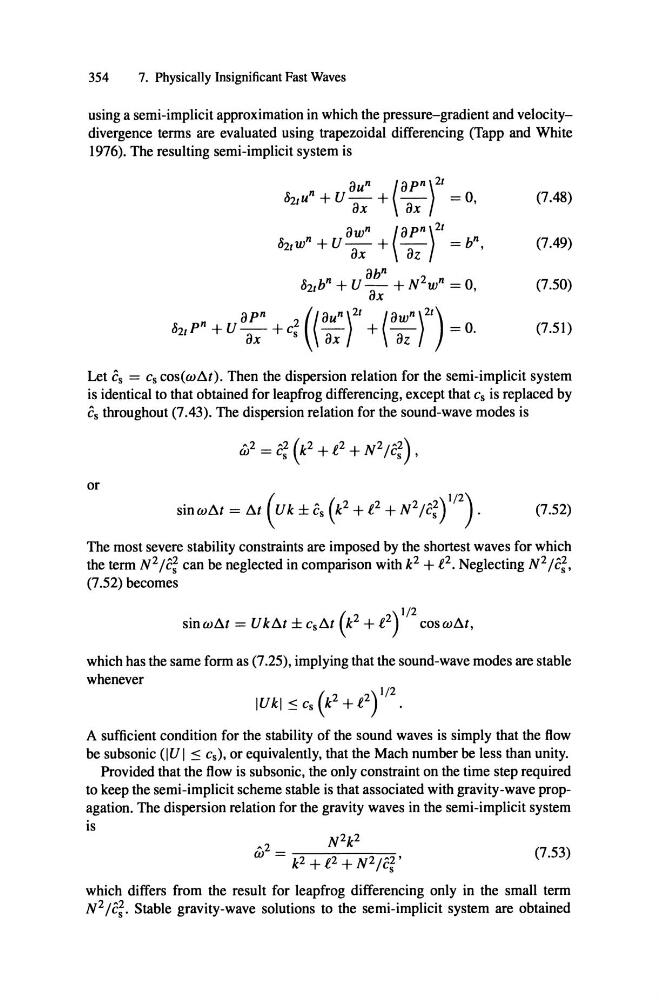
using a semi-implicit approximation in which the pressure-gradient and velocitydivergence terms are evaluated using trapezoidal differencing (Tapp and White
1976). The resulting semi-implicit system is
(7.48)
(7.49)
(7.50)
(7.51)
Let Cs = C s cos(wL\t). Then the dispersion relation for the semi-implicit system
is identical to that obtained for leapfrog differencing, except that C s is replaced by
Cs throughout (7.43). The dispersion relation for the sound-wave modes is
or
sinwL\t = L\t (Vk ± Cs (k 2 + l2 + N2Ic;Y /2).
(7.52)
The most severe stability constraints are imposed by the shortest waves for which
the term N 2 1c; can be neglected in comparison with k 2 + l2. Neglecting N 2 1c;,
(7.52) becomes
sinwL\t = Uk S: ± csL\t k 2 + l2
(
)
1/ 2 coswL\t,
which has the same form as (7.25), implying that the sound-wave modes are stable
whenever
A sufficient condition for the stability of the sound waves is simply that the flow
be subsonic (IV I ::; cs), or equivalently, that the Mach number be less than unity.
Provided that the flow is subsonic, the only constraint on the time step required
to keep the semi-implicit scheme stable is that associated with gravity-wave propagation. The dispersion relation for the gravity waves in the serni-implicit system
is
N 2k2
(J} = k2+ l2 + N21cf
(7.53)
which differs from the result for leapfrog differencing only in the small term
N2Ic;. Stable gravity-wave solutions to the semi-implicit system are obtained
7. Physically Insignificant Fast Waves
using a semi-implicit approximation in which the pressure-gradient and velocitydivergence terms are evaluated using trapezoidal differencing (Tapp and White
1976). The resulting semi-implicit system is
(7.48)
(7.49)
(7.50)
(7.51)
Let Cs = C s cos(wL\t). Then the dispersion relation for the semi-implicit system
is identical to that obtained for leapfrog differencing, except that C s is replaced by
Cs throughout (7.43). The dispersion relation for the sound-wave modes is
or
sinwL\t = L\t (Vk ± Cs (k 2 + l2 + N2Ic;Y /2).
(7.52)
The most severe stability constraints are imposed by the shortest waves for which
the term N 2 1c; can be neglected in comparison with k 2 + l2. Neglecting N 2 1c;,
(7.52) becomes
sinwL\t = Uk S: ± csL\t k 2 + l2
(
)
1/ 2 coswL\t,
which has the same form as (7.25), implying that the sound-wave modes are stable
whenever
A sufficient condition for the stability of the sound waves is simply that the flow
be subsonic (IV I ::; cs), or equivalently, that the Mach number be less than unity.
Provided that the flow is subsonic, the only constraint on the time step required
to keep the semi-implicit scheme stable is that associated with gravity-wave propagation. The dispersion relation for the gravity waves in the serni-implicit system
is
N 2k2
(J} = k2+ l2 + N21cf
(7.53)
which differs from the result for leapfrog differencing only in the small term
N2Ic;. Stable gravity-wave solutions to the semi-implicit system are obtained