

7.2 The Semi-irnplicit Method
353
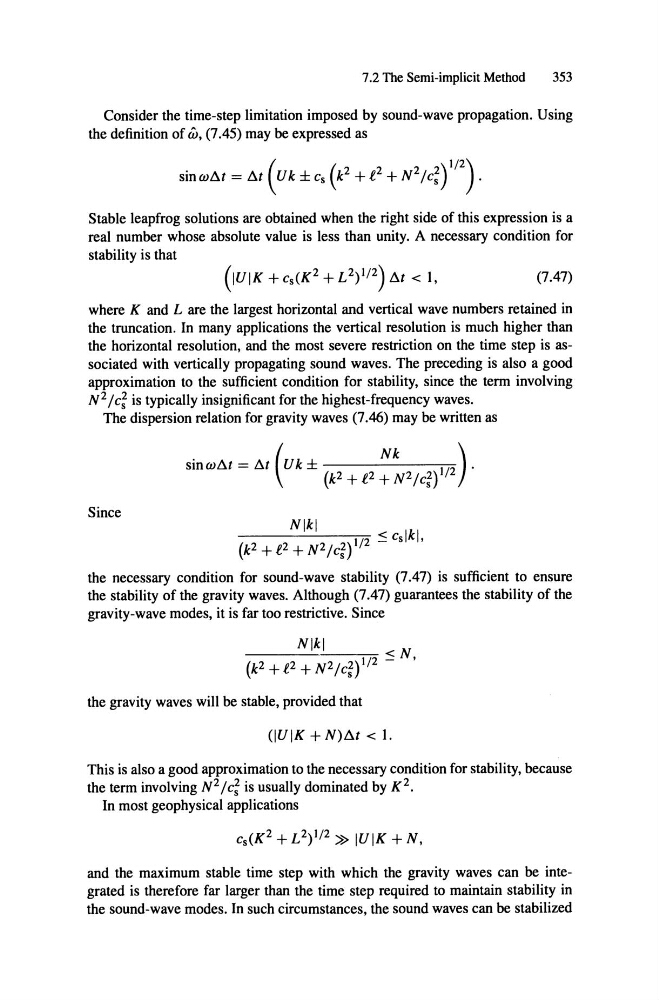
Consider the time-step limitation imposed by sound-wave propagation. Using
the definition of W, (7.45) may be expressed as
Stable leapfrog solutions are obtained when the right side of this expression is a
real number whose absolute value is less than unity. A necessary condition for
stability is that
(7.47)
where K and L are the largest horizontal and vertical wave numbers retained in
the truncation. In many applications the vertical resolution is much higher than
the horizontal resolution, and the most severe restriction on the time step is associated with vertically propagating sound waves. The preceding is also a good
approximation to the sufficient condition for stability, since the term involving
N
2
/e; is typically insignificant for the highest-frequency waves.
The dispersion relation for gravity waves (7.46) may be written as
sinw/)"t = /)"t (Uk ±
(k 2 + e 2 + N2/en
Nk
1/2) .
Since
(k2 + e2 + N2/ en
N lkl
1/2
s eslkl,
the necessary condition for sound-wave stability (7.47) is sufficient to ensure
the stability of the gravity waves. Although (7.47) guarantees the stability of the
gravity-wave modes, it is far too restrictive. Since
the gravity waves will be stable, provided that
(lU IK + N)/)"t < 1.
This is also a good approximation to the necessary condition fOT stability, because
the term involving N 2 / e; is usually dominated by K 2 .
In most geophysical applications
and the maximum stable time step with which the gravity waves can be integrated is therefore far larger than the time step required to maintain stability in
the sound-wave modes. In such circumstances , the sound waves can be stabilized
353
Consider the time-step limitation imposed by sound-wave propagation. Using
the definition of W, (7.45) may be expressed as
Stable leapfrog solutions are obtained when the right side of this expression is a
real number whose absolute value is less than unity. A necessary condition for
stability is that
(7.47)
where K and L are the largest horizontal and vertical wave numbers retained in
the truncation. In many applications the vertical resolution is much higher than
the horizontal resolution, and the most severe restriction on the time step is associated with vertically propagating sound waves. The preceding is also a good
approximation to the sufficient condition for stability, since the term involving
N
2
/e; is typically insignificant for the highest-frequency waves.
The dispersion relation for gravity waves (7.46) may be written as
sinw/)"t = /)"t (Uk ±
(k 2 + e 2 + N2/en
Nk
1/2) .
Since
(k2 + e2 + N2/ en
N lkl
1/2
s eslkl,
the necessary condition for sound-wave stability (7.47) is sufficient to ensure
the stability of the gravity waves. Although (7.47) guarantees the stability of the
gravity-wave modes, it is far too restrictive. Since
the gravity waves will be stable, provided that
(lU IK + N)/)"t < 1.
This is also a good approximation to the necessary condition fOT stability, because
the term involving N 2 / e; is usually dominated by K 2 .
In most geophysical applications
and the maximum stable time step with which the gravity waves can be integrated is therefore far larger than the time step required to maintain stability in
the sound-wave modes. In such circumstances , the sound waves can be stabilized