

338
7. Physically Insignificant Fast Waves
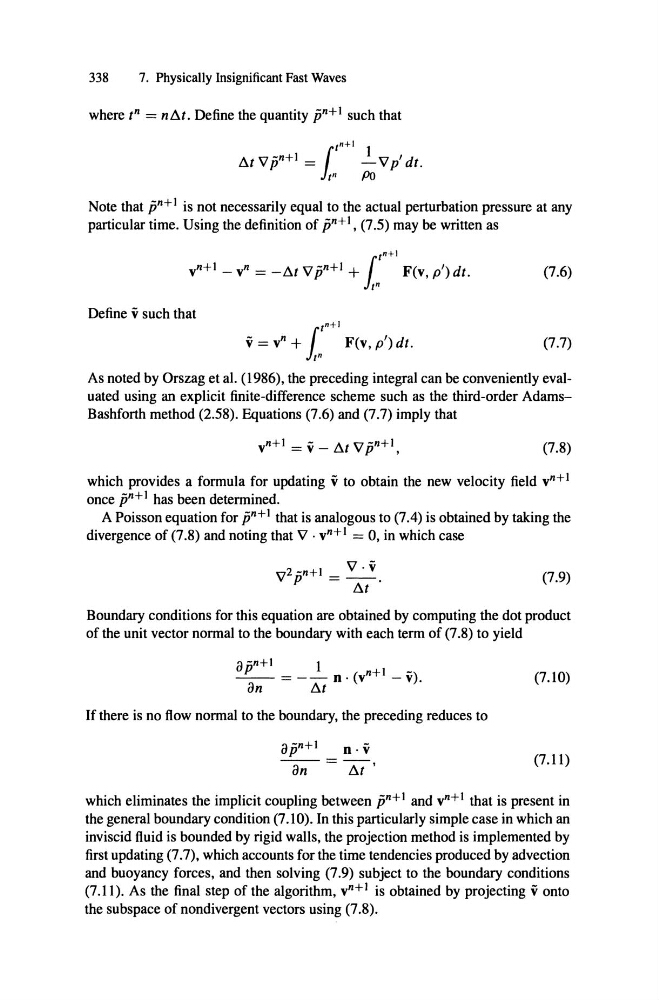
where t" = n St . Define the quantity ßn+l such that
,"+1 I
t::.t 'Vßn+l = 1 -'Vp' dt .
,"
Po
Note that r:
1 is not necessarily equal to the actual perturbation press ure at any
particular time. Using the definition of ßn+!, (7.5) may be written as
+1 ,"
," +1
yn+! _yn = -t::.t'Vßn+1
F(y,p')dt.
(7.6)
Define vsuch that
1 ,"
," + 1
V = yn +
F(y , p') dt .
(7.7)
As noted by Orszag et aI. (1986), the preceding integral can be conveniently evaluated using an explicit finite-difference scheme such as the third-order AdamsBashforth method (2.58) . Equations (7.6) and (7.7) imply that
yn+ I = V _ t::.t 'Vßn+! ,
(7.8)
which provides a formula for updating vto obtain the new velocity field yn+ 1
once ßn+I has been determined.
A Poisson equation for ßn+l that is analogous to (7.4) is obtained by taking the
divergence of (7.8) and noting that 'V . yn+! = 0, in which case
=
'V. V
- - .
t::.t
02 -n+1
v p
(7.9)
Boundary conditions for this equation are obtained by computing the dot product
of the unit vector normal to the boundary with each term of (7.8) to yield
a -n+l
I
- - = - - n · (v
p
n+l - v) .
-
an
t::.t
(7.10)
If there is no flow normal to the boundary, the preceding reduces to
aßn+!
an
n·v
= t::.t '
(7.11)
which eliminates the implicit coupling between ßn+1 and yn+! that is present in
the general boundary condition (7. I0). In this particularly simple case in which an
inviscid fluid is bounded by rigid walls, the projection method is implemented by
first updating (7.7), which accounts for the time tendencics produced by advection
and buoyancy forces, and then solving (7.9) subject to the boundary conditions
(7.1 I). As the final step of the algorithm, yn+! is obtained by projecting vonto
the subspace ofnondivergent vectors using (7.8).
7. Physically Insignificant Fast Waves
where t" = n St . Define the quantity ßn+l such that
,"+1 I
t::.t 'Vßn+l = 1 -'Vp' dt .
,"
Po
Note that r:
1 is not necessarily equal to the actual perturbation press ure at any
particular time. Using the definition of ßn+!, (7.5) may be written as
+1 ,"
," +1
yn+! _yn = -t::.t'Vßn+1
F(y,p')dt.
(7.6)
Define vsuch that
1 ,"
," + 1
V = yn +
F(y , p') dt .
(7.7)
As noted by Orszag et aI. (1986), the preceding integral can be conveniently evaluated using an explicit finite-difference scheme such as the third-order AdamsBashforth method (2.58) . Equations (7.6) and (7.7) imply that
yn+ I = V _ t::.t 'Vßn+! ,
(7.8)
which provides a formula for updating vto obtain the new velocity field yn+ 1
once ßn+I has been determined.
A Poisson equation for ßn+l that is analogous to (7.4) is obtained by taking the
divergence of (7.8) and noting that 'V . yn+! = 0, in which case
=
'V. V
- - .
t::.t
02 -n+1
v p
(7.9)
Boundary conditions for this equation are obtained by computing the dot product
of the unit vector normal to the boundary with each term of (7.8) to yield
a -n+l
I
- - = - - n · (v
p
n+l - v) .
-
an
t::.t
(7.10)
If there is no flow normal to the boundary, the preceding reduces to
aßn+!
an
n·v
= t::.t '
(7.11)
which eliminates the implicit coupling between ßn+1 and yn+! that is present in
the general boundary condition (7. I0). In this particularly simple case in which an
inviscid fluid is bounded by rigid walls, the projection method is implemented by
first updating (7.7), which accounts for the time tendencics produced by advection
and buoyancy forces, and then solving (7.9) subject to the boundary conditions
(7.1 I). As the final step of the algorithm, yn+! is obtained by projecting vonto
the subspace ofnondivergent vectors using (7.8).