

332
6. Semi-Lagrangian Methods
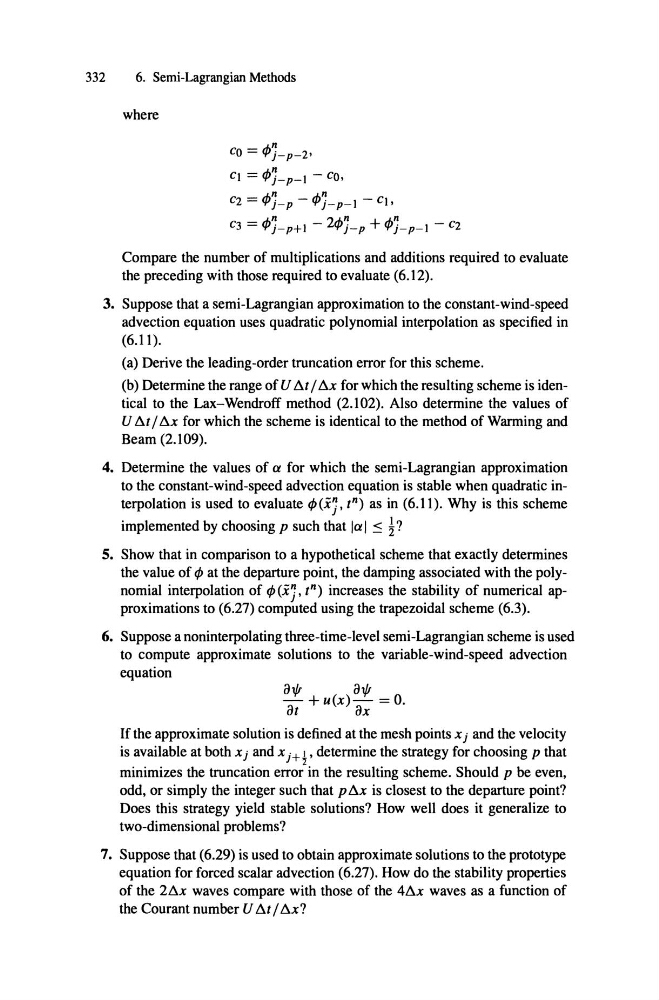
where
_ ,J,n
Co - 'f' j-p-2 '
CI = rPi-p-1 - Co,
C
2
'f'J-P
- 'f'J-p-1
-
C I,
C3 = 'f'J-P+ I - 'f'J-P + 'f'J-P- I - C2
Compare the number of multiplications and additions required to evaluate
the preceding with those required to evaluate (6.12) .
3. Suppose that a semi-Lagrangian approximation to the constant-wind-speed
advection equation uses quadratic polynomial interpolation as specified in
(6.11).
(a) Derive the leading-order truncation error for this scheme.
(b) Determine the range of U l:i.t / Sx for which the resulting scheme is identical to the Lax-Wendroff method (2.102). Also determine the values of
U !!.t / !!.x for which the scheme is identical to the method of Warming and
Beam (2.109).
4. Determine the values of a for which the serni-Lagrangian approximation
to the constant-wind-speed advection equation is stable when quadratic interpolation is used to evaluate rP(xi, t") as in (6.11). Why is this scheme
implemented by choosing p such that laI !?
5. Show that in comparison to a hypothetical scheme that exactly determines
the va1ueof 4J at the departure point, the damping associated with the polynomial interpolation of rP(xi, r") increases the stability of numerical approximations to (6.27) computed using the trapezoidal scheme (6.3).
6. Suppose a noninterpolating three-tirne-level semi-Lagrangian scheme is used
to compute approximate solutions to the variable-wind-speed advection
equation
a1/J + u(x) a1/J = o.
at
ax
If the approximate solution is defined at the mesh points x j and the velocity
is available at both x j and x j+ determine the strategy for choosing p that
minimizes the truncation error in the resulting scheme. Should p be even,
odd, or simply the integer such that p Sx is closest to the departure point?
Does this strategy yield stable solutions? How weIl does it generalize to
two-dimensional problems?
7. Suppose that (6.29) is used to obtain approximate solutions to the prototype
equation for forced scalar advection (6.27). How do the stability properties
of the 2!!.x waves compare with those of the 4!!.x waves as a function of
the Courant number U !!.t / tsx'!
6. Semi-Lagrangian Methods
where
_ ,J,n
Co - 'f' j-p-2 '
CI = rPi-p-1 - Co,
C
2
'f'J-P
- 'f'J-p-1
-
C I,
C3 = 'f'J-P+ I - 'f'J-P + 'f'J-P- I - C2
Compare the number of multiplications and additions required to evaluate
the preceding with those required to evaluate (6.12) .
3. Suppose that a semi-Lagrangian approximation to the constant-wind-speed
advection equation uses quadratic polynomial interpolation as specified in
(6.11).
(a) Derive the leading-order truncation error for this scheme.
(b) Determine the range of U l:i.t / Sx for which the resulting scheme is identical to the Lax-Wendroff method (2.102). Also determine the values of
U !!.t / !!.x for which the scheme is identical to the method of Warming and
Beam (2.109).
4. Determine the values of a for which the serni-Lagrangian approximation
to the constant-wind-speed advection equation is stable when quadratic interpolation is used to evaluate rP(xi, t") as in (6.11). Why is this scheme
implemented by choosing p such that laI !?
5. Show that in comparison to a hypothetical scheme that exactly determines
the va1ueof 4J at the departure point, the damping associated with the polynomial interpolation of rP(xi, r") increases the stability of numerical approximations to (6.27) computed using the trapezoidal scheme (6.3).
6. Suppose a noninterpolating three-tirne-level semi-Lagrangian scheme is used
to compute approximate solutions to the variable-wind-speed advection
equation
a1/J + u(x) a1/J = o.
at
ax
If the approximate solution is defined at the mesh points x j and the velocity
is available at both x j and x j+ determine the strategy for choosing p that
minimizes the truncation error in the resulting scheme. Should p be even,
odd, or simply the integer such that p Sx is closest to the departure point?
Does this strategy yield stable solutions? How weIl does it generalize to
two-dimensional problems?
7. Suppose that (6.29) is used to obtain approximate solutions to the prototype
equation for forced scalar advection (6.27). How do the stability properties
of the 2!!.x waves compare with those of the 4!!.x waves as a function of
the Courant number U !!.t / tsx'!