

Problems
331
ing is similar in both the Lagrangian and Eulerian reference frames occurs in those
shallow-water systems where the fluid velocities are much slower than the phase
speeds of the gravity waves. In such systems both semi-Lagrangian and Eulerian
methods must use essentially the same time step to accurately simulate the most
rapidly moving waves.
In some applications the fastest -moving waves are not physically significant,
and in these applications the semi-implicit approximation can be used to increase
the time step in the numerical integration. When used in conjunction with the
serni-implicit method, semi-Lagrangian schemes can be considerably more efficient than Eulerian methods. Semi-implicit semi-Lagrangian schemes have proved
particularly useful in global atmospheric modeling. Ritchie et aI. (1995) compared
Eulerian and semi-Lagrangian versions ofthe serni-implicit global forecast model
developed at the European Center for Medium Range Weather Forecasting and
reported that "the semi-Lagrangian version with a 15-minute time step gave an
accuracy equivalent to that of an Eulerian version with a 3-min time step, giving
an efficiency improvement of about a factor offour after allowing for the 20% ...
[overhead for] the semi-Lagrangian computations."
It should be emphasized that the fastest-moving waves in the shallow-water system are artificially decelerated whenever semi-implicit integrations are performed
using time steps significantly greater than those permitted by the CFL condition
for gravity waves. This loss of accuracy occurs in both Eulerian semi-implicit and
serni-Lagrangian semi -implicit models . In contrast, the increase in the time step
permitted in semi-Lagrangian approximations to the pure advection equation is
achieved without any inherent loss of accuracy because advective forcing generates a zero frequency response in the Lagrangian reference frame.
Problems
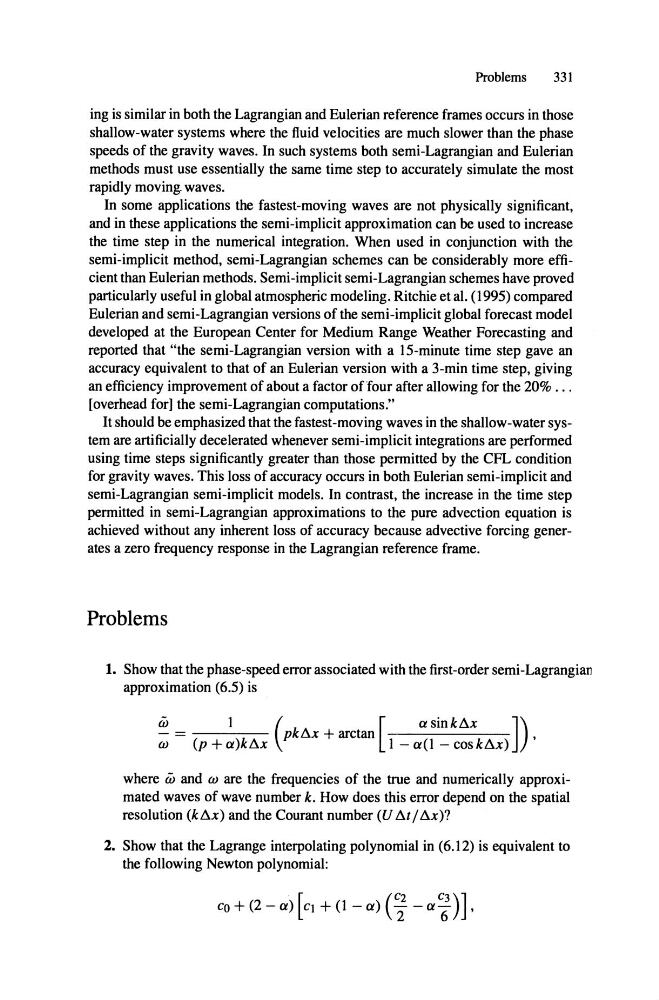
1. Show that the phase-speed error associated with the first-order semi-Lagrangian
approximation (6.5) is
- iiJ =
1
( pkSx + arctan [ClSinkßX
I - Cl(1 - coskßx)
J)
(t)
(p + Cl)kßx
,
where iiJ and co are the frequencies of the true and numerically approximated waves of wave number k. How does this error depend on the spatial
resolution (kßx) and the Courant number (U ßt/ ßX)?
2. Show that the Lagrange interpolating polynomial in (6.12) is equivalent to
the following Newton polynomial:
co + (2 - Cl) [CI + (1 - Cl)
- Cl ) ] ,
331
ing is similar in both the Lagrangian and Eulerian reference frames occurs in those
shallow-water systems where the fluid velocities are much slower than the phase
speeds of the gravity waves. In such systems both semi-Lagrangian and Eulerian
methods must use essentially the same time step to accurately simulate the most
rapidly moving waves.
In some applications the fastest -moving waves are not physically significant,
and in these applications the semi-implicit approximation can be used to increase
the time step in the numerical integration. When used in conjunction with the
serni-implicit method, semi-Lagrangian schemes can be considerably more efficient than Eulerian methods. Semi-implicit semi-Lagrangian schemes have proved
particularly useful in global atmospheric modeling. Ritchie et aI. (1995) compared
Eulerian and semi-Lagrangian versions ofthe serni-implicit global forecast model
developed at the European Center for Medium Range Weather Forecasting and
reported that "the semi-Lagrangian version with a 15-minute time step gave an
accuracy equivalent to that of an Eulerian version with a 3-min time step, giving
an efficiency improvement of about a factor offour after allowing for the 20% ...
[overhead for] the semi-Lagrangian computations."
It should be emphasized that the fastest-moving waves in the shallow-water system are artificially decelerated whenever semi-implicit integrations are performed
using time steps significantly greater than those permitted by the CFL condition
for gravity waves. This loss of accuracy occurs in both Eulerian semi-implicit and
serni-Lagrangian semi -implicit models . In contrast, the increase in the time step
permitted in semi-Lagrangian approximations to the pure advection equation is
achieved without any inherent loss of accuracy because advective forcing generates a zero frequency response in the Lagrangian reference frame.
Problems
1. Show that the phase-speed error associated with the first-order semi-Lagrangian
approximation (6.5) is
- iiJ =
1
( pkSx + arctan [ClSinkßX
I - Cl(1 - coskßx)
J)
(t)
(p + Cl)kßx
,
where iiJ and co are the frequencies of the true and numerically approximated waves of wave number k. How does this error depend on the spatial
resolution (kßx) and the Courant number (U ßt/ ßX)?
2. Show that the Lagrange interpolating polynomial in (6.12) is equivalent to
the following Newton polynomial:
co + (2 - Cl) [CI + (1 - Cl)
- Cl ) ] ,