

6.3 Systems of Equations
319
special case because tbe cbaracteristic curves are identical to tbe fluid parcel trajectories. The semi-Lagrangian method retains its simplicity and practical utility
in more complicated applications precisely because the evolution of the flow continues to be computed following fluid parcel trajectories. The classical method
of characteristics, on the other hand, becomes unwieldy or impossible in more
general problems where the evolution of the flow along the characteristic curves
may be more complicated or characteristic curves may not even be defined. As a
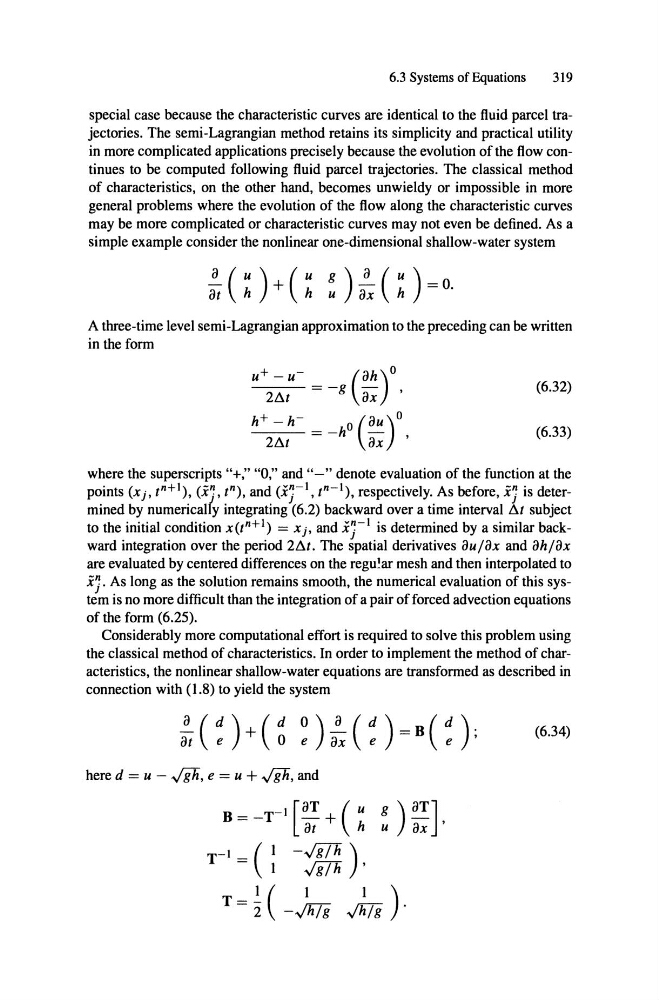
simple example consider the nonlinear one-dimensional shallow -water system
ot
h
h u OX
h - .
A three-time level semi-Lagrangian approximation to the preceding can be written
in the form
8h ) O
21:1t = -g ( 8x
h+ - h- = _ho (8U)O
21:1t
OX'
(6.32)
(6.33)
where the superscripts "+," "0," and "-" denote evaluation of the function at the
points (x], t n+ I ) , (x'! ,t n ) , and (ir I ,t n - I ) , respectively. As before , xi is determined by numerically integrating (6.2) backward over a time interval I:1t subject
to the initial condition x(t n +
l ) = Xj, and ir
l is determined by a similar backward integration over the period 21:1t. The spatial derivatives oujox and ohj8x
are evaluated by centered differences on the regular mesh and then interpolated to
xj. As long as the solution remains smooth, the numerical evaluation of this system is no more difficult than the integration of a pair of forced advection equations
of the form (6.25).
Considerably more computational effort is required to solve this problem using
the classical method of characteristics. In order to implement the method of characteristics, the nonlinear shallow-water equations are transformed as described in
connection with (1.8) to yield the system
(6.34)
8t
e
0 e
8x
e
-
e '
here d = u - ..jjJi, e = u + ..jjJi, and
B = _ T-I [8T + (u
ot
h
T- I =
g
u
(I -Jgj h )
Jgjh
I
'
T = (-Jhjg
319
special case because tbe cbaracteristic curves are identical to tbe fluid parcel trajectories. The semi-Lagrangian method retains its simplicity and practical utility
in more complicated applications precisely because the evolution of the flow continues to be computed following fluid parcel trajectories. The classical method
of characteristics, on the other hand, becomes unwieldy or impossible in more
general problems where the evolution of the flow along the characteristic curves
may be more complicated or characteristic curves may not even be defined. As a
simple example consider the nonlinear one-dimensional shallow -water system
ot
h
h u OX
h - .
A three-time level semi-Lagrangian approximation to the preceding can be written
in the form
8h ) O
21:1t = -g ( 8x
h+ - h- = _ho (8U)O
21:1t
OX'
(6.32)
(6.33)
where the superscripts "+," "0," and "-" denote evaluation of the function at the
points (x], t n+ I ) , (x'! ,t n ) , and (ir I ,t n - I ) , respectively. As before , xi is determined by numerically integrating (6.2) backward over a time interval I:1t subject
to the initial condition x(t n +
l ) = Xj, and ir
l is determined by a similar backward integration over the period 21:1t. The spatial derivatives oujox and ohj8x
are evaluated by centered differences on the regular mesh and then interpolated to
xj. As long as the solution remains smooth, the numerical evaluation of this system is no more difficult than the integration of a pair of forced advection equations
of the form (6.25).
Considerably more computational effort is required to solve this problem using
the classical method of characteristics. In order to implement the method of characteristics, the nonlinear shallow-water equations are transformed as described in
connection with (1.8) to yield the system
(6.34)
8t
e
0 e
8x
e
-
e '
here d = u - ..jjJi, e = u + ..jjJi, and
B = _ T-I [8T + (u
ot
h
T- I =
g
u
(I -Jgj h )
Jgjh
I
'
T = (-Jhjg