

294
5. Finite-Volume Methods
In contrast to the general FCT procedure, there is no initial step involving a loworder monotone scheme because it is not necessary to use a low-order solution
to estimate the permissible range of values for rp'tI . One simply sets rpjin = 0,
imposes no constraint on rpjax, and corrects the f1uxes to avoid generating values
less than rpt n • Clearly, it is possible to further generalize this procedure by setting
both -rand rpjax to any pair of arbitrarily specified constants.
5.8.2 Antidiffusion via Upstream Differencing
One unique way to obtain a positive definite advection scheme is to use upstream
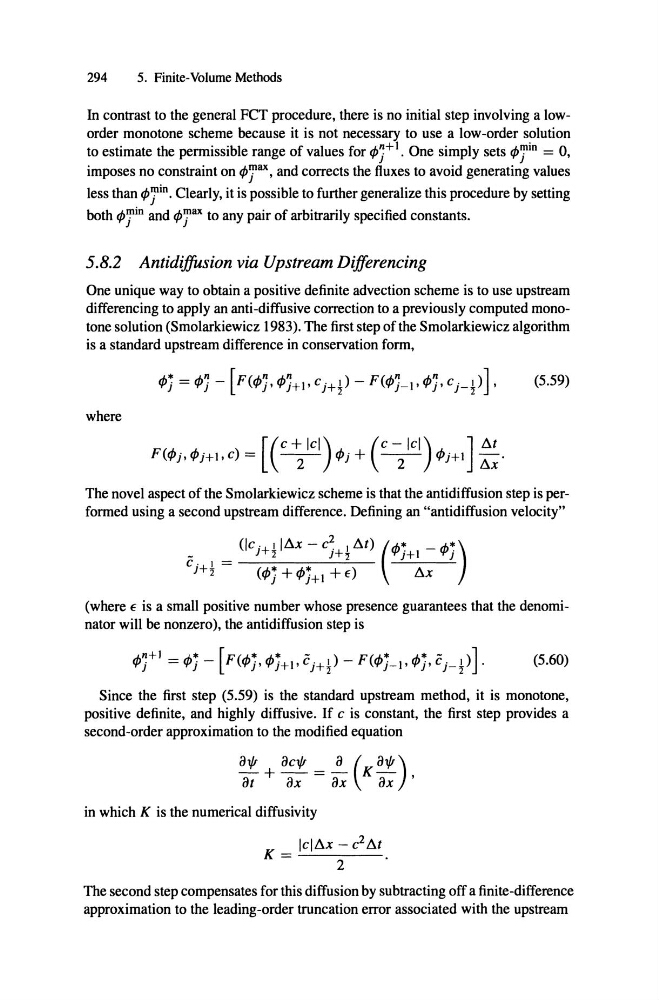
differencing to apply an anti-diffusive correction to a previously computed monotone solution (Smolarkiewicz 1983). The first step of the Smolarkiewicz algorithm
is a standard upstream difference in conservation form,
(5.59)
where
The novel aspect of the Smolarkiewicz scheme is that the antidiffusion step is performed using a second upstream difference. Defining an "antidiffusion velocity"
(where E is a small positive number whose presence guarantees that the denorninator will be nonzero), the antidiffusion step is
rp't' = rpj - [F(rpj, rpj+l'
- F(rpj_l' rpj,
(5.60)
Since the first step (5.59) is thc standard upstream method, it is monotone,
positive definite, and highly diffusive. If c is constant, the first step provides a
second-order approximation to the modified equation
in which K is the numerical diffusivity
The second step compensates for this diffusion by subtracting off a finite-difference
approximation to the leading-order truncation error associated with the upstream
5. Finite-Volume Methods
In contrast to the general FCT procedure, there is no initial step involving a loworder monotone scheme because it is not necessary to use a low-order solution
to estimate the permissible range of values for rp'tI . One simply sets rpjin = 0,
imposes no constraint on rpjax, and corrects the f1uxes to avoid generating values
less than rpt n • Clearly, it is possible to further generalize this procedure by setting
both -rand rpjax to any pair of arbitrarily specified constants.
5.8.2 Antidiffusion via Upstream Differencing
One unique way to obtain a positive definite advection scheme is to use upstream
differencing to apply an anti-diffusive correction to a previously computed monotone solution (Smolarkiewicz 1983). The first step of the Smolarkiewicz algorithm
is a standard upstream difference in conservation form,
(5.59)
where
The novel aspect of the Smolarkiewicz scheme is that the antidiffusion step is performed using a second upstream difference. Defining an "antidiffusion velocity"
(where E is a small positive number whose presence guarantees that the denorninator will be nonzero), the antidiffusion step is
rp't' = rpj - [F(rpj, rpj+l'
- F(rpj_l' rpj,
(5.60)
Since the first step (5.59) is thc standard upstream method, it is monotone,
positive definite, and highly diffusive. If c is constant, the first step provides a
second-order approximation to the modified equation
in which K is the numerical diffusivity
The second step compensates for this diffusion by subtracting off a finite-difference
approximation to the leading-order truncation error associated with the upstream