

5.8 Schemes for Positive Definite Advection
293
5.8.1 An FCT Approach
A much better approach can be obtained using flux-corrected transport. Depending on exactly how it is implemented, the standard FCT method gives an essentially monotone scheme. The general FCT algorithm can, however, be greatly
simplified if all that is required is a positive definite result. As noted by Smolarkiewicz (1989), any numerical conservation law ofthe form
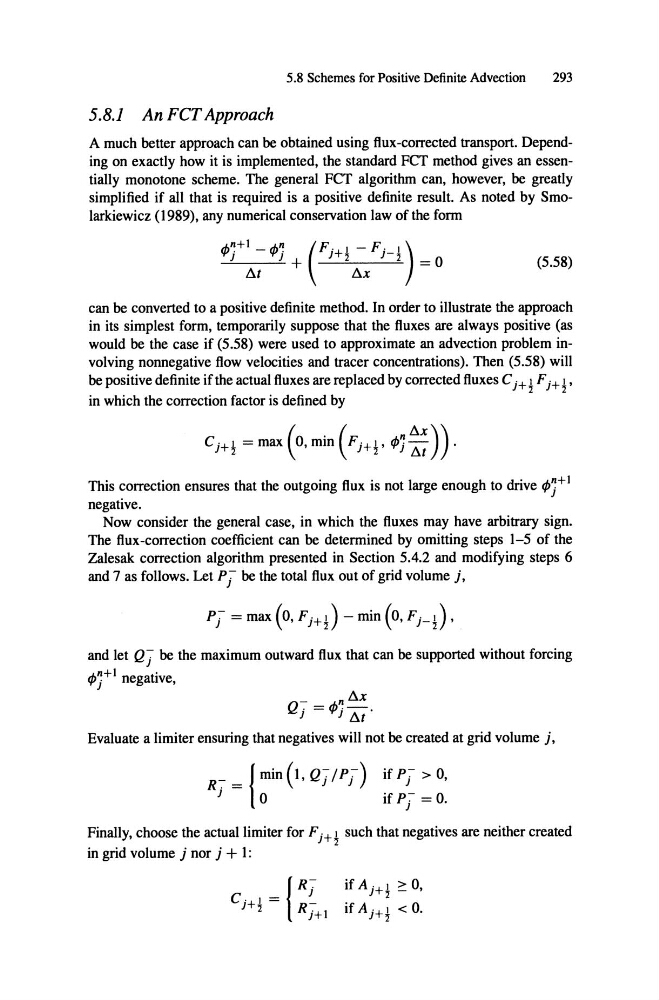
(5.58)
can be converted to a positive definite method. In order to illustrate the approach
in its simplest form, temporarily suppose that the fluxes are always positive (as
would be the case if (5.58) were used to approximate an advection problem involving nonnegative flow velocities and tracer concentrations). Then (5.58) will
be positive definite if the actual fluxes are replaced by corrected fluxes Cj+ i Fj+i '
in which the correction factor is defined by
Cj+ i
This correction ensures that the outgoing flux is not large enough to drive rt >' j+1
negative .
Now consider the general case, in which the fluxes may have arbitrary sign .
The flux-correction coefficient can be determined by omitting steps 1-5 of the
Zalesak correction algorithm presented in Section 5.4.2 and modifying steps 6
and 7 as folIows. Let Pj be the total flux out of grid volume j,
J
and let Qj be the maximum outward flux that can be supported without forcing
rt>, !+1 negative,
_
n d x
Qj = rt >rt;;·
Evaluate a limiter ensuring that negatives will not be created at grid volume j,
R-: = Imin ( 1 , o;/Pj) if P j
- > 0,
J
0
if P j
- = O.
Finally, choose the actuallimiter for
in grid volume j nor j + 1:
such that negatives are neither created
::: 0,
< O.
if A
if
293
5.8.1 An FCT Approach
A much better approach can be obtained using flux-corrected transport. Depending on exactly how it is implemented, the standard FCT method gives an essentially monotone scheme. The general FCT algorithm can, however, be greatly
simplified if all that is required is a positive definite result. As noted by Smolarkiewicz (1989), any numerical conservation law ofthe form
(5.58)
can be converted to a positive definite method. In order to illustrate the approach
in its simplest form, temporarily suppose that the fluxes are always positive (as
would be the case if (5.58) were used to approximate an advection problem involving nonnegative flow velocities and tracer concentrations). Then (5.58) will
be positive definite if the actual fluxes are replaced by corrected fluxes Cj+ i Fj+i '
in which the correction factor is defined by
Cj+ i
This correction ensures that the outgoing flux is not large enough to drive rt >' j+1
negative .
Now consider the general case, in which the fluxes may have arbitrary sign .
The flux-correction coefficient can be determined by omitting steps 1-5 of the
Zalesak correction algorithm presented in Section 5.4.2 and modifying steps 6
and 7 as folIows. Let Pj be the total flux out of grid volume j,
J
and let Qj be the maximum outward flux that can be supported without forcing
rt>, !+1 negative,
_
n d x
Qj = rt >rt;;·
Evaluate a limiter ensuring that negatives will not be created at grid volume j,
R-: = Imin ( 1 , o;/Pj) if P j
- > 0,
J
0
if P j
- = O.
Finally, choose the actuallimiter for
in grid volume j nor j + 1:
such that negatives are neither created
::: 0,
< O.
if A
if