

y
x
290
0.5
5. Finite-Volume Methods
(8)( -: ·
(b)
.05
x
/1
,:' 1j
"
.
j
0.5
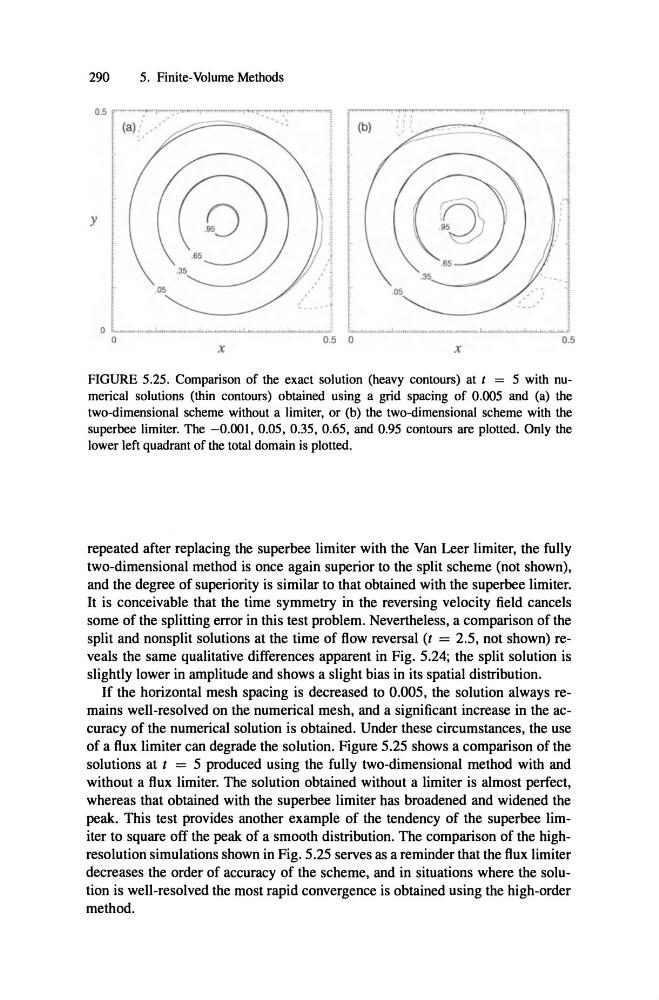
FIGURE 5.25. Comparison of the exact solution (heavy contours) at t
5 with numerical solutions (thin contours) obtained using a grid spacing of 0.005 and (a) the
two-dimensional scheme without a limiter, or (b) the two-dimensional scheme with the
superbee limiter. The -0.001,0.05, 0.35, 0.65, and 0.95 contours are plotted. Only the
lowerleft quadrant of the totaldomain is plotted.
repeated after replacing the superbee limiter with the Van Leer limiter, the fully
two-dimensional method is once again superior to the split scheme (not shown),
and the degree of superiority is similar to that obtained with the superbee limiter.
It is conceivable that the time symmetry in the reversing velocity field cancels
some of the splitting error in this test problem. Nevertheless, a comparison of the
split and nonsplit solutions at the time of flow reversal (t = 2.5, not shown) reveals the same qualitative differences apparent in Fig. 5.24; the split solution is
slightly lower in amplitude and shows a slight bias in its spatial distribution.
If the horizontal mesh spacing is decreased to 0.005, the solution always remains well-resolved on the numerical mesh, and a significant increase in the accuracy of the numerical solution is obtained. Under these circumstances, the use
of a flux limiter can degrade the solution. Figure 5.25 shows a comparison of the
solutions at t = 5 produced using the fully two-dimensional method with and
without a flux limiter. The solution obtained without a limiter is almost perfect,
whereas that obtained with the superbee limiter has broadened and widened the
peak . This test provides another example of the tendency of the superbee limiter to square off the peak of a smooth distribution. The comparison of the highresolution simulations shown in Fig. 5.25 serves as areminder that the flux limiter
decreases the order of accuracy of the scheme, and in situations where the solution is well-resolved the most rapid convergence is obtained using the high-order
method.
x
290
0.5
5. Finite-Volume Methods
(8)( -: ·
(b)
.05
x
/1
,:' 1j
"
.
j
0.5
FIGURE 5.25. Comparison of the exact solution (heavy contours) at t
5 with numerical solutions (thin contours) obtained using a grid spacing of 0.005 and (a) the
two-dimensional scheme without a limiter, or (b) the two-dimensional scheme with the
superbee limiter. The -0.001,0.05, 0.35, 0.65, and 0.95 contours are plotted. Only the
lowerleft quadrant of the totaldomain is plotted.
repeated after replacing the superbee limiter with the Van Leer limiter, the fully
two-dimensional method is once again superior to the split scheme (not shown),
and the degree of superiority is similar to that obtained with the superbee limiter.
It is conceivable that the time symmetry in the reversing velocity field cancels
some of the splitting error in this test problem. Nevertheless, a comparison of the
split and nonsplit solutions at the time of flow reversal (t = 2.5, not shown) reveals the same qualitative differences apparent in Fig. 5.24; the split solution is
slightly lower in amplitude and shows a slight bias in its spatial distribution.
If the horizontal mesh spacing is decreased to 0.005, the solution always remains well-resolved on the numerical mesh, and a significant increase in the accuracy of the numerical solution is obtained. Under these circumstances, the use
of a flux limiter can degrade the solution. Figure 5.25 shows a comparison of the
solutions at t = 5 produced using the fully two-dimensional method with and
without a flux limiter. The solution obtained without a limiter is almost perfect,
whereas that obtained with the superbee limiter has broadened and widened the
peak . This test provides another example of the tendency of the superbee limiter to square off the peak of a smooth distribution. The comparison of the highresolution simulations shown in Fig. 5.25 serves as areminder that the flux limiter
decreases the order of accuracy of the scheme, and in situations where the solution is well-resolved the most rapid convergence is obtained using the high-order
method.