

/ / ,
----' --'---'
x =o
- 1 -
(b)
5. Finite-Volume Methods
(a)
/
'
"
274
o
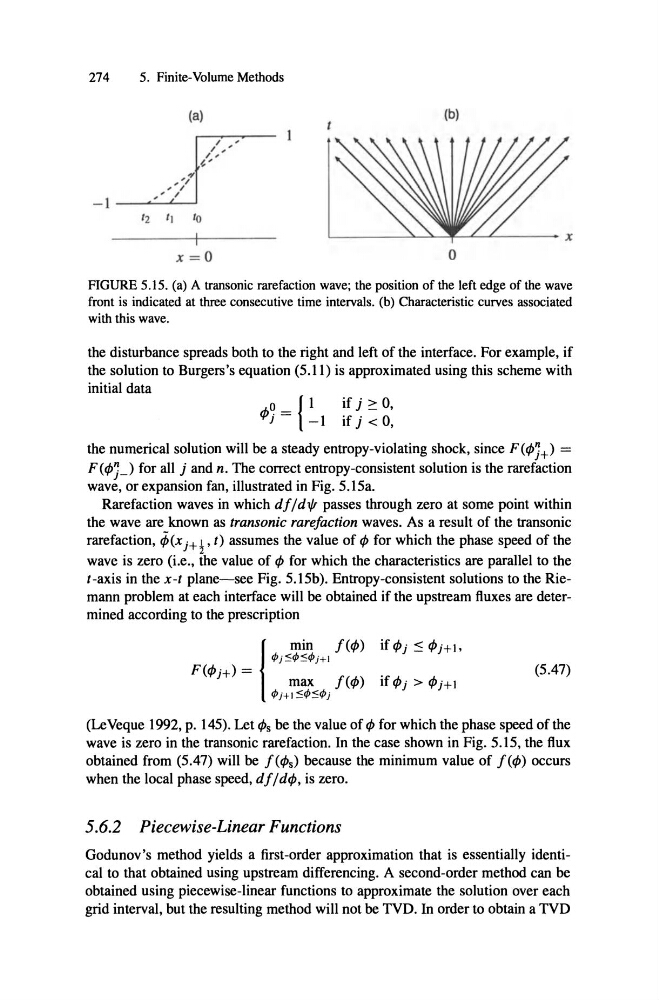
FIGURE 5.15. (a) A transonic rarefaction wave; the position of the left edge of the wave
front is indicated at three consecutive time intervals. (b) Characteristic curves associated
with this wave.
the disturbance spreads both to the right and left of the interface. For example, if
the solution to Burgers's equation (5.11) is approximated using this scheme with
initial data
if j 2: 0,
if j < 0,
the numerical solution will be a steady entropy-violating shock, since F(q,'J+) =
F(q,'J_) for all j and n, The correct entropy-consistent solution is the rarefaction
wave, or expansion fan, illustrated in Fig. 5.15a.
Rarefaction waves in which df/d1{t passes through zero at some point within
the wave are known as transonic rarefaction waves. As a result of the transonic
rarefaction,
t) assumes the value of q, for which the phase speed of the
wave is zero (i.e., the value of q, for which the characteristics are parallel to the
t-axis in the x-t plane-see Fig. 5.15b). Entropy-consistent solutions to the Riemann problem at each interface will be obtained if the upstream fluxes are determined according to the prescription
(5.47)
(LeVeque 1992, p. 145). Let q,s be the value of q,for which the phase speed of the
wave is zero in the transonic rarefaction. In the case shown in Fig. 5.15, the flux
obtained from (5.47) will be f(q,s) because the minimum value of f(q,) occurs
when the local phase speed, df/ dq" is zero.
5.6.2 Piecewise-Linear Functions
Godunov's method yields a first-order approximation that is essentially identical to that obtained using upstream differencing. A second-order method can be
obtained using piecewise-linear functions to approximate the solution over each
grid interval, but the resulting method will not be TVD . In order to obtain a TVD
----' --'---'
x =o
- 1 -
(b)
5. Finite-Volume Methods
(a)
/
'
"
274
o
FIGURE 5.15. (a) A transonic rarefaction wave; the position of the left edge of the wave
front is indicated at three consecutive time intervals. (b) Characteristic curves associated
with this wave.
the disturbance spreads both to the right and left of the interface. For example, if
the solution to Burgers's equation (5.11) is approximated using this scheme with
initial data
if j 2: 0,
if j < 0,
the numerical solution will be a steady entropy-violating shock, since F(q,'J+) =
F(q,'J_) for all j and n, The correct entropy-consistent solution is the rarefaction
wave, or expansion fan, illustrated in Fig. 5.15a.
Rarefaction waves in which df/d1{t passes through zero at some point within
the wave are known as transonic rarefaction waves. As a result of the transonic
rarefaction,
t) assumes the value of q, for which the phase speed of the
wave is zero (i.e., the value of q, for which the characteristics are parallel to the
t-axis in the x-t plane-see Fig. 5.15b). Entropy-consistent solutions to the Riemann problem at each interface will be obtained if the upstream fluxes are determined according to the prescription
(5.47)
(LeVeque 1992, p. 145). Let q,s be the value of q,for which the phase speed of the
wave is zero in the transonic rarefaction. In the case shown in Fig. 5.15, the flux
obtained from (5.47) will be f(q,s) because the minimum value of f(q,) occurs
when the local phase speed, df/ dq" is zero.
5.6.2 Piecewise-Linear Functions
Godunov's method yields a first-order approximation that is essentially identical to that obtained using upstream differencing. A second-order method can be
obtained using piecewise-linear functions to approximate the solution over each
grid interval, but the resulting method will not be TVD . In order to obtain a TVD