

5.6 Approximation withLocal Polynomials
273
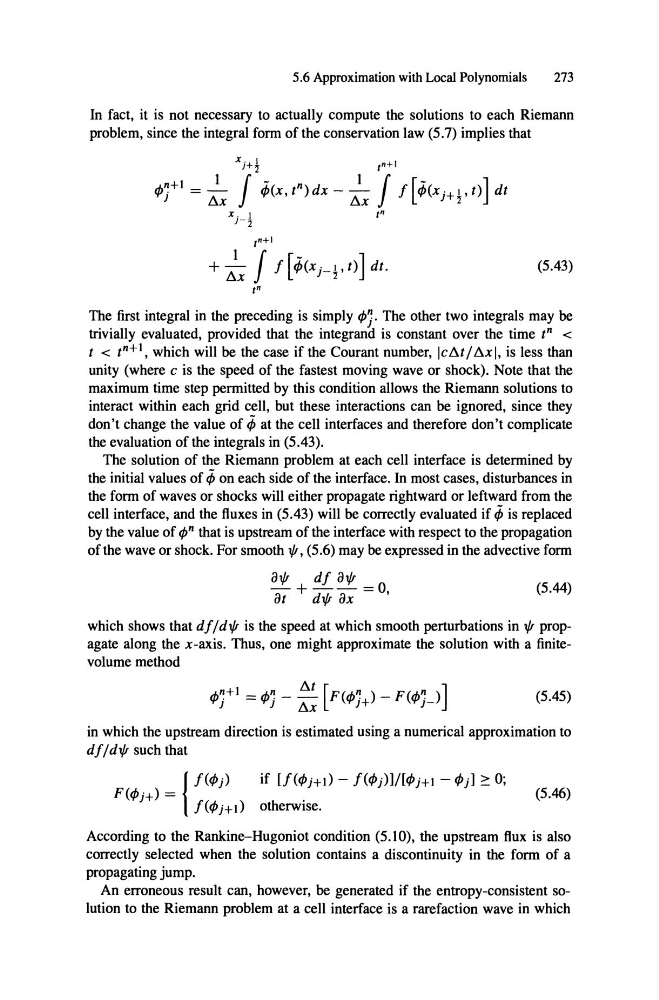
In fact, it is not necessary to actually compute the solutions to each Riemann
problem, since the integral form of the conservation law (5.7) implies that
In+1
J
In
tP'J+l =
+!
X j
J
dt
x j_!
In+1
+
J
dt .
(5.43)
In
The first integral in the preceding is simply tPj. The other two integrals may be
trivially evaluated, provided that the integrand is constant over the time t" <
t < t n + 1 , which will be the case ifthe Courant number, ICßt/ßxl, is less than
unity (where c is the speed of the fastest moving wave or shock) . Note that the
maximum time step permitted by this condition allows the Riemann solutions to
interact within each grid cell, but these interactions can be ignored, since they
don't change the value of at the cell interfaces and therefore don 't complicate
the evaluation of the integrals in (5.43).
The solution of the Riemann problem at each cell interface is determined by
the initial values of on each side of the interface. In most cases , disturbances in
the form of waves or shocks will either propagate rightward or leftward from the
cell interface, and the fluxes in (5.43) will be correctly evaluated if is replaced
by the value of tP n that is upstream of the interface with respect to the propagation
of the wave or shock. For smooth 1/1, (5.6) may be expressed in the advective form
81/1 df 81/1
at + d1/l = 0,
(5.44)
which shows that df/d1/l is the speed at which smooth perturbations in 1/1 propagate along the x-axis. Thus, one might approximate the solution with a finitevolume method
tP,!+1 = tP'! -
J
J
S»
[F(tP'!
J+
) - F(tP'!
J)]
(5.45)
in which the upstream direction is estimated using a numerical approximation to
df/d1/l such that
0;
tPj]
f(tPj)
if [f(tP j+l) - f(tPj)]/ltPj+l -
F(tPj+) =
(5.46)
f (tPj+}) otherwise.
According to the Rankine-Hugoniot condition (5.10), the upstream flux is also
correctly selected when the solution contains a discontinuity in the form of a
propagating jump.
An erroneous result can, however, be generated if the entropy-consistent solution to the Riemann problem at a cell interface is a rarefaction wave in which
I
273
In fact, it is not necessary to actually compute the solutions to each Riemann
problem, since the integral form of the conservation law (5.7) implies that
In+1
J
In
tP'J+l =
+!
X j
J
dt
x j_!
In+1
+
J
dt .
(5.43)
In
The first integral in the preceding is simply tPj. The other two integrals may be
trivially evaluated, provided that the integrand is constant over the time t" <
t < t n + 1 , which will be the case ifthe Courant number, ICßt/ßxl, is less than
unity (where c is the speed of the fastest moving wave or shock) . Note that the
maximum time step permitted by this condition allows the Riemann solutions to
interact within each grid cell, but these interactions can be ignored, since they
don't change the value of at the cell interfaces and therefore don 't complicate
the evaluation of the integrals in (5.43).
The solution of the Riemann problem at each cell interface is determined by
the initial values of on each side of the interface. In most cases , disturbances in
the form of waves or shocks will either propagate rightward or leftward from the
cell interface, and the fluxes in (5.43) will be correctly evaluated if is replaced
by the value of tP n that is upstream of the interface with respect to the propagation
of the wave or shock. For smooth 1/1, (5.6) may be expressed in the advective form
81/1 df 81/1
at + d1/l = 0,
(5.44)
which shows that df/d1/l is the speed at which smooth perturbations in 1/1 propagate along the x-axis. Thus, one might approximate the solution with a finitevolume method
tP,!+1 = tP'! -
J
J
S»
[F(tP'!
J+
) - F(tP'!
J)]
(5.45)
in which the upstream direction is estimated using a numerical approximation to
df/d1/l such that
0;
tPj]
f(tPj)
if [f(tP j+l) - f(tPj)]/ltPj+l -
F(tPj+) =
(5.46)
f (tPj+}) otherwise.
According to the Rankine-Hugoniot condition (5.10), the upstream flux is also
correctly selected when the solution contains a discontinuity in the form of a
propagating jump.
An erroneous result can, however, be generated if the entropy-consistent solution to the Riemann problem at a cell interface is a rarefaction wave in which
I