

5.4 Flux-Corrected Transport
259
4J
•
•
•
•
•
limit
•
set to zero
x
x
j - I
j
j+1
j+2
j-I
j
j+ 1
j + 2
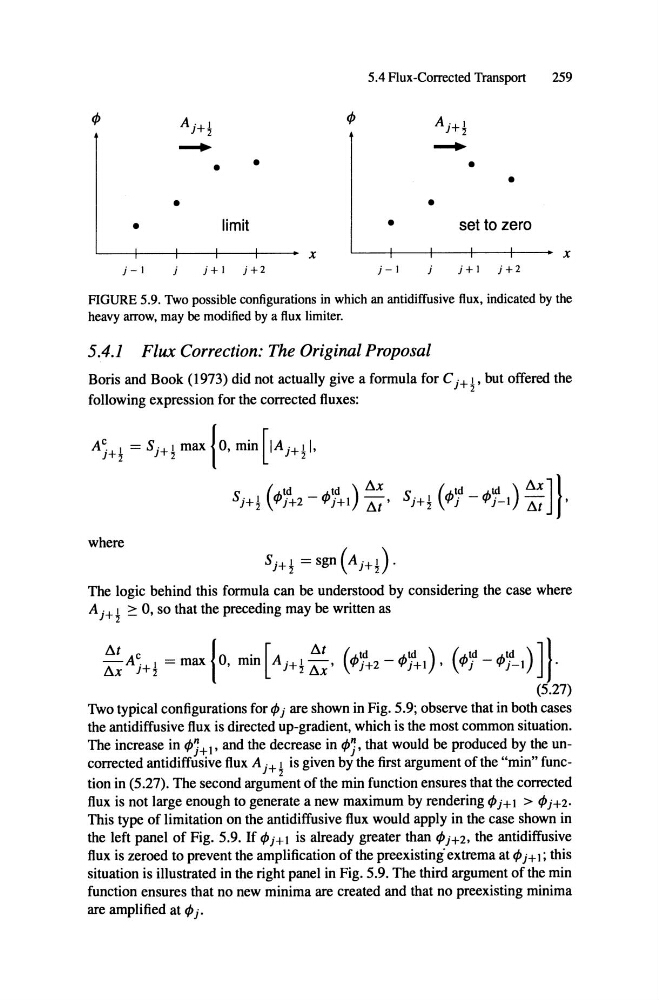
FIGURE 5.9. Two possible configurations in which an antidiffusive f1ux, indicated by the
heavy arrow, may be modified by a f1ux limiter.
5.4.1 Flux Correction: The Original Proposal
Boris and Book (1973) did not actually give a formula for C}+
following expression for the corrected fluxes:
but offered the
A .+,
.....
J 2
•
A '+I
.....
J 2
•
where
= sgn (A
The logic behind this formula can be understood by considering the case where
::: 0, so that the preceding may be written as
(4Jjd - 4Jjd_\) JI.
(5.27)
Two typical configurations for 4Jj are shown in Fig. 5.9; observe that in both cases
the antidiffusive flux is directed up-gradient, which is the most common situation.
The increase in 4Jj+\, and the decrease in 4J'}, that would be produced by the uncorrected antidiffusive flux
is given by the first argument ofthe "rnin" function in (5.27). The second argument of the min function ensures that the corrected
flux is not large enough to generate a new maximum by rendering 4Jj+\ > 4Jj+2.
This type of limitation on the antidiffusive flux would apply in the case shown in
the left panel of Fig. 5.9. If 4J}+\ is already greater than 4Jj+2, the antidiffusive
flux is zeroed to prevent the amplification of the preexisting' extrema at 4Jj+l; this
situation is illustrated in the right panel in Fig. 5.9. The third argument of the min
function ensures that no new minima are created and that no preexisting minima
are amplified at 4Jl:
259
4J
•
•
•
•
•
limit
•
set to zero
x
x
j - I
j
j+1
j+2
j-I
j
j+ 1
j + 2
FIGURE 5.9. Two possible configurations in which an antidiffusive f1ux, indicated by the
heavy arrow, may be modified by a f1ux limiter.
5.4.1 Flux Correction: The Original Proposal
Boris and Book (1973) did not actually give a formula for C}+
following expression for the corrected fluxes:
but offered the
A .+,
.....
J 2
•
A '+I
.....
J 2
•
where
= sgn (A
The logic behind this formula can be understood by considering the case where
::: 0, so that the preceding may be written as
(4Jjd - 4Jjd_\) JI.
(5.27)
Two typical configurations for 4Jj are shown in Fig. 5.9; observe that in both cases
the antidiffusive flux is directed up-gradient, which is the most common situation.
The increase in 4Jj+\, and the decrease in 4J'}, that would be produced by the uncorrected antidiffusive flux
is given by the first argument ofthe "rnin" function in (5.27). The second argument of the min function ensures that the corrected
flux is not large enough to generate a new maximum by rendering 4Jj+\ > 4Jj+2.
This type of limitation on the antidiffusive flux would apply in the case shown in
the left panel of Fig. 5.9. If 4J}+\ is already greater than 4Jj+2, the antidiffusive
flux is zeroed to prevent the amplification of the preexisting' extrema at 4Jj+l; this
situation is illustrated in the right panel in Fig. 5.9. The third argument of the min
function ensures that no new minima are created and that no preexisting minima
are amplified at 4Jl: