

258
5. Finite-Volume Methods
the solution is poorly resolved or discontinuous . The concept of FCT and the
algorithms for its implementation were further generalized by Zalesak (1979).
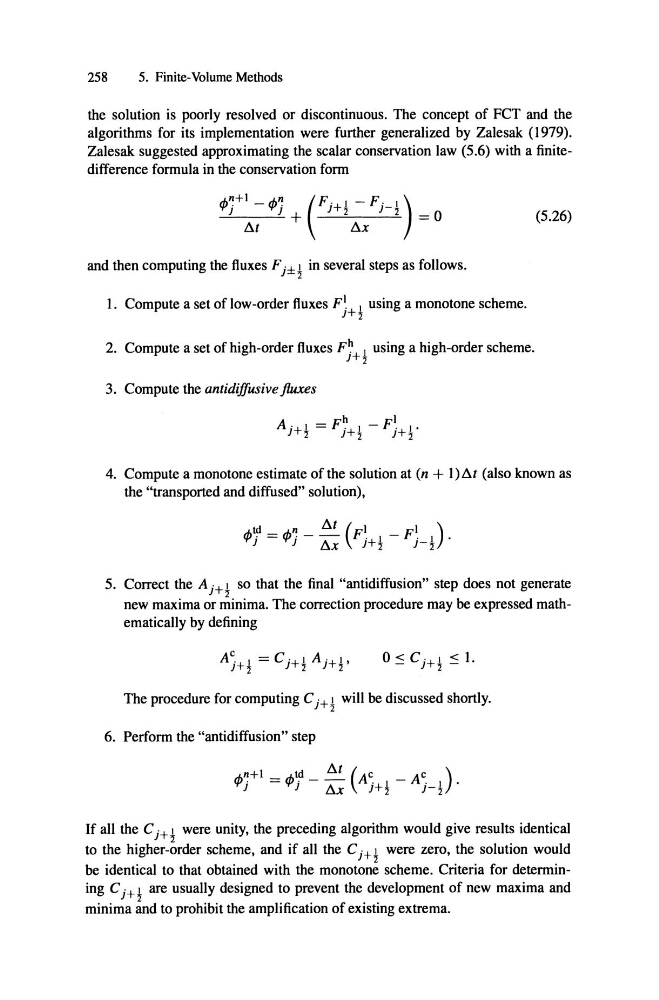
Zalesak suggested approximating the scalar conservation law (5.6) with a finitedifference formula in the conservation form
(5.26)
and then computing the fluxes
in several steps as folIows.
I. Compute a set of low-order fluxes F10 I using a monotone scheme.
}+ 2
2. Compute a set of high-order fluxes
I using a high-order scheme.
}+2
3. Compute the antidiffusive fluxes
4. Compute a monotone estimate ofthe solution at (n +
the "transported and diffused" solution),
r/>}o = r/>}o - -
td
n
( F I 0 + I
} 2
- F I )
°
I
}-2
•
(also known as
5. Correct the Aj+! so that the final "antidiffusion" step does not generate
new maxima or minima. The correction procedure may be expressed mathematically by defining
0< e 0 +
-
}
I < 1.
2 -
The procedure for computing eH! will be discussed shortly.
6. Perform the "antidiffusion" step
If all the eH! were unity, the preceding algorithm would give results identical
to the higher-order scheme, and if all the
were zero, the solution would
be identical to that obtained with the monotone scheme . Criteria for determining e are usually designed to prevent the development of new maxima and
5. Finite-Volume Methods
the solution is poorly resolved or discontinuous . The concept of FCT and the
algorithms for its implementation were further generalized by Zalesak (1979).
Zalesak suggested approximating the scalar conservation law (5.6) with a finitedifference formula in the conservation form
(5.26)
and then computing the fluxes
in several steps as folIows.
I. Compute a set of low-order fluxes F10 I using a monotone scheme.
}+ 2
2. Compute a set of high-order fluxes
I using a high-order scheme.
}+2
3. Compute the antidiffusive fluxes
4. Compute a monotone estimate ofthe solution at (n +
the "transported and diffused" solution),
r/>}o = r/>}o - -
td
n
( F I 0 + I
} 2
- F I )
°
I
}-2
•
(also known as
5. Correct the Aj+! so that the final "antidiffusion" step does not generate
new maxima or minima. The correction procedure may be expressed mathematically by defining
0< e 0 +
-
}
I < 1.
2 -
The procedure for computing eH! will be discussed shortly.
6. Perform the "antidiffusion" step
If all the eH! were unity, the preceding algorithm would give results identical
to the higher-order scheme, and if all the
were zero, the solution would
be identical to that obtained with the monotone scheme . Criteria for determining e are usually designed to prevent the development of new maxima and