

5.1 Conservation Laws and Weak Solutions
245
past these points during the time interval of interest. The speed of the shock may
be determined as folIows. From (5.8),
xR
l
t/f(x, t) dx = (st - Xdt/fL + (XR - st)t/fR'
XL
and thus
d l
xR
-d
t XL
t/f(x, t) dx = S(t/fL - t/fR)'
(5.9)
Integrating (5.6) over the interval [XL. XR] , one obtains
d lxR t/f(x, t) dx = f(t/fd - f(t/fR) ,
d t XL
which together with (5.9) implies that
f(t/fd - f(t/fR)
S=
t/fL - v«
(5.10)
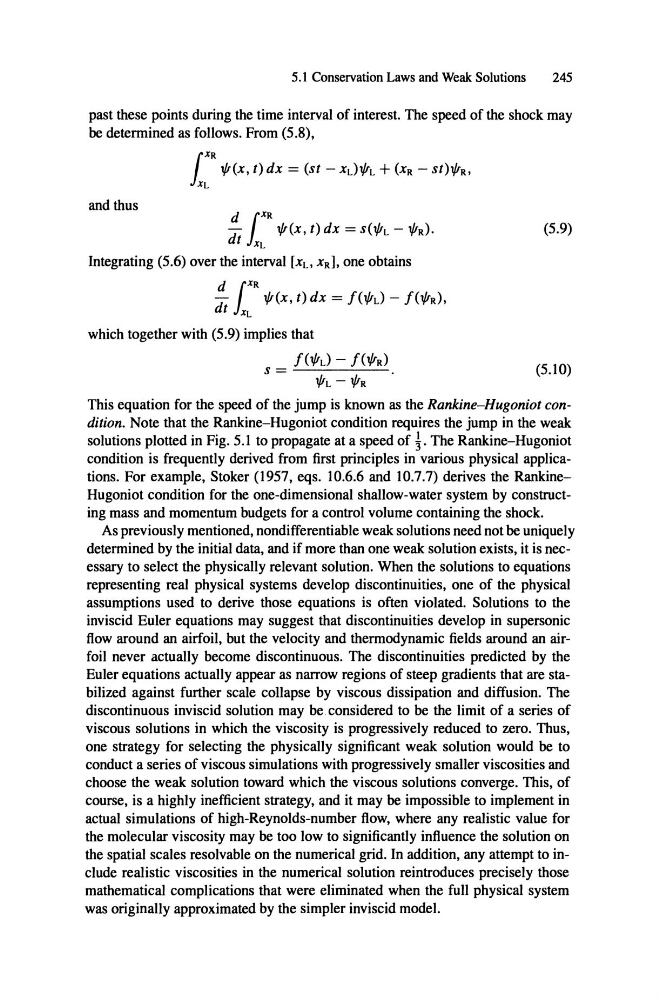
This equation for the speed of the jump is known as the Rankine-Hugoniot condition. Note that the Rankine-Hugoniot condition requires the jump in the weak
solutions plotted in Fig. 5.1 to propagate at a speed of l. The Rankine-Hugoniot
condition is frequently derived from first principles in various physical applications. For example, Stoker (1957, eqs. 10.6.6 and 10.7.7) derives the RankineHugoniot condition for the one-dimensional shallow-water system by constructing mass and momentum budgets for a control volume containing the shock.
As previously mentioned, nondifferentiable weak solutions need not be uniquely
determined by the initial data, and if more than one weak solution exists, it is necessary to select the physically relevant solution . When the solutions to equations
representing real physical systems develop discontinuities, one of the physical
assumptions used to derive those equations is often violated. Solutions to the
inviscid Euler equations may suggest that discontinuities develop in supersonic
flow around an airfoil, but the velocity and thermodynamic fields around an airfoil never actually become discontinuous. The discontinuities predicted by the
Euler equations actually appear as narrow regions of steep gradients that are stabilized against further scale collapse by viscous dissipation and diffusion. The
discontinuous inviscid solution may be considered to be the limit of aseries of
viscous solutions in which the viscosity is progressively reduced to zero. Thus,
one strategy for selecting the physically significant weak solution would be to
conduct aseries of viscous simulations with progressively smaller viscosities and
choose the weak solution toward which the viscous solutions converge. This, of
course, is a highly inefficient strategy, and it may be impossible to implement in
actual simulations of high-Reynolds-number flow, where any realistic value for
the molecular viscosity may be too low to significantly influence the solution on
the spatial scales resolvable on the numerical grid. In addition, any attempt to include realistic viscosities in the numerical solution reintroduces precisely those
mathematical complications that were eliminated when the full physical system
was originally approximated by the simpler inviscid model.
245
past these points during the time interval of interest. The speed of the shock may
be determined as folIows. From (5.8),
xR
l
t/f(x, t) dx = (st - Xdt/fL + (XR - st)t/fR'
XL
and thus
d l
xR
-d
t XL
t/f(x, t) dx = S(t/fL - t/fR)'
(5.9)
Integrating (5.6) over the interval [XL. XR] , one obtains
d lxR t/f(x, t) dx = f(t/fd - f(t/fR) ,
d t XL
which together with (5.9) implies that
f(t/fd - f(t/fR)
S=
t/fL - v«
(5.10)
This equation for the speed of the jump is known as the Rankine-Hugoniot condition. Note that the Rankine-Hugoniot condition requires the jump in the weak
solutions plotted in Fig. 5.1 to propagate at a speed of l. The Rankine-Hugoniot
condition is frequently derived from first principles in various physical applications. For example, Stoker (1957, eqs. 10.6.6 and 10.7.7) derives the RankineHugoniot condition for the one-dimensional shallow-water system by constructing mass and momentum budgets for a control volume containing the shock.
As previously mentioned, nondifferentiable weak solutions need not be uniquely
determined by the initial data, and if more than one weak solution exists, it is necessary to select the physically relevant solution . When the solutions to equations
representing real physical systems develop discontinuities, one of the physical
assumptions used to derive those equations is often violated. Solutions to the
inviscid Euler equations may suggest that discontinuities develop in supersonic
flow around an airfoil, but the velocity and thermodynamic fields around an airfoil never actually become discontinuous. The discontinuities predicted by the
Euler equations actually appear as narrow regions of steep gradients that are stabilized against further scale collapse by viscous dissipation and diffusion. The
discontinuous inviscid solution may be considered to be the limit of aseries of
viscous solutions in which the viscosity is progressively reduced to zero. Thus,
one strategy for selecting the physically significant weak solution would be to
conduct aseries of viscous simulations with progressively smaller viscosities and
choose the weak solution toward which the viscous solutions converge. This, of
course, is a highly inefficient strategy, and it may be impossible to implement in
actual simulations of high-Reynolds-number flow, where any realistic value for
the molecular viscosity may be too low to significantly influence the solution on
the spatial scales resolvable on the numerical grid. In addition, any attempt to include realistic viscosities in the numerical solution reintroduces precisely those
mathematical complications that were eliminated when the full physical system
was originally approximated by the simpler inviscid model.