

244
5. Finite-Volume Methods
st:J.t - - -
1/IL------,-----------,
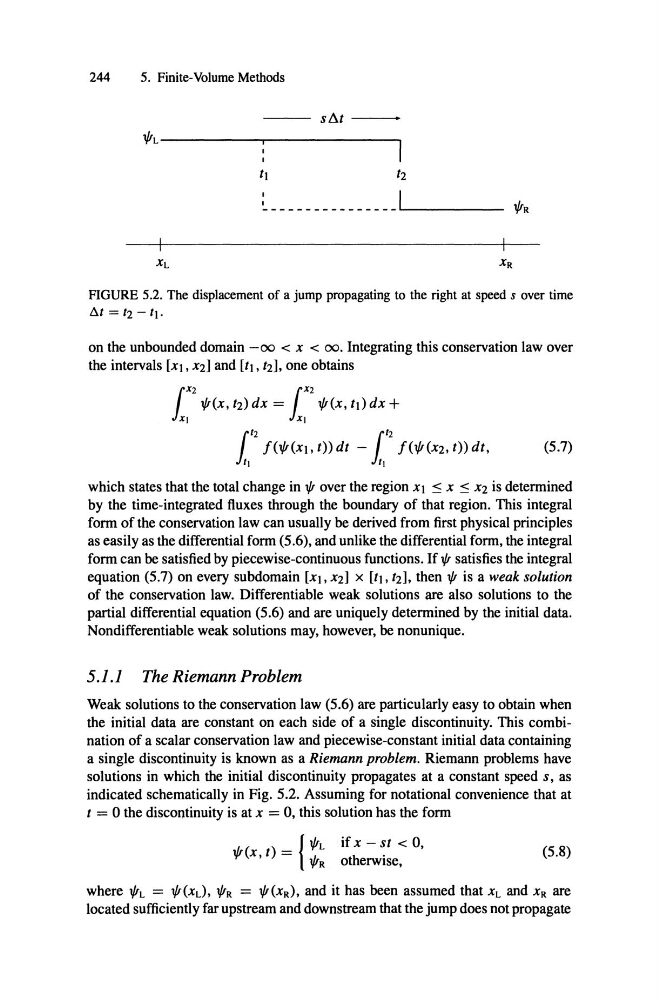
1----------FIGURE 5.2. The displacement of a jump propagating to the right at speed S over time
6.t = t2 - tl.
on the unbounded domain -00 < x < 00 . Integrating this conservation law over
the intervals [XI, X2] and [tl , t2], one obtains
1/I(x t) = {1/I L if X -
< 0,
,
1/IR otherwise,
(5.8)
(5.7)
which states that the total change in 1/1 over the region XI X X2 is determined
by the time-integrated fluxes through the boundary of that region. This integral
form of the conservation law can usually be derived from first physical principles
as easily as the differential form (5.6), and unlike the differential form, the integral
form can be satisfied by piecewise-continuous functions. If 1/1 satisfies the integral
equation (5.7) on every subdomain [XI, X2] x [tl , t2l. then 1/1 is a weak solution
of the conservation law. Differentiable weak solutions are also solutions to the
partial differential equation (5.6) and are uniquely determined by the initial data .
Nondifferentiable weak solutions may, however, be nonunique.
5.1.1 The Riemann Problem
Weak solutions to the conservation law (5.6) are particularly easy to obtain when
the initial data are constant on each side of a single discontinuity. This combination of a scalar conservation law and piecewise-constant initial data containing
a single discontinuity is known as aRiemann problem. Riemann problems have
solutions in which the initial discontinuity propagates at a constant speed s, as
t = °the discontinuity is at X = 0, this solution has the form
indicated schematically in Fig. 5.2. Assuming for notational convenience that at
where 1/IL = 1/I(XL) , 1/IR = 1/I(XR), and it has been assumed that XL and XR are
located sufficiently far upstream and downstream that the jump does not propagate
5. Finite-Volume Methods
st:J.t - - -
1/IL------,-----------,
1----------FIGURE 5.2. The displacement of a jump propagating to the right at speed S over time
6.t = t2 - tl.
on the unbounded domain -00 < x < 00 . Integrating this conservation law over
the intervals [XI, X2] and [tl , t2], one obtains
1/I(x t) = {1/I L if X -
< 0,
,
1/IR otherwise,
(5.8)
(5.7)
which states that the total change in 1/1 over the region XI X X2 is determined
by the time-integrated fluxes through the boundary of that region. This integral
form of the conservation law can usually be derived from first physical principles
as easily as the differential form (5.6), and unlike the differential form, the integral
form can be satisfied by piecewise-continuous functions. If 1/1 satisfies the integral
equation (5.7) on every subdomain [XI, X2] x [tl , t2l. then 1/1 is a weak solution
of the conservation law. Differentiable weak solutions are also solutions to the
partial differential equation (5.6) and are uniquely determined by the initial data .
Nondifferentiable weak solutions may, however, be nonunique.
5.1.1 The Riemann Problem
Weak solutions to the conservation law (5.6) are particularly easy to obtain when
the initial data are constant on each side of a single discontinuity. This combination of a scalar conservation law and piecewise-constant initial data containing
a single discontinuity is known as aRiemann problem. Riemann problems have
solutions in which the initial discontinuity propagates at a constant speed s, as
t = °the discontinuity is at X = 0, this solution has the form
indicated schematically in Fig. 5.2. Assuming for notational convenience that at
where 1/IL = 1/I(XL) , 1/IR = 1/I(XR), and it has been assumed that XL and XR are
located sufficiently far upstream and downstream that the jump does not propagate