

Problems
237
9. Express the associated Legendre function P4,4(jL) as an algebraic function
of J.L (thereby producing an expression similar to those in Table 4.2).
10. Derive (4.21) by repeated1y integrating
by parts.
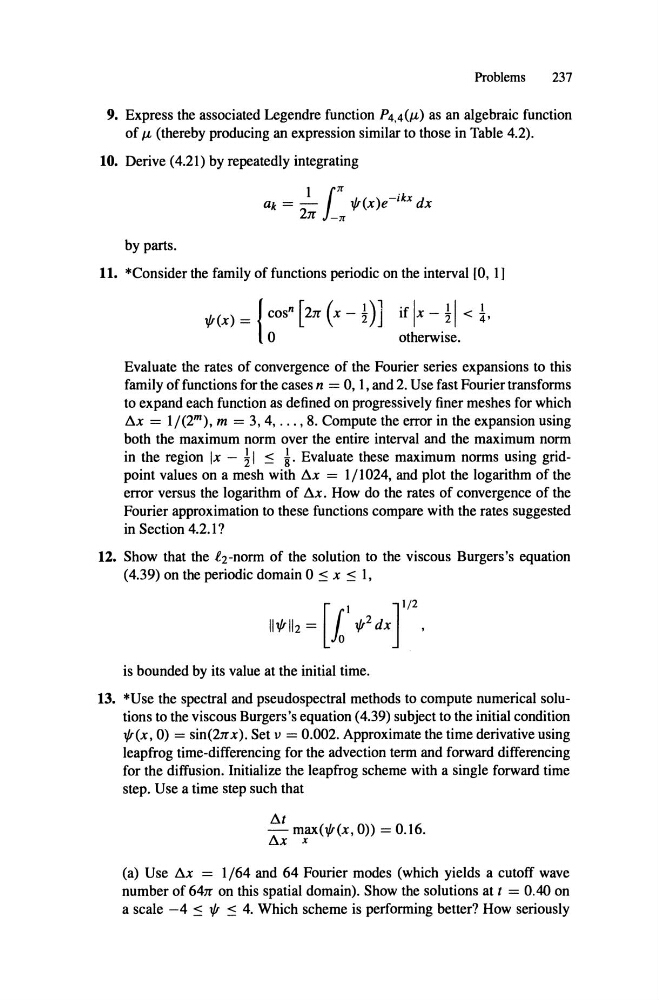
11. *Consider the family offunctions periodic on the interval [0, 1]
if Ix - 11< *'
otherwise.
Evaluate the rates of convergence of the Fourier series expansions to this
family of functions for the cases n = 0, 1, and 2. Use fast Fourier transforms
to expand each function as defined on progressively finer meshes for which
!:!..x = 1/(2
m ) , m = 3,4, .. . ,8. Compute the error in the expansion using
both the maximum norm over the entire interval and the maximum norm
in the region Ix - 1I ::; k.Evaluate these maximum norms using gridpoint values on a mesh with Sx = 1/1024, and plot the logarithm of the
error versus the logarithm of S». How do the rates of convergence of the
Fourier approximation to these functions compare with the rates suggested
in Section 4.2.1?
12. Show that the 12-norm of the solution to the viscous Burgers's equation
(4.39) on the periodic domain 0 ::; x ::; 1,
is bounded by its value at the initial time.
13. *Use the spectral and pseudospectral methods to compute numerical solutions to the viscous Burgers 's equation (4.39) subject to the initial condition
1/1(x , 0) = sin(2JTx). Set v = 0.002. Approximate the time derivative using
leapfrog time-differencing for the advection term and forward differencing
for the diffusion. Initialize the 1eapfrog scheme with a single forward time
step. Use a time step such that
!:!..t
-
max(1/I(x , 0)) = 0.16.
!:!..x x
(a) Use !:!..x = 1/64 and 64 Fourier modes (which yields a cutoff wave
number of 64JT on this spatial domain). Show the solutions at t = 0.40 on
237
9. Express the associated Legendre function P4,4(jL) as an algebraic function
of J.L (thereby producing an expression similar to those in Table 4.2).
10. Derive (4.21) by repeated1y integrating
by parts.
11. *Consider the family offunctions periodic on the interval [0, 1]
if Ix - 11< *'
otherwise.
Evaluate the rates of convergence of the Fourier series expansions to this
family of functions for the cases n = 0, 1, and 2. Use fast Fourier transforms
to expand each function as defined on progressively finer meshes for which
!:!..x = 1/(2
m ) , m = 3,4, .. . ,8. Compute the error in the expansion using
both the maximum norm over the entire interval and the maximum norm
in the region Ix - 1I ::; k.Evaluate these maximum norms using gridpoint values on a mesh with Sx = 1/1024, and plot the logarithm of the
error versus the logarithm of S». How do the rates of convergence of the
Fourier approximation to these functions compare with the rates suggested
in Section 4.2.1?
12. Show that the 12-norm of the solution to the viscous Burgers's equation
(4.39) on the periodic domain 0 ::; x ::; 1,
is bounded by its value at the initial time.
13. *Use the spectral and pseudospectral methods to compute numerical solutions to the viscous Burgers 's equation (4.39) subject to the initial condition
1/1(x , 0) = sin(2JTx). Set v = 0.002. Approximate the time derivative using
leapfrog time-differencing for the advection term and forward differencing
for the diffusion. Initialize the 1eapfrog scheme with a single forward time
step. Use a time step such that
!:!..t
-
max(1/I(x , 0)) = 0.16.
!:!..x x
(a) Use !:!..x = 1/64 and 64 Fourier modes (which yields a cutoff wave
number of 64JT on this spatial domain). Show the solutions at t = 0.40 on