

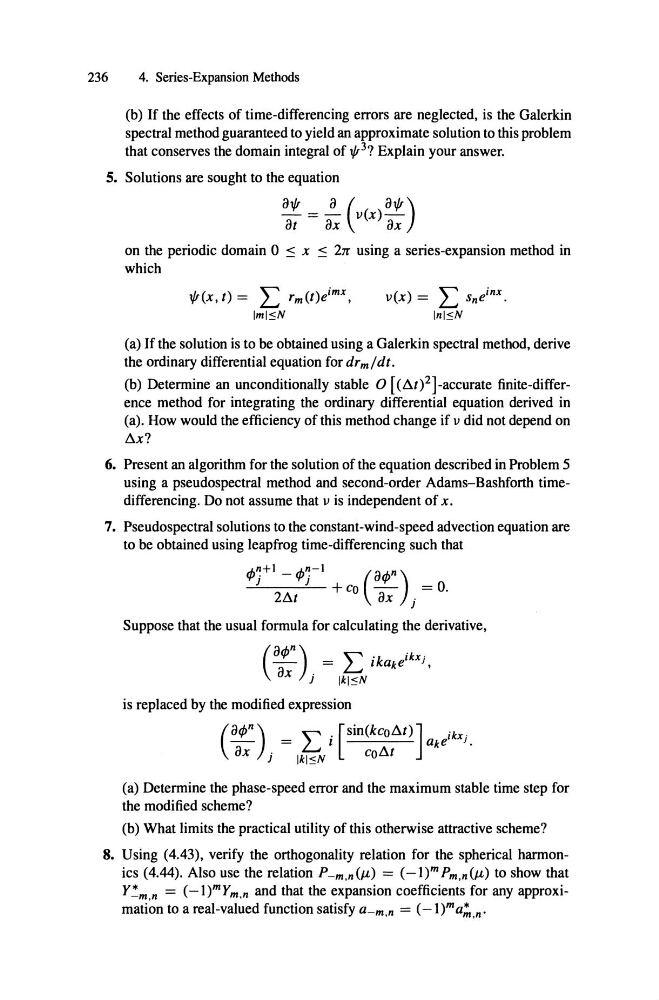
236
4. Series-Expansion Methods
(b) If the effects of time -differencing errors are neglected, is the Galerkin
spectral method guaranteed to yield an approximate solution to this problem
that conserves the domain integral of 1/13? Explain your answer.
5. Solutions are sought to the equation
a1/1 =
at
ax
(V(X) a1/1)
ax
on the periodic domain 0
which
x
27T using a series-expansion method in
1/1(x , t) = L rm(t)e imx, v(x) = L sn einx .
(a) If the solution is to be obtained using a Galerkin spectral method, derive
the ordinary differential equation for drm/dt .
(b) Determine an unconditionally stable 0 [(6.t)2] -accurate finite-difference method for integrating the ordinary differential equation derived in
(a). How would the efficiency of this method change if v did not depend on
6.x?
6. Present an algorithm for the solution of the equation described in Problem 5
using a pseudospectral method and second-order Adams-Bashforth timedifferencing. Do not assume that v is independent of x .
7. Pseudospectral solutions to the constant-wind-speed advection equation are
to be obtained using leapfrog time-differencing such that
cPj+l - cPr
1
(acPn)
-
=0.
26.t
ax j
Suppose that the usual formula for calculating the derivative,
( - a cPn ) = L ikake ' kx j
. ,
ax j
is replaced by the modified expression
( - -
acPn )
ax j
= L...J I
' " . [Sin(kC 06.t)] ase
ikx ,
J.
co6.t
(a) Determine the phase -speed error and the maximum stable time step for
the modified scheme?
(b) What limits the practical utility of this otherwise attractive scheme?
8. Using (4.43), verify the orthogonality relation for the spherical harmon -
ics (4.44) . Also use the relation P-rm.n (J-L) = (_l)m Pm ,n(J-L) to show that
= (_l)mym.n and that the expansion coefficients for any approximation to a real-valued function satisfy a_ m.n = (_l)m a;' ,n'
4. Series-Expansion Methods
(b) If the effects of time -differencing errors are neglected, is the Galerkin
spectral method guaranteed to yield an approximate solution to this problem
that conserves the domain integral of 1/13? Explain your answer.
5. Solutions are sought to the equation
a1/1 =
at
ax
(V(X) a1/1)
ax
on the periodic domain 0
which
x
27T using a series-expansion method in
1/1(x , t) = L rm(t)e imx, v(x) = L sn einx .
(a) If the solution is to be obtained using a Galerkin spectral method, derive
the ordinary differential equation for drm/dt .
(b) Determine an unconditionally stable 0 [(6.t)2] -accurate finite-difference method for integrating the ordinary differential equation derived in
(a). How would the efficiency of this method change if v did not depend on
6.x?
6. Present an algorithm for the solution of the equation described in Problem 5
using a pseudospectral method and second-order Adams-Bashforth timedifferencing. Do not assume that v is independent of x .
7. Pseudospectral solutions to the constant-wind-speed advection equation are
to be obtained using leapfrog time-differencing such that
cPj+l - cPr
1
(acPn)
-
=0.
26.t
ax j
Suppose that the usual formula for calculating the derivative,
( - a cPn ) = L ikake ' kx j
. ,
ax j
is replaced by the modified expression
( - -
acPn )
ax j
= L...J I
' " . [Sin(kC 06.t)] ase
ikx ,
J.
co6.t
(a) Determine the phase -speed error and the maximum stable time step for
the modified scheme?
(b) What limits the practical utility of this otherwise attractive scheme?
8. Using (4.43), verify the orthogonality relation for the spherical harmon -
ics (4.44) . Also use the relation P-rm.n (J-L) = (_l)m Pm ,n(J-L) to show that
= (_l)mym.n and that the expansion coefficients for any approximation to a real-valued function satisfy a_ m.n = (_l)m a;' ,n'