

234
4. Series-Expansion Methods
3
5
(a)
(b)
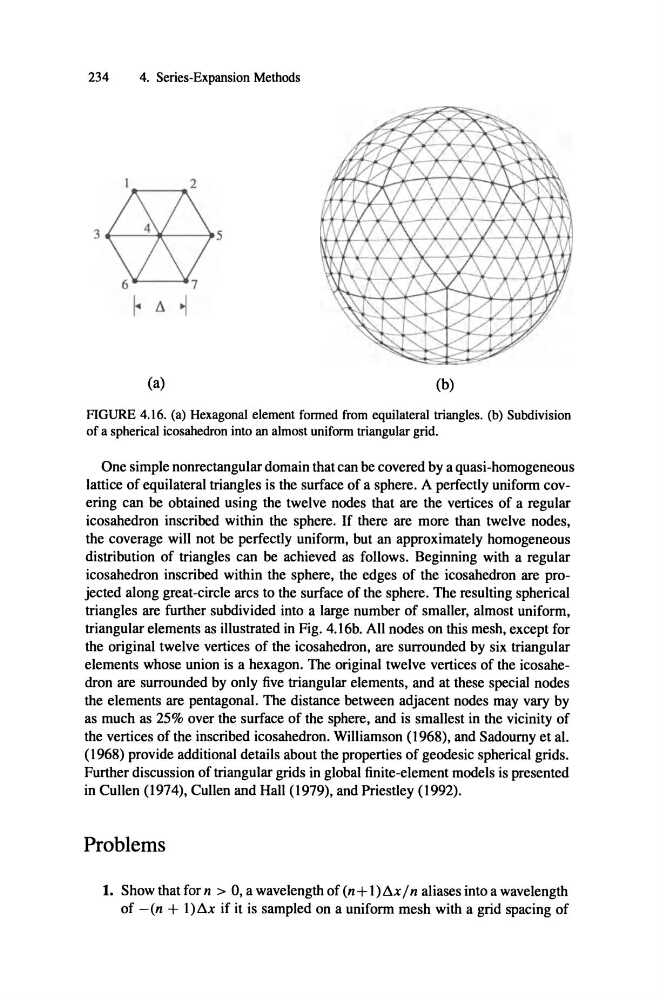
FIGURE 4.16. (a) Hexagonal element fonned from equilateral triangles. (b) Subdivision
of a spherical icosahedron into an almost uniform triangular grid.
One simple nonreetangular domain that can be eovered by a quasi-homogeneous
lattice of equilateral triangles is the surfaee of a sphere. A perfeetly uniform covering ean be obtained using the twelve nodes that are the vertiees of a regular
ieosahedron inseribed within the sphere. If there are more than twelve nodes,
the eoverage will not be perfeetly uniform, but an approximately homogeneous
distribution of triangles ean be aehieved as folIows. Beginning with a regular
ieosahedron inseribed within the sphere, the edges of the icosahedron are projeeted along great-circle ares to the surfaee of the sphere. The resulting spherieal
triangles are further subdivided into a large number of smaller, almost uniform,
triangular elements as iIIustrated in Fig. 4.16b. All nodes on this mesh, exeept for
the original twelve vertiees of the ieosahedron, are surrounded by six triangular
elements whose union is a hexagon. The original twelve vertiees of the ieosahedron are surrounded by only five triangular elements , and at these special nodes
the elements are pentagonal. The distanee between adjaeent nodes may vary by
as mueh as 25% over the surfaee of the sphere, and is smallest in the vicinity of
the vertices of the inseribed icosahedron. Williamson (1968), and Sadoumy et al.
(1968) provide additional details about the properties of geodesie spherical grids.
Further diseussion of triangular grids in global finite-element models is presented
in Cullen (1974), Cullen and Hall (1979), and Priestley (1992).
Problems
1. Show that for n > 0, a wavelength of (n +1) / n aliases into a wavelength
of -(n +
if it is sampled on a uniform mesh with a grid spaeing of
4. Series-Expansion Methods
3
5
(a)
(b)
FIGURE 4.16. (a) Hexagonal element fonned from equilateral triangles. (b) Subdivision
of a spherical icosahedron into an almost uniform triangular grid.
One simple nonreetangular domain that can be eovered by a quasi-homogeneous
lattice of equilateral triangles is the surfaee of a sphere. A perfeetly uniform covering ean be obtained using the twelve nodes that are the vertiees of a regular
ieosahedron inseribed within the sphere. If there are more than twelve nodes,
the eoverage will not be perfeetly uniform, but an approximately homogeneous
distribution of triangles ean be aehieved as folIows. Beginning with a regular
ieosahedron inseribed within the sphere, the edges of the icosahedron are projeeted along great-circle ares to the surfaee of the sphere. The resulting spherieal
triangles are further subdivided into a large number of smaller, almost uniform,
triangular elements as iIIustrated in Fig. 4.16b. All nodes on this mesh, exeept for
the original twelve vertiees of the ieosahedron, are surrounded by six triangular
elements whose union is a hexagon. The original twelve vertiees of the ieosahedron are surrounded by only five triangular elements , and at these special nodes
the elements are pentagonal. The distanee between adjaeent nodes may vary by
as mueh as 25% over the surfaee of the sphere, and is smallest in the vicinity of
the vertices of the inseribed icosahedron. Williamson (1968), and Sadoumy et al.
(1968) provide additional details about the properties of geodesie spherical grids.
Further diseussion of triangular grids in global finite-element models is presented
in Cullen (1974), Cullen and Hall (1979), and Priestley (1992).
Problems
1. Show that for n > 0, a wavelength of (n +1) / n aliases into a wavelength
of -(n +
if it is sampled on a uniform mesh with a grid spaeing of