

4.5 The Finite-Element Method
221
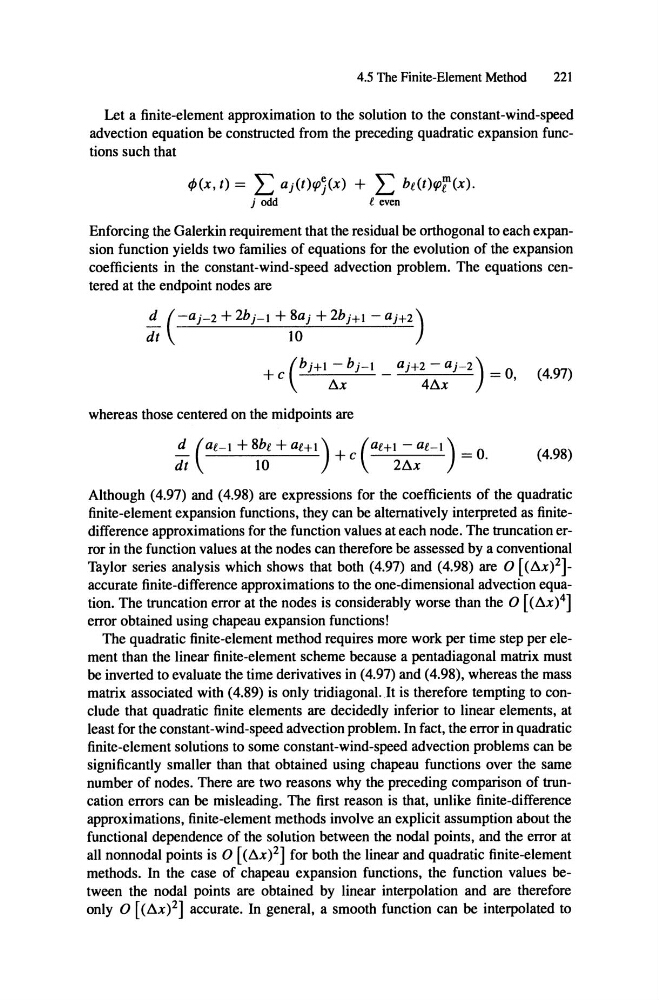
Let a finite-element approximation to the solution to the constant-wind-speed
advection equation be constructed from the preceding quadratic expansion functions such that
t!J(x, t) = L Oj(t)cpj(x) + L bl (t)cpr; (x) .
j odd
l even
Enforcing the Galerkin requirement that the residual be orthogonal to each expansion function yields two families of equations for the evolution of the expansion
coefficients in the constant-wind-speed advection problem. The equations centered at the endpoint nodes are
!!- (-Oj-2 + 2bj_1 + 80j + 2bj+1 - aj+2)
dt
10
+ c
b o + 1 - b o_ 1
J
J
-
aj+2 - Oj-2) =0
(4.97)
(
!lx
whereas those centered on the midpoints are
- d (Ol -I + 8bl + 0l+1) +c (0l+1 - Ol -I) =0.
(4.98)
10
2!lx
Although (4.97) and (4.98) are expressions for the coefficients of the quadratic
finite-elernent expansion functions, they can be altematively interpreted as finitedifference approximations for the function values at each node. The truncation errar in the function values at the nodes can therefore be assessed by a conventional
Taylor series analysis which shows that both (4.97) and (4.98) are 0 [(!lx )2]_
accurate finite-difference approximations to the one-dirnensional advection equation. The truncation error at the nodes is considerably worse than the 0 [(!lx)4]
error obtained using chapeau expansion functions!
The quadratic finite-element method requires more work per time step per element than the linear finite-element scheme because a pentadiagonal matrix must
be inverted to evaluate the time derivatives in (4.97) and (4.98), whereas the mass
matrix associated with (4.89) is only tridiagonaI. .It is therefore tempting to conc1ude that quadratic finite elements are decidedly inferior to linear elements, at
least for the constant-wind-speed advection problem . In fact, the error in quadratic
finite-elernent solutions to some constant-wind-speed advection problems can be
significantly smaller than that obtained using chapeau functions over the same
number of nodes. There are two reasons why the preceding comparison of truncation errors can be misleading. The first reason is that, unlike finite-difference
approximations, finite-element methods involve an explicit assumption about the
functional dependence of the solution between the nodal points, and the error at
all nonnodal points is 0 [(!lx )2] for both the linear and quadratic finite-element
methods. In the case of chapeau expansion functions , the function values between the nodal points are obtained by linear interpolation and are therefore
only 0 [(!lx)2] accurate. In general, a smooth function can be interpolated to
221
Let a finite-element approximation to the solution to the constant-wind-speed
advection equation be constructed from the preceding quadratic expansion functions such that
t!J(x, t) = L Oj(t)cpj(x) + L bl (t)cpr; (x) .
j odd
l even
Enforcing the Galerkin requirement that the residual be orthogonal to each expansion function yields two families of equations for the evolution of the expansion
coefficients in the constant-wind-speed advection problem. The equations centered at the endpoint nodes are
!!- (-Oj-2 + 2bj_1 + 80j + 2bj+1 - aj+2)
dt
10
+ c
b o + 1 - b o_ 1
J
J
-
aj+2 - Oj-2) =0
(4.97)
(
!lx
whereas those centered on the midpoints are
- d (Ol -I + 8bl + 0l+1) +c (0l+1 - Ol -I) =0.
(4.98)
10
2!lx
Although (4.97) and (4.98) are expressions for the coefficients of the quadratic
finite-elernent expansion functions, they can be altematively interpreted as finitedifference approximations for the function values at each node. The truncation errar in the function values at the nodes can therefore be assessed by a conventional
Taylor series analysis which shows that both (4.97) and (4.98) are 0 [(!lx )2]_
accurate finite-difference approximations to the one-dirnensional advection equation. The truncation error at the nodes is considerably worse than the 0 [(!lx)4]
error obtained using chapeau expansion functions!
The quadratic finite-element method requires more work per time step per element than the linear finite-element scheme because a pentadiagonal matrix must
be inverted to evaluate the time derivatives in (4.97) and (4.98), whereas the mass
matrix associated with (4.89) is only tridiagonaI. .It is therefore tempting to conc1ude that quadratic finite elements are decidedly inferior to linear elements, at
least for the constant-wind-speed advection problem . In fact, the error in quadratic
finite-elernent solutions to some constant-wind-speed advection problems can be
significantly smaller than that obtained using chapeau functions over the same
number of nodes. There are two reasons why the preceding comparison of truncation errors can be misleading. The first reason is that, unlike finite-difference
approximations, finite-element methods involve an explicit assumption about the
functional dependence of the solution between the nodal points, and the error at
all nonnodal points is 0 [(!lx )2] for both the linear and quadratic finite-element
methods. In the case of chapeau expansion functions , the function values between the nodal points are obtained by linear interpolation and are therefore
only 0 [(!lx)2] accurate. In general, a smooth function can be interpolated to