

4.5 The Finite-Element Method
219
residual be orthogonal to each expansion function, one obtains the Taylor-Galerkin
formula for the function value at each node
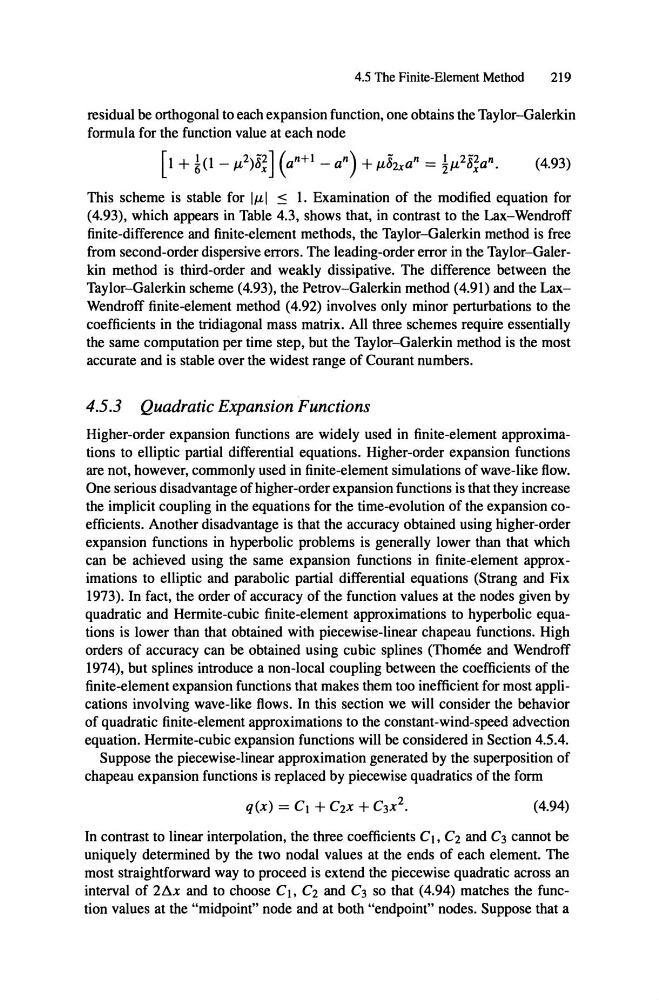
[1 + i(l - J.L2)i;] (a n + 1 - an) + J.Li2xa n = tJ.L 2i;an . (4.93)
Tbis scheme is stable for IJ.LI
1. Examination of the modified equation for
(4.93), which appears in Table 4.3, shows that, in contrast to the Lax-Wendroff
finite-difference and finite-element methods, the Taylor-Galerkin method is free
from second-order dispersive errors. The leading-order error in the Taylor-Galerkin method is third-order and weakly dissipative . The difference between the
Taylor-Galerkin scheme (4.93), the Petrov-Galerkin method (4.91) and the LaxWendroff finite-element method (4.92) involves only minor perturbations to the
coefficients in the tridiagonal mass matrix. All three schemes require essentially
the same computation per time step, but the Taylor-Galerkin method is the most
accurate and is stable over the widest range of Courant numbers.
4.5.3 Quadratic Expansion Functions
Higher-order expansion functions are widely used in finite-element approximations to elliptic partial differential equations. Higher-order expansion functions
are not, however, commonly used in finite-element simulations of wave-like flow.
One serious disadvantage of higher-order expansion functions is that they increase
the implicit coupling in the equations for the time-evolution of the expansion coefficients. Another disadvantage is that the accuracy obtained using higher-order
expansion functions in hyperbolic problems is generally lower than that which
can be achieved using the same expansion functions in finite-elernent approximations to elliptic and parabolic partial differential equations (Strang and Fix
1973). In fact, the order of accuracy of the function values at the nodes given by
quadratic and Hermite-cubic finite-element approximations to hyperbolic equations is lower than that obtained with piecewise-linear chapeau functions . High
orders of accuracy can be obtained using cubic splines (Thomee and Wendroff
1974), but splines introduce a non-local coupling between the coefficients of the
finite-element expansion functions that makes them too inefficient for most applications involving wave-like flows. In this section we will consider the behavior
of quadratic finite-element approximations to the constant-wind-speed advection
equation. Hermite-cubic expansion functions will be considered in Section 4.5.4.
Suppose the piecewise-linear approximation generated by the superposition of
chapeau expansion functions is replaced by piecewise quadratics of the form
(4.94)
In contrast to linear interpolation, the three coefficients CI, C2 and C3 cannot be
uniquely determined by the two nodal values at the ends of each element. Tbe
most straightforward way to proceed is extend the piecewise quadratic across an
interval of
and to choose CI, C2 and C3 so that (4.94) matches the function values at the "midpoint" node and at both "endpoint" nodes . Suppose that a
219
residual be orthogonal to each expansion function, one obtains the Taylor-Galerkin
formula for the function value at each node
[1 + i(l - J.L2)i;] (a n + 1 - an) + J.Li2xa n = tJ.L 2i;an . (4.93)
Tbis scheme is stable for IJ.LI
1. Examination of the modified equation for
(4.93), which appears in Table 4.3, shows that, in contrast to the Lax-Wendroff
finite-difference and finite-element methods, the Taylor-Galerkin method is free
from second-order dispersive errors. The leading-order error in the Taylor-Galerkin method is third-order and weakly dissipative . The difference between the
Taylor-Galerkin scheme (4.93), the Petrov-Galerkin method (4.91) and the LaxWendroff finite-element method (4.92) involves only minor perturbations to the
coefficients in the tridiagonal mass matrix. All three schemes require essentially
the same computation per time step, but the Taylor-Galerkin method is the most
accurate and is stable over the widest range of Courant numbers.
4.5.3 Quadratic Expansion Functions
Higher-order expansion functions are widely used in finite-element approximations to elliptic partial differential equations. Higher-order expansion functions
are not, however, commonly used in finite-element simulations of wave-like flow.
One serious disadvantage of higher-order expansion functions is that they increase
the implicit coupling in the equations for the time-evolution of the expansion coefficients. Another disadvantage is that the accuracy obtained using higher-order
expansion functions in hyperbolic problems is generally lower than that which
can be achieved using the same expansion functions in finite-elernent approximations to elliptic and parabolic partial differential equations (Strang and Fix
1973). In fact, the order of accuracy of the function values at the nodes given by
quadratic and Hermite-cubic finite-element approximations to hyperbolic equations is lower than that obtained with piecewise-linear chapeau functions . High
orders of accuracy can be obtained using cubic splines (Thomee and Wendroff
1974), but splines introduce a non-local coupling between the coefficients of the
finite-element expansion functions that makes them too inefficient for most applications involving wave-like flows. In this section we will consider the behavior
of quadratic finite-element approximations to the constant-wind-speed advection
equation. Hermite-cubic expansion functions will be considered in Section 4.5.4.
Suppose the piecewise-linear approximation generated by the superposition of
chapeau expansion functions is replaced by piecewise quadratics of the form
(4.94)
In contrast to linear interpolation, the three coefficients CI, C2 and C3 cannot be
uniquely determined by the two nodal values at the ends of each element. Tbe
most straightforward way to proceed is extend the piecewise quadratic across an
interval of
and to choose CI, C2 and C3 so that (4.94) matches the function values at the "midpoint" node and at both "endpoint" nodes . Suppose that a