

218
4. Series-Expansion Methods
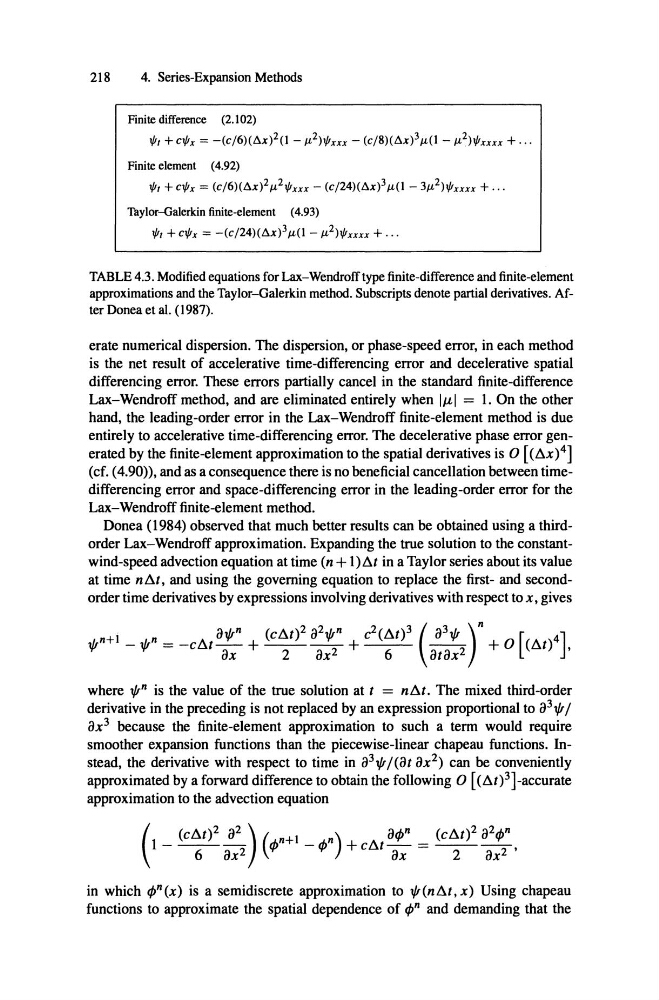
Finite difference (2.102)
t/J, + ct/Jx = -(c/6)(ßx)2(l - JL2)t/Jxxx - (c/8)(ßx)3 JL(l - JL2)t/Jxxxx + ...
Finite element (4.92)
t/J, + ct/Jx = (c/6)(ßx)2 JL2t/Jxxx - (c/24)(ßx)3 JL(l - 3JL2)t/Jxxxx + ...
Taylor-Galerkin finite-element (4.93)
t/J, + ct/Jx = -(c/24)(ßx)3 JL(l - JL2)t/Jxxxx + .. .
TABLE 4.3. Modified equations for Lax-Wendrofftype finite-difference and finite-element
approximations and the Taylor-Galerkin method . Subscripts denote partial derivatives. After Donea et al. (1987).
erate numerical dispersion . The dispersion, or phase-speed error, in each method
is the net result of accelerative time-differencing error and decelerative spatial
differencing error. These errors partially cancel in the standard finite-difference
Lax-Wendroff method, and are eliminated entirely when IJLI = 1. On the other
hand, the leading-order error in the Lax-Wendroff finite-element method is due
entirely to accelerative time-differencing error. The decelerative phase error generated by the finite-element approximation to the spatial derivatives is 0
(cf. (4.90», and as a consequence there is no beneficial cancellation between timedifferencing error and space-differencing error in the leading-order error for the
Lax-Wendroff finite-element method.
Donea (1984) observed that much better results can be obtained using a thirdorder Lax-Wendroff approximation. Expanding the true solution to the constantwind-speed advection equation at time (n +
in a Taylor series about its value
at time n St ; and using the goveming equation to replace the first- and secondorder time derivatives by expressions involving derivatives with respect to x, gives
where 1/Jn is the value of the true solution at t =
The mixed third-order
derivative in the preceding is not replaced by an expression proportional to a 31/J /
ax 3 because the finite-element approximation to such a term would require
smoother expansion functions than the piecewise-linear chapeau functions. Instead, the derivative with respect to time in a 31/J/(at ax 2 ) can be conveniently
approximated by a forward difference to obtain the following 0 [(M)3]-accurate
approximation to the advection equation
in which rjJn(x) is a semidiscrete approximation to
x) Using chapeau
functions to approximate the spatial dependence of rjJn and demanding that the
4. Series-Expansion Methods
Finite difference (2.102)
t/J, + ct/Jx = -(c/6)(ßx)2(l - JL2)t/Jxxx - (c/8)(ßx)3 JL(l - JL2)t/Jxxxx + ...
Finite element (4.92)
t/J, + ct/Jx = (c/6)(ßx)2 JL2t/Jxxx - (c/24)(ßx)3 JL(l - 3JL2)t/Jxxxx + ...
Taylor-Galerkin finite-element (4.93)
t/J, + ct/Jx = -(c/24)(ßx)3 JL(l - JL2)t/Jxxxx + .. .
TABLE 4.3. Modified equations for Lax-Wendrofftype finite-difference and finite-element
approximations and the Taylor-Galerkin method . Subscripts denote partial derivatives. After Donea et al. (1987).
erate numerical dispersion . The dispersion, or phase-speed error, in each method
is the net result of accelerative time-differencing error and decelerative spatial
differencing error. These errors partially cancel in the standard finite-difference
Lax-Wendroff method, and are eliminated entirely when IJLI = 1. On the other
hand, the leading-order error in the Lax-Wendroff finite-element method is due
entirely to accelerative time-differencing error. The decelerative phase error generated by the finite-element approximation to the spatial derivatives is 0
(cf. (4.90», and as a consequence there is no beneficial cancellation between timedifferencing error and space-differencing error in the leading-order error for the
Lax-Wendroff finite-element method.
Donea (1984) observed that much better results can be obtained using a thirdorder Lax-Wendroff approximation. Expanding the true solution to the constantwind-speed advection equation at time (n +
in a Taylor series about its value
at time n St ; and using the goveming equation to replace the first- and secondorder time derivatives by expressions involving derivatives with respect to x, gives
where 1/Jn is the value of the true solution at t =
The mixed third-order
derivative in the preceding is not replaced by an expression proportional to a 31/J /
ax 3 because the finite-element approximation to such a term would require
smoother expansion functions than the piecewise-linear chapeau functions. Instead, the derivative with respect to time in a 31/J/(at ax 2 ) can be conveniently
approximated by a forward difference to obtain the following 0 [(M)3]-accurate
approximation to the advection equation
in which rjJn(x) is a semidiscrete approximation to
x) Using chapeau
functions to approximate the spatial dependence of rjJn and demanding that the