

188
4. Series-Expansion Methods
Here M = 2N + I is the total number of grid points on the physical mesh. Let
the values of r/J (x j) and X(x j) appearing in the preceding formula be expressed
in the form
N
N
r/J(Xj) = L ameimxj,
m=-N
X(Xj) = L bneinxj,
n=-N
where those values of an and b m that were not included in the original series
expansions (4.27) are zero, i.e.,
ar = be = 0 for K < III N.
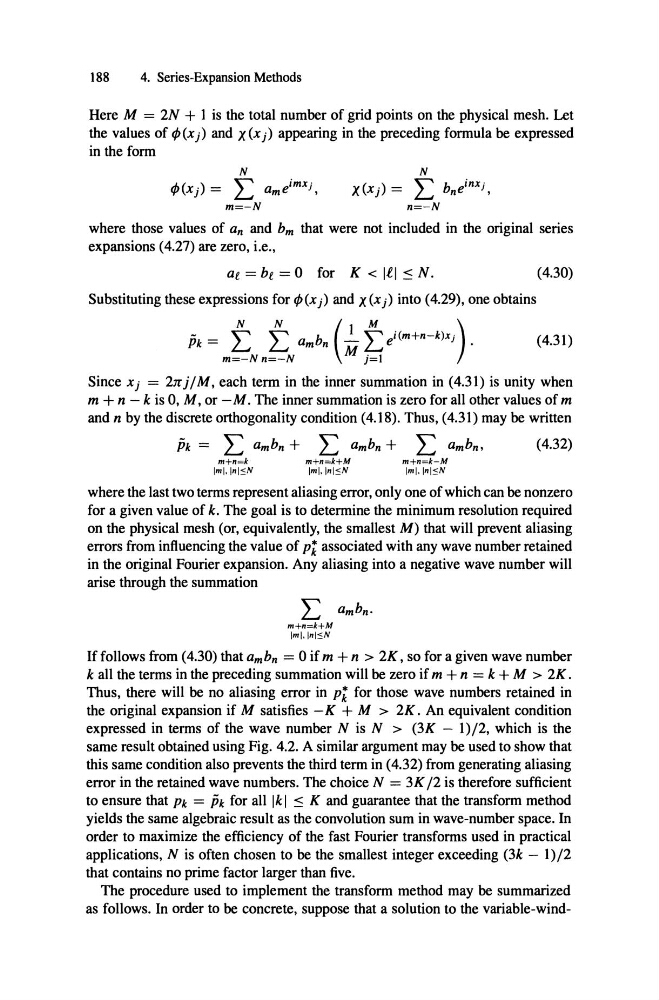
Substituting these expressions for r/J (x j) and X(x j) into (4.29), one obtains
ßk = i: i: amb n (-.!-. t ei
(4.31)
m=-N n=-N
M j=1
Since x j = 2rrj / M, each term in the inner summation in (4.31) is unity when
m + n - k is 0, M, or - M. The inner summation is zero for all other values of m
and n by the discrete orthogonality condition (4.18). Thus , (4.31) may be written
ßk = L ambn + L ambn + L ambn,
(4.32)
m+n=k
m+n=k+M
m+n=k- M
where the last two terms represent aliasing error, only one of which can be nonzero
for a given value of k, The goal is to determine the minimum resolution required
on the physical mesh (or, equivalently, the smallest M) that will prevent aliasing
errors from influencing the value of Pk associated with any wave number retained
in the original Fourier expansion. Any aliasing into a negative wave number will
arise through the summation
L ambn.
m+n= k+M
If follows from (4.30) that amb n = 0 if m + n > 2K, so for a given wave number
k all the terms in the preceding summation will be zero if m + n = k + M > 2K .
Thus, there will be no aliasing error in Pk for those wave numbers retained in
the original expansion if M satisfies - K + M > 2K . An equivalent condition
expressed in terms of the wave number N is N > (3K - 1)/2, which is the
same result obtained using Fig. 4.2. A similar argument may be used to show that
this same condition also prevents the third term in (4.32) from generating aliasing
error in the retained wave numbers. The choice N = 3K /2 is therefore sufficient
to ensure that Pk = Pk for all Ikl K and guarantee that the transform method
yields the same algebraic result as the convolution sum in wave-number space. In
order to maximize the efficiency of the fast Fourier transforms used in practical
applications, N is often chosen to be the smallest integer exceeding (3k - 1)/2
that contains no prime factor larger than five.
The procedure used to implement the transform method may be summarized
as folIows. In order to be concrete, suppose that a solution to the variable-wind-
4. Series-Expansion Methods
Here M = 2N + I is the total number of grid points on the physical mesh. Let
the values of r/J (x j) and X(x j) appearing in the preceding formula be expressed
in the form
N
N
r/J(Xj) = L ameimxj,
m=-N
X(Xj) = L bneinxj,
n=-N
where those values of an and b m that were not included in the original series
expansions (4.27) are zero, i.e.,
ar = be = 0 for K < III N.
Substituting these expressions for r/J (x j) and X(x j) into (4.29), one obtains
ßk = i: i: amb n (-.!-. t ei
(4.31)
m=-N n=-N
M j=1
Since x j = 2rrj / M, each term in the inner summation in (4.31) is unity when
m + n - k is 0, M, or - M. The inner summation is zero for all other values of m
and n by the discrete orthogonality condition (4.18). Thus , (4.31) may be written
ßk = L ambn + L ambn + L ambn,
(4.32)
m+n=k
m+n=k+M
m+n=k- M
where the last two terms represent aliasing error, only one of which can be nonzero
for a given value of k, The goal is to determine the minimum resolution required
on the physical mesh (or, equivalently, the smallest M) that will prevent aliasing
errors from influencing the value of Pk associated with any wave number retained
in the original Fourier expansion. Any aliasing into a negative wave number will
arise through the summation
L ambn.
m+n= k+M
If follows from (4.30) that amb n = 0 if m + n > 2K, so for a given wave number
k all the terms in the preceding summation will be zero if m + n = k + M > 2K .
Thus, there will be no aliasing error in Pk for those wave numbers retained in
the original expansion if M satisfies - K + M > 2K . An equivalent condition
expressed in terms of the wave number N is N > (3K - 1)/2, which is the
same result obtained using Fig. 4.2. A similar argument may be used to show that
this same condition also prevents the third term in (4.32) from generating aliasing
error in the retained wave numbers. The choice N = 3K /2 is therefore sufficient
to ensure that Pk = Pk for all Ikl K and guarantee that the transform method
yields the same algebraic result as the convolution sum in wave-number space. In
order to maximize the efficiency of the fast Fourier transforms used in practical
applications, N is often chosen to be the smallest integer exceeding (3k - 1)/2
that contains no prime factor larger than five.
The procedure used to implement the transform method may be summarized
as folIows. In order to be concrete, suppose that a solution to the variable-wind-