

I
lt
!!.xe
o
K
?
. -
•
wavenumber
I .
2K
4.2 The Spectral Method
IkI
... .. ••
--.
(kl + k2)
187
I+-originalexpansion - - . l
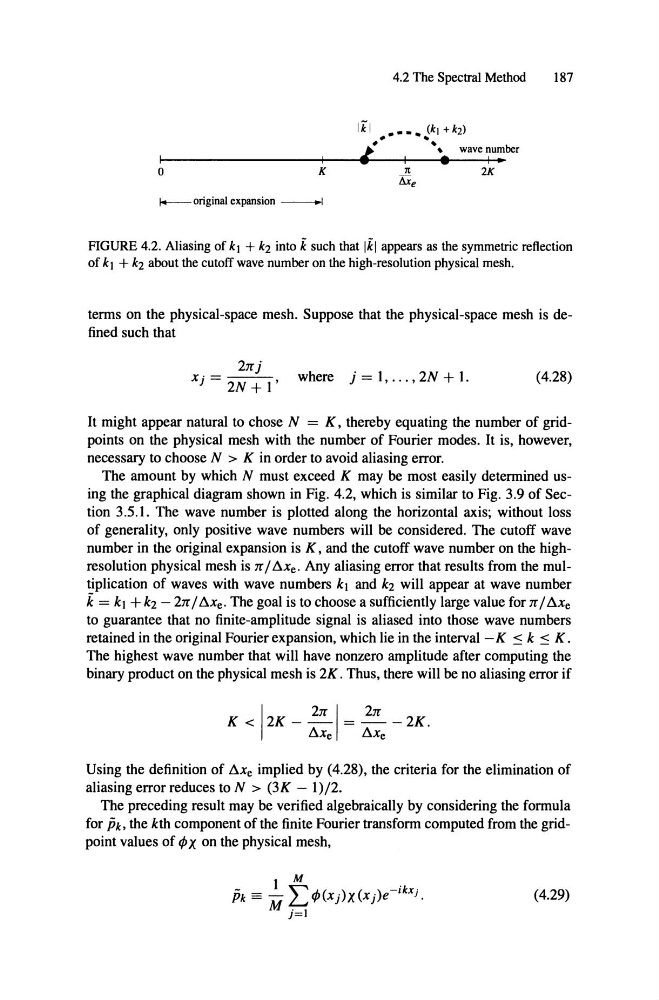
FIGURE 4.2. Aliasing of k) + k2 into k sueh that Ikl appears as the symmetrie refleetion
of k) + k2 about the eutoff wave number on the high-resolution physical mesh.
terms on the physical-space mesh. Suppose that the physical-space mesh is defined such that
2rrj
x j = 2N + l ' where j = 1, . . . , 2N + 1.
(4.28)
It might appear natural to chose N = K, thereby equating the number of gridpoints on the physical mesh with the number of Fourier modes. It is, however,
necessary to choose N > K in order to avoid aliasing error.
The amount by which N must exceed K may be most easily determined using the graphical diagram shown in Fig. 4.2, which is similar to Fig. 3.9 of Section 3.5.1. The wave number is plotred along the horizontal axis; without loss
of generality, only positive wave numbers will be considered. The cutoff wave
number in the original expansion is K, and the cutoff wave number on the highresolution physical mesh is rr /
Any aliasing error that results from the multiplication of waves with wave numbers k) and k2 will appear at wave number
k = k) +ka - 2rr/
The goal is to choose a sufficiently large value for rr/
to guarantee that no finite-arnplitude signal is aliased into those wave numbers
retained in the original Fourier expansion, which lie in the interval - K S k S K.
The highest wave number that will have nonzero amplitude after computing the
binary product on the physical mesh is 2K . Thus, there will be no aliasing error if
2 K - - = - - 2 K .
2rr
2rr I
K<
I
Using the definition of
implied by (4.28), the criteria for the elimination of
aliasing error reduces to N > (3K - 1)/2.
The preceding result may be verified algebraically by considering the formula
for Pt, the kth component of the finite Fourier transform computed from the gridpoint values of (4.29)
lt
!!.xe
o
K
?
. -
•
wavenumber
I .
2K
4.2 The Spectral Method
IkI
... .. ••
--.
(kl + k2)
187
I+-originalexpansion - - . l
FIGURE 4.2. Aliasing of k) + k2 into k sueh that Ikl appears as the symmetrie refleetion
of k) + k2 about the eutoff wave number on the high-resolution physical mesh.
terms on the physical-space mesh. Suppose that the physical-space mesh is defined such that
2rrj
x j = 2N + l ' where j = 1, . . . , 2N + 1.
(4.28)
It might appear natural to chose N = K, thereby equating the number of gridpoints on the physical mesh with the number of Fourier modes. It is, however,
necessary to choose N > K in order to avoid aliasing error.
The amount by which N must exceed K may be most easily determined using the graphical diagram shown in Fig. 4.2, which is similar to Fig. 3.9 of Section 3.5.1. The wave number is plotred along the horizontal axis; without loss
of generality, only positive wave numbers will be considered. The cutoff wave
number in the original expansion is K, and the cutoff wave number on the highresolution physical mesh is rr /
Any aliasing error that results from the multiplication of waves with wave numbers k) and k2 will appear at wave number
k = k) +ka - 2rr/
The goal is to choose a sufficiently large value for rr/
to guarantee that no finite-arnplitude signal is aliased into those wave numbers
retained in the original Fourier expansion, which lie in the interval - K S k S K.
The highest wave number that will have nonzero amplitude after computing the
binary product on the physical mesh is 2K . Thus, there will be no aliasing error if
2 K - - = - - 2 K .
2rr
2rr I
K<
I
Using the definition of
implied by (4.28), the criteria for the elimination of
aliasing error reduces to N > (3K - 1)/2.
The preceding result may be verified algebraically by considering the formula
for Pt, the kth component of the finite Fourier transform computed from the gridpoint values of (4.29)