

180
4. Series-Expansion Methods
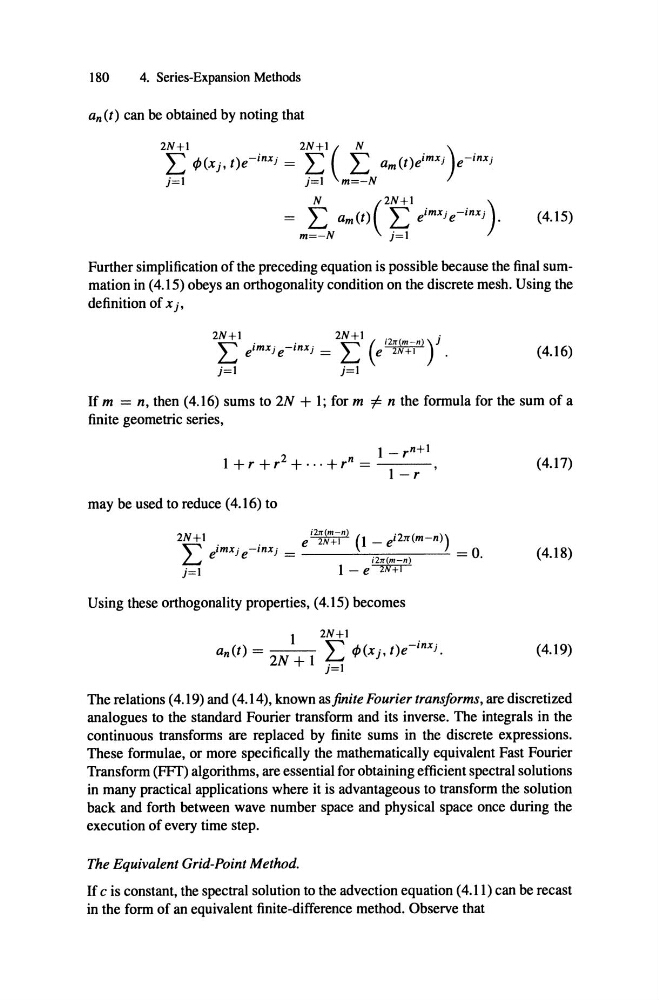
an(t) ean be obtained by noting that
(4.15)
Further simplifieation of the preeeding equation is possible beeause the final summation in (4.15) obeys an orthogonality eondition on the diserete mesh. Using the
definition of x l:
2N+I
L
.
.
e,mxje -lnX j =
2N+I (
L
i27f(m- n») j
e 2N +1
•
(4.16)
j =1
j=1
If m = n, then (4.16) sums to 2N + I; for m f= n the formula for the sum of a
finite geometrie series,
I - r n + 1
I + r + r
2
+ ... + r" = - - -
1 - r '
(4.17)
may be used to reduee (4.16) to
2N+I .
.
/ 2 i1
m
+, n) (I _ ei2rr(m - n »)
.
= O.
L....J
""' e,mxje-lnXj =
(4.18)
, 27f(m -n )
j=1
l-eZN""+"!
Using these orthogonality properties, (4.15) beeomes
(4.19)
The relations (4.19) and (4.14), known asfinite Fourier transforms, are diseretized
analogues to the standard Fourier transform and its inverse. The integrals in the
eontinuous transforms are replaeed by finite sums in the diserete expressions.
These formulae, or more specifieally the mathematieally equivalent Fast Fourier
Transform (FFT) algorithms , are essential for obtaining efficient speetral solutions
in many praetieal applieations where it is advantageous to transform the solution
baek and forth between wave number spaee and physieal spaee onee during the
exeeution of every time step.
The Equivalent Grid-Point Method.
If c is eonstant, the speetral solution to the adveetion equation (4.11) ean be reeast
in the form of an equivalent finite-differenee method. Observe that
4. Series-Expansion Methods
an(t) ean be obtained by noting that
(4.15)
Further simplifieation of the preeeding equation is possible beeause the final summation in (4.15) obeys an orthogonality eondition on the diserete mesh. Using the
definition of x l:
2N+I
L
.
.
e,mxje -lnX j =
2N+I (
L
i27f(m- n») j
e 2N +1
•
(4.16)
j =1
j=1
If m = n, then (4.16) sums to 2N + I; for m f= n the formula for the sum of a
finite geometrie series,
I - r n + 1
I + r + r
2
+ ... + r" = - - -
1 - r '
(4.17)
may be used to reduee (4.16) to
2N+I .
.
/ 2 i1
m
+, n) (I _ ei2rr(m - n »)
.
= O.
L....J
""' e,mxje-lnXj =
(4.18)
, 27f(m -n )
j=1
l-eZN""+"!
Using these orthogonality properties, (4.15) beeomes
(4.19)
The relations (4.19) and (4.14), known asfinite Fourier transforms, are diseretized
analogues to the standard Fourier transform and its inverse. The integrals in the
eontinuous transforms are replaeed by finite sums in the diserete expressions.
These formulae, or more specifieally the mathematieally equivalent Fast Fourier
Transform (FFT) algorithms , are essential for obtaining efficient speetral solutions
in many praetieal applieations where it is advantageous to transform the solution
baek and forth between wave number spaee and physieal spaee onee during the
exeeution of every time step.
The Equivalent Grid-Point Method.
If c is eonstant, the speetral solution to the adveetion equation (4.11) ean be reeast
in the form of an equivalent finite-differenee method. Observe that