

4.2 The Spectral Method
179
(a)
(bl
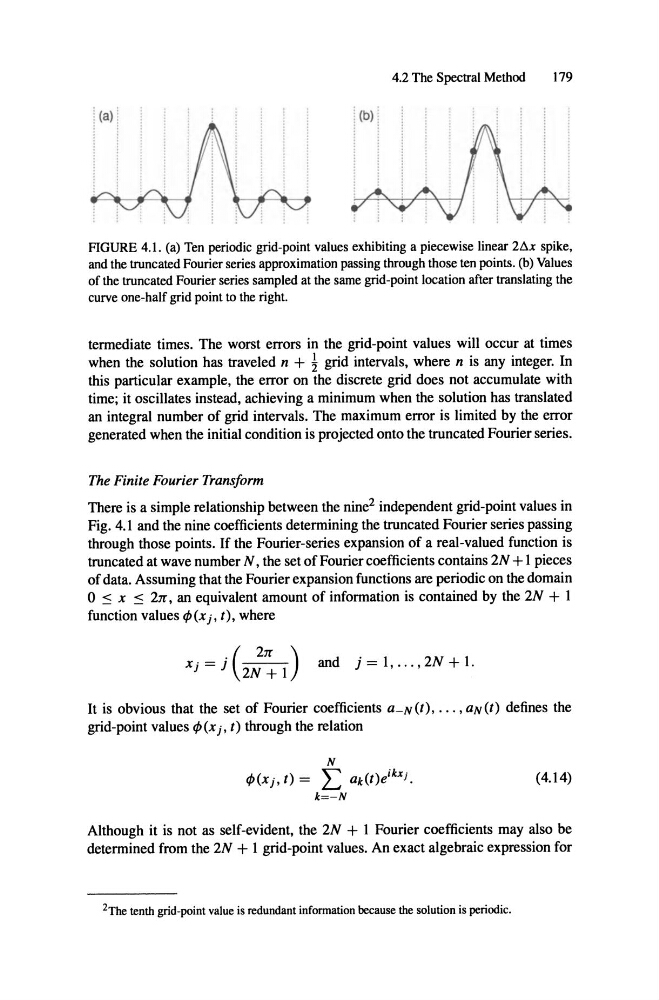
FIGURE 4.1 . (a) Ten periodie grid-point values exhibiting a piecewise linear 2t.x spike,
and the truncated Fourier series approximation passing through those ten points. (b) Values
of the truncated Fourier series sampled at the same grid-point location after translating the
curve one-half grid point to the right.
termediate times. The worst errors in the grid-point values will occur at times
when the solution has traveled n + grid intervals, where n is any integer. In
this particular exarnple, the error on the discrete grid does not accumulate with
time; it oscillates instead, achieving a minimum when the solution has translated
an integral number of grid intervals. The maximum error is limited by the error
generated when the initial condition is projected onto the truncated Fourier series.
The Finite Fourier Transform
There is a simple relationship between the nine 2 independent grid-point values in
Fig. 4.1 and the nine coefficients determining the truncated Fourier series passing
through those points. If the Fourier-series expansion of a real-valued function is
truncated at wave number N, the set of Fourier coefficients contains 2N +I pieces
of data. Assuming that the Fourier expansion functions are periodic on the domain
o x 2Jr, an equivalent amount of information is contained by the 2N + I
function values
It is obvious that the set of Fourier coefficients a-N (I), ... , aN (I) defines the
grid-point values
k=-N
(4.14)
Although it is not as self-evident, the 2N + I Fourier coefficients mayaiso be
determined from the 2N + I grid-point values. An exact algebraic expression for
2The tenth grid-point value is redundant information because the solution is periodie.
179
(a)
(bl
FIGURE 4.1 . (a) Ten periodie grid-point values exhibiting a piecewise linear 2t.x spike,
and the truncated Fourier series approximation passing through those ten points. (b) Values
of the truncated Fourier series sampled at the same grid-point location after translating the
curve one-half grid point to the right.
termediate times. The worst errors in the grid-point values will occur at times
when the solution has traveled n + grid intervals, where n is any integer. In
this particular exarnple, the error on the discrete grid does not accumulate with
time; it oscillates instead, achieving a minimum when the solution has translated
an integral number of grid intervals. The maximum error is limited by the error
generated when the initial condition is projected onto the truncated Fourier series.
The Finite Fourier Transform
There is a simple relationship between the nine 2 independent grid-point values in
Fig. 4.1 and the nine coefficients determining the truncated Fourier series passing
through those points. If the Fourier-series expansion of a real-valued function is
truncated at wave number N, the set of Fourier coefficients contains 2N +I pieces
of data. Assuming that the Fourier expansion functions are periodic on the domain
o x 2Jr, an equivalent amount of information is contained by the 2N + I
function values
It is obvious that the set of Fourier coefficients a-N (I), ... , aN (I) defines the
grid-point values
k=-N
(4.14)
Although it is not as self-evident, the 2N + I Fourier coefficients mayaiso be
determined from the 2N + I grid-point values. An exact algebraic expression for
2The tenth grid-point value is redundant information because the solution is periodie.