

4.1 Strategies for Minimizing the Residual
175
A second approach, referred to as collocation, is to require the residual to be zero
at a discrete set of grid points :
R(c/J(j/lx)) = 0 for aII j = I, ... , N.
The third strategy, known as the Galerkin approximation, requires the residual to
be orthogonal to each of the expansion functions , i.e.,
i R (rjJ (X))CfJk (x) dx = 0 for all k = I , ... , N . (4.4)
Different series-expansion methods rely on one or more of the preceding approaches. The coIIocation strategy is used in the pseudospectral method and in
some finite-element formulations, but not in the spectral method. The 12-minimization and Galerkin criteria are equivalent when applied to a problem of the
form (4.1), and are the basis of the spectral method. The Galerkin approximation
is also used extensively in finite-elernent schemes .
The equivalence of the 12-minimization criterion and the Galerkin approximation can be demonstrated as follows. According to (4.3), the residual depends on
both the instantaneous values of the expansion coefficients and their time tendencies. The expansion coefficients are determined at the outset from the initial
conditions and are known at the bcginning of any subsequent integration step. The
criteria for constraining the residual are not used to obtain the instantaneous values of the expansion coefficients, but rather to determine their time evolution.
If thc rate of change of the kth expansion function is calculated to minimize
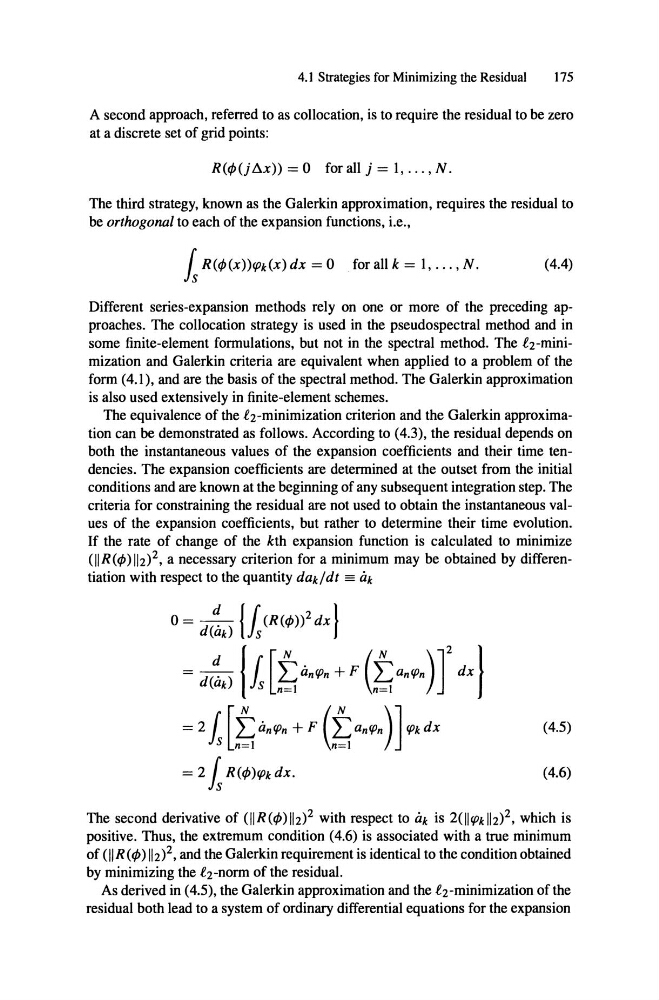
(11 R(c/J) 112)2, a necessary criterion for a minimum may be obtained by differentiation with respect to the quantity daifdt == äk
(4.5)
(4.6)
= 2 i R(rjJ)CfJk dx.
0=
{i
I + F
(R(rjJ))2 dX}
= 2 i
+ F
r I
dx
CfJk dx
The second derivative of (11 R (rjJ) 112)2 with respect to äk is 2(IICfJkIl2)2, which is
positive. Thus , the extremum condition (4.6) is associated with a true minimum
of (11 R(c/J) 112)2, and the Galerkin requirement is identical to the condition obtained
by minimizing the 12-norm of the residual .
As derived in (4.5), the Galerkin approximation and the 12-minimization ofthe
residual both lead to a system of ordinary differential equations for the expansion
175
A second approach, referred to as collocation, is to require the residual to be zero
at a discrete set of grid points :
R(c/J(j/lx)) = 0 for aII j = I, ... , N.
The third strategy, known as the Galerkin approximation, requires the residual to
be orthogonal to each of the expansion functions , i.e.,
i R (rjJ (X))CfJk (x) dx = 0 for all k = I , ... , N . (4.4)
Different series-expansion methods rely on one or more of the preceding approaches. The coIIocation strategy is used in the pseudospectral method and in
some finite-element formulations, but not in the spectral method. The 12-minimization and Galerkin criteria are equivalent when applied to a problem of the
form (4.1), and are the basis of the spectral method. The Galerkin approximation
is also used extensively in finite-elernent schemes .
The equivalence of the 12-minimization criterion and the Galerkin approximation can be demonstrated as follows. According to (4.3), the residual depends on
both the instantaneous values of the expansion coefficients and their time tendencies. The expansion coefficients are determined at the outset from the initial
conditions and are known at the bcginning of any subsequent integration step. The
criteria for constraining the residual are not used to obtain the instantaneous values of the expansion coefficients, but rather to determine their time evolution.
If thc rate of change of the kth expansion function is calculated to minimize
(11 R(c/J) 112)2, a necessary criterion for a minimum may be obtained by differentiation with respect to the quantity daifdt == äk
(4.5)
(4.6)
= 2 i R(rjJ)CfJk dx.
0=
{i
I + F
(R(rjJ))2 dX}
= 2 i
+ F
r I
dx
CfJk dx
The second derivative of (11 R (rjJ) 112)2 with respect to äk is 2(IICfJkIl2)2, which is
positive. Thus , the extremum condition (4.6) is associated with a true minimum
of (11 R(c/J) 112)2, and the Galerkin requirement is identical to the condition obtained
by minimizing the 12-norm of the residual .
As derived in (4.5), the Galerkin approximation and the 12-minimization ofthe
residual both lead to a system of ordinary differential equations for the expansion